

Prince Al-Waleed bin Khaled bin Talal Al Saud, known internationally as the “Sleeping Prince,” became widely recognized due to his prolonged medical condition following a tragic accident in his teenage years. His story attracted global attention not only because of his royal background, but also because of the extraordinary length of time he remained in a coma under continuous medical care. Born in April 1990, Prince Al-Waleed was a member of the Saudi royal family and the son of Prince Khaled bin Talal Al Saud.
He was raised within a prominent royal household in Saudi Arabia, growing up with expectations and opportunities typical of his family background. Those close to him described him as a young man with a structured education and a future ahead of him before the incident that changed everything. In 2005, at the age of 15, Prince Al-Waleed was involved in a severe car accident while studying abroad in London as part of his military-related education.
The accident caused serious brain injuries and internal bleeding, requiring immediate emergency treatment. His condition was considered critical, and he was later transferred back to Saudi Arabia for long-term specialized medical care.
Long-Term Hospital Care and Medical Condition
After being brought back to Saudi Arabia, Prince Al-Waleed was admitted to King Abdulaziz Medical City in Riyadh, one of the country’s leading medical facilities. Medical teams provided continuous intensive care as he remained in a coma and dependent on life-support systems.
Over the years, his condition was described as stable but unchanged, and he remained under constant medical supervision. Specialists monitored his health regularly, although there was no significant recovery reported. His case became one of the longest publicly known coma cases involving a royal family member in the region.
Despite the passage of time, he continued to receive advanced medical attention, reflecting the ongoing efforts to maintain his condition and ensure consistent care.
His Father’s Ongoing Support and Public Presence
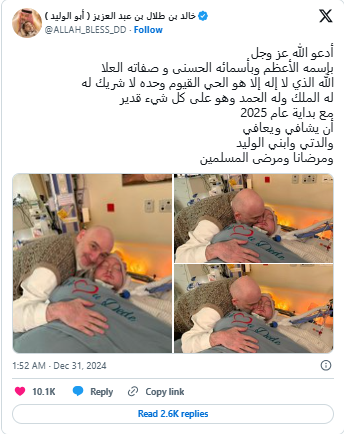
A widely discussed part of Prince Al-Waleed’s story is the dedication of his father, Prince Khaled bin Talal Al Saud. Throughout the years, Prince Khaled remained closely involved in his son’s care, frequently visiting him at the hospital and publicly expressing hope and faith.
Reports and social media posts shared by the family occasionally showed moments from the hospital room, where the prince was being cared for. These updates often attracted widespread emotional responses from people following his story.
According to various public appearances and statements, the father maintained a strong belief in hope and continued care, choosing to remain involved in every stage of his son’s medical journey.
A Hospital Room Marked by Hope and Faith
Over time, Prince Al-Waleed’s hospital environment reportedly became a place of emotional significance for his family. During certain occasions, especially religious holidays, the room was sometimes decorated in a modest way to reflect family traditions and maintain a sense of connection.
Visitors and family members would occasionally come to offer support, prayers, and encouragement. These moments were sometimes shared publicly, drawing attention to the emotional aspect of long-term care situations.
The hospital setting, while medical in nature, also became a symbol of patience, faith, and endurance for those following the story.
Public Attention and Media Coverage
As years passed, Prince Al-Waleed’s condition received increasing attention from both regional and international media. He became widely known as the “Sleeping Prince,” a term used to describe his long-term coma state.
Media coverage often focused on the emotional and human aspects of the story, particularly the role of family support and the challenges of long-term medical care. However, medical professionals generally emphasized that coma cases vary widely and outcomes depend on individual conditions.
The family itself shared only selected updates over time, maintaining a balance between public interest and privacy.
Announcement of His Passing
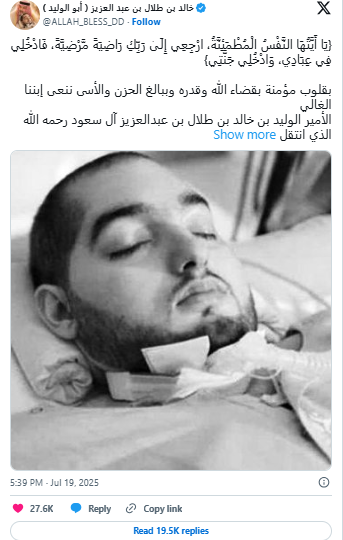
In 2025, reports and official family statements confirmed the passing of Prince Al-Waleed bin Khaled bin Talal Al Saud after many years in a coma. The announcement was shared by members of his family, who expressed deep sadness and emphasized faith in God’s will.
Following the announcement, condolences were expressed across Saudi Arabia and from international audiences who had followed his long medical journey. Members of the royal family, friends, and members of the public participated in offering sympathy and support to the family.
A funeral prayer service was held in accordance with Islamic traditions, allowing relatives and members of the community to pay their final respects.
Legacy and Public Memory
Prince Al-Waleed’s story is often remembered as both a medical case and a deeply emotional family journey that lasted nearly two decades. It drew attention to the realities of long-term coma care and the emotional challenges faced by families in such situations.
For many people, his life became a symbol of patience, hope, and parental dedication. At the same time, it also highlighted broader discussions about long-term medical treatment and the complexity of neurological conditions.
His story continues to be referenced in media coverage as an example of an extraordinary and prolonged medical journey marked by both struggle and devotion.

