
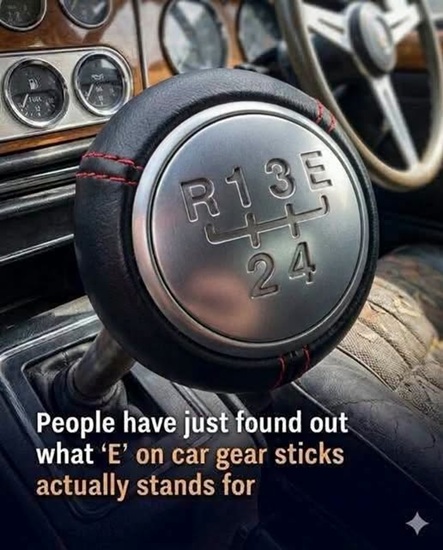
If you have ever looked inside an older vehicle from the 1970s, 1980s, or early 1990s, you may have noticed an unusual letter displayed on the gear selector or gear shift pattern: “E.” Unlike the familiar “P,” “R,” “N,” and “D” found on most automatic transmissions today, or the numbered gears found in manual vehicles, this single letter often raises questions among people who have never driven an older car. While it has largely disappeared from modern vehicles, the “E” represented an important engineering idea during its time.
Depending on the manufacturer and model, it generally referred to “Economy” or “Economy Mode,” a feature designed to improve fuel efficiency under certain driving conditions. The appearance of Economy modes in passenger vehicles reflected a broader trend within the automotive industry during the 1970s and 1980s. Following the global oil crises of the 1970s, rising fuel prices encouraged both manufacturers and consumers to pay greater attention to fuel consumption.
Automakers around the world began developing technologies that could help drivers use less fuel without requiring entirely new engine designs. Improvements in transmission design, engine tuning, aerodynamics, and vehicle weight all became important areas of research. Economy driving modes were one practical solution introduced on certain models to support more efficient everyday driving.
It is important to note that the exact function of the “E” designation varied among manufacturers. There was never a single universal system used across the entire automotive industry. Some companies used the letter on automatic transmission selector switches, while others incorporated an Economy gear into specific manual transmissions. Because manufacturers designed their own transmission systems independently, drivers often encountered different implementations depending on the brand and model of the vehicle they owned.
In many automatic transmission vehicles produced during the 1980s and early 1990s, particularly on certain European models, Economy mode adjusted the transmission’s shift strategy. When activated, the transmission generally shifted into higher gears at lower engine speeds, commonly measured in revolutions per minute (RPM). By allowing the engine to operate at lower RPM during normal driving, the system could reduce fuel consumption while also producing a quieter driving experience during steady acceleration and highway travel.
Lower engine speed generally means the engine performs fewer combustion cycles over a given period while maintaining vehicle speed under appropriate driving conditions. Because fuel consumption is closely related to engine load, speed, and throttle position, operating at lower RPM during light acceleration may improve fuel economy. However, the exact improvement depended on numerous factors, including vehicle weight, engine size, terrain, traffic conditions, weather, maintenance, and individual driving habits.
Some automatic transmissions equipped with Economy mode also delayed downshifting during gentle acceleration. Instead of immediately shifting to a lower gear whenever the driver pressed the accelerator slightly, the transmission attempted to remain in the higher gear whenever practical. This behavior reduced unnecessary gear changes and encouraged smoother, more gradual acceleration. Drivers seeking maximum performance could simply apply additional throttle pressure, allowing the transmission to downshift when greater engine power became necessary.
Certain vehicles also incorporated what enthusiasts sometimes describe as a second-gear start when Economy mode was selected. Instead of beginning movement in first gear during light acceleration, the transmission could start from second gear under suitable conditions. Because second gear provides less torque multiplication than first gear, the vehicle accelerated more gradually while reducing wheel spin on slippery surfaces and lowering engine speed during initial movement. Whether this feature was available depended entirely on the transmission design chosen by the manufacturer.
Manual transmission vehicles introduced a different interpretation of the “E” designation. Several manufacturers produced manual gearboxes featuring an additional Economy gear or overdrive gear intended primarily for highway cruising. Rather than serving as another acceleration gear, this extra gear allowed the engine to rotate more slowly while maintaining highway speed. In practical terms, the vehicle could travel at the same speed while the engine operated at lower RPM, often improving fuel economy and reducing engine noise during long-distance travel.
An overdrive gear works by using a gear ratio in which the output shaft rotates faster than the engine’s crankshaft relative to lower gears. This reduces engine speed once the vehicle has already reached cruising velocity. Lower RPM can decrease engine wear over extended periods and improve driving comfort by reducing vibration and mechanical noise inside the passenger cabin. For drivers who regularly traveled long highway distances, this feature often made extended journeys quieter and more relaxed.
Despite these advantages, Economy gears were never intended for every driving situation. Because overdrive ratios reduce available engine torque at the wheels, they are less suitable for rapid acceleration, steep hills, or towing heavy loads. When additional power became necessary, drivers were expected to shift back into a lower gear. This operating principle remains true for modern manual transmissions that include overdrive gears today.
As automotive engineering continued advancing through the 1990s and early 2000s, transmission technology improved dramatically. Four-speed automatic transmissions gradually gave way to five-speed, six-speed, eight-speed, nine-speed, and even ten-speed designs. These newer transmissions provided much smaller gaps between gear ratios, allowing the engine to remain within its most efficient operating range automatically under a much wider variety of driving conditions.
At the same time, electronic control units—commonly known as ECUs—became increasingly sophisticated. Modern transmission control systems continuously analyze information such as vehicle speed, engine load, throttle position, road conditions, and driver input hundreds of times each second. Using this data, the vehicle automatically selects the most appropriate gear without requiring the driver to manually choose an Economy setting in many situations.
The disappearance of the traditional “E” from many vehicles therefore reflects the evolution of automotive technology rather than the disappearance of fuel-efficiency goals. Modern vehicles continue pursuing the same objective—reducing fuel consumption while maintaining acceptable performance—but they accomplish this through advanced electronic systems that automatically optimize engine and transmission operation. Although the visible “E” may no longer appear on many dashboards, the engineering philosophy behind it continues to influence modern vehicle design and remains an important chapter in the history of automotive efficiency.
As automotive technology continued to evolve during the late 1990s and early 2000s, manufacturers gradually introduced increasingly sophisticated electronic systems capable of managing engine and transmission performance automatically. Instead of relying on manually selected Economy gears or transmission switches, modern vehicles began using electronic control units (ECUs) that continuously monitor how a vehicle is being driven. These computers analyze information such as engine speed, throttle position, vehicle speed, transmission load, and numerous sensor readings to determine the most efficient operating strategy for a wide range of driving conditions.
Unlike the older Economy systems found in some vehicles, modern electronic controls do not rely on a single fixed setting. Instead, the software constantly adjusts transmission behavior in real time. Under gentle acceleration, the transmission may shift into higher gears sooner to reduce engine speed and fuel consumption. When additional power is required for merging, climbing a hill, or overtaking another vehicle, the system can quickly select a lower gear to provide more engine torque. This continuous adjustment allows modern transmissions to balance performance, efficiency, and driver comfort more effectively than many earlier mechanical designs.
Today’s automatic transmissions also contain significantly more gear ratios than those commonly available several decades ago. While three-speed and four-speed automatic transmissions were once standard, many current passenger vehicles use six-speed, eight-speed, nine-speed, or even ten-speed transmissions. Some manufacturers also use continuously variable transmissions (CVTs), which do not shift through fixed gears in the traditional sense but instead continuously adjust gear ratios to keep the engine operating within an efficient range. These advancements help improve both fuel economy and overall driving smoothness.
Many modern vehicles include a selectable Eco Mode, although its operation differs from the older “E” systems found in some classic vehicles. Depending on the manufacturer, activating Eco Mode may adjust throttle response, transmission shift timing, air-conditioning operation, cruise control behavior, and other vehicle systems to encourage more efficient driving. The exact functions vary among manufacturers and models, so drivers are encouraged to consult the owner’s manual to understand how Eco Mode operates in their specific vehicle.
Modern Eco Modes generally do not increase engine power or fundamentally change the vehicle’s mechanical components. Instead, they encourage smoother acceleration and optimize existing systems to reduce unnecessary fuel consumption when conditions allow. Under many everyday driving situations, this may contribute to modest improvements in fuel economy. However, the actual results depend on numerous factors, including traffic conditions, terrain, weather, vehicle maintenance, cargo weight, tire pressure, and individual driving habits.
Driver behavior remains one of the most important influences on fuel consumption regardless of the technology installed in the vehicle. Transportation agencies and automotive engineers consistently note that gradual acceleration, maintaining steady speeds, anticipating traffic flow, reducing unnecessary idling, and following recommended maintenance schedules may all contribute to improved fuel efficiency. Proper tire inflation, regular engine servicing, and replacing air filters according to manufacturer recommendations can also help vehicles operate more efficiently over time.
Looking back at the older Economy modes provides an interesting perspective on how automotive engineering has progressed. During earlier decades, many efficiency improvements depended on direct driver involvement. Drivers selected Economy settings manually, chose when to shift gears, and often developed an understanding of how engine speed affected fuel consumption. Although modern electronics now perform much of this work automatically, the underlying engineering objective remains remarkably similar: achieving efficient operation without unnecessarily sacrificing everyday drivability.
Older Economy systems also reflected the technological limitations and design priorities of their era. Mechanical transmissions and hydraulic control systems offered reliable performance but lacked the computing power available in today’s vehicles. As onboard electronics became faster and more capable, manufacturers were able to integrate sophisticated software capable of making thousands of small adjustments every minute. These improvements allowed vehicles to respond more precisely to changing driving conditions than purely mechanical systems could achieve.
Even so, many automotive enthusiasts continue to appreciate older Economy systems because they represent an important stage in the history of vehicle engineering. Classic cars equipped with manual overdrive gears or selectable Economy transmission modes provide insight into how manufacturers approached fuel efficiency before the widespread adoption of advanced digital controls. For collectors and historians, these features illustrate the steady progression of automotive technology across several decades.
It is also important to recognize that not every older vehicle displaying the letter “E” used the same system. Manufacturers developed their own transmission designs, terminology, and engineering solutions. On some vehicles, the letter referred to an Economy driving program for the automatic transmission. On others, it identified a dedicated overdrive gear in a manual gearbox. Because these designs varied, owners should always consult the official service literature or owner’s manual for the specific make and model rather than assuming identical operation across different vehicles.
Today, the principles that inspired the original Economy modes continue influencing the development of new technologies. Hybrid powertrains, regenerative braking systems, cylinder deactivation, start-stop technology, lightweight materials, improved aerodynamics, and increasingly efficient engines all pursue the same general objective of reducing fuel consumption while maintaining practical everyday performance. Advances in electric vehicles further demonstrate how the automotive industry continues searching for new ways to improve efficiency using modern engineering approaches.
The small “E” that appeared on certain older dashboards may no longer be common, but it remains an interesting reminder of an important period in automotive history. It reflects an era when manufacturers began placing greater emphasis on fuel economy, consumer awareness, and engineering innovation in response to changing economic and environmental conditions. Although today’s vehicles accomplish these goals using far more advanced electronic systems, the original concept behind Economy mode helped shape the evolution of modern automotive technology.
For drivers interested in learning more about their own vehicle, the owner’s manual remains the most reliable source of information regarding available driving modes, transmission operation, recommended maintenance, and fuel-saving features. Understanding how a particular vehicle has been designed allows owners to operate it more effectively while following the manufacturer’s recommendations for safety, performance, and efficiency.

