
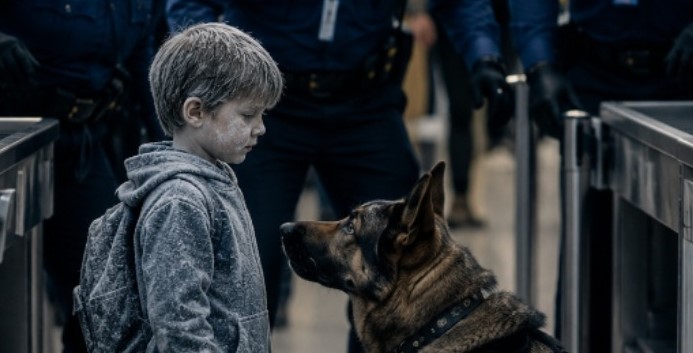
In many police operations, K9 units are trained to react quickly, sometimes aggressively, when they sense danger. They are used for tracking, detection, and protection, and their instincts often help officers respond to situations that humans may miss. However, not every alert from a police dog involves aggression. Sometimes, the most important signals are the quiet ones, and that is exactly what made this situation unusual and deeply concerning for the officer involved. It began as a routine encounter.
A police officer and his K9 partner were stationed in a public area where people were passing by normally. There were no immediate signs of danger, no disturbance, and no reason to expect anything unusual. Then a young boy appeared. He looked nervous, uncertain, and slightly out of place. The K9, trained for detection and situational awareness, immediately focused on the child, but not in the way the officer expected. Instead of barking or showing aggression, the dog remained still and intensely focused.
Its posture changed subtly, showing alertness rather than hostility. Experienced handlers understand that this type of reaction can sometimes indicate that a dog is picking up on something unusual that does not fit normal behavioral patterns. The officer noticed this immediately and became more attentive to the situation unfolding in front of him.
The surrounding environment remained quiet, but the dog’s behavior created tension. It did not move away or lose interest. Instead, it continued observing the boy carefully, as if trying to understand something beyond surface-level behavior. The officer, trusting his partner’s instincts, began to suspect that this was not a standard interaction. Dogs trained in law enforcement often respond differently when they sense distress, fear, or chemical changes associated with medical or environmental issues.
The officer approached the boy gently and asked simple questions to understand his situation. The child appeared frightened and struggled to respond clearly. When asked if he was alone, the boy answered hesitantly that he was. However, both the officer and the K9 seemed unconvinced. The dog shifted slightly closer, maintaining a calm but alert stance, reinforcing the officer’s suspicion that something was wrong.
At this point, the officer’s training guided him to continue the conversation calmly rather than escalate the situation. He asked more detailed questions, trying to determine whether the child had been given anything or had come into contact with a stranger. The boy hesitated again, showing signs of internal conflict and fear. This reaction suggested that he might have been instructed not to tell the full truth or did not fully understand what he had been involved in.
After a longer pause, the boy finally mentioned a drink he had received earlier. This detail immediately changed the tone of the situation. The officer became more alert, recognizing that unknown substances or items given to children by strangers can sometimes indicate serious risk scenarios. The K9 responded again with a brief sound, not aggressive but firm, reinforcing the officer’s concern that something critical was unfolding.
When asked who had given him the drink, the boy pointed toward someone who was no longer in the immediate area. This raised urgency because it suggested a missing person of interest. The officer quickly assessed the surroundings, but the crowd made it difficult to identify anyone matching a clear description. Time was becoming a factor, and the situation required a controlled but rapid response.
Following protocol, the officer called for additional medical evaluation to ensure the child’s safety. The boy became visibly anxious and asked whether he was in trouble. The officer reassured him that he was not, emphasizing that the priority was his safety. Meanwhile, the K9 remained close, staying calm and steady, as if providing emotional grounding rather than operational force.
Medical assessment tools were brought in to evaluate the boy’s condition. In real-world scenarios, this could involve scanning equipment depending on the suspected risk. The child remained fearful but cooperative, guided by both the officer’s calm instructions and the steady presence of the dog beside him. The K9’s behavior continued to be unusually gentle, maintaining proximity without stress signals.
When preliminary imaging or assessment results were reviewed, the medical personnel became more serious. While details in such situations depend on actual findings, what mattered most was that something required immediate attention. The officer’s focus shifted fully to ensuring the boy remained stable and calm while professionals evaluated the situation further.
Throughout the process, the K9 stayed close to the child. Instead of reacting aggressively or showing high alert aggression behavior, it maintained a protective and stabilizing presence. This type of behavior, while less dramatic, can be just as important in high-stress environments, especially when dealing with frightened individuals. Dogs in service roles are often trained to detect emotional distress as well as physical threats.
As the situation developed, the officer began to understand that the dog’s earlier behavior had not been random. It had not responded as if the boy was a threat. Instead, it had responded as if the boy himself was in distress. This distinction is critical in K9 training, where dogs may react differently depending on whether they sense danger, fear, illness, or abnormal environmental signals.
The boy gradually became calmer as he was reassured repeatedly that he was safe. Breathing instructions and steady communication helped reduce his anxiety. The presence of the K9 contributed to this calming effect, as many trained dogs naturally provide emotional grounding in high-pressure environments. The officer remained focused on ensuring that no escalation occurred while the situation was still being assessed.
At a later stage, professionals concluded that immediate attention was required to ensure the child’s safety. While specific outcomes depend on real case data, what is important in similar situations is rapid response, calm management, and careful evaluation. The officer’s decisions, combined with the K9’s behavior, reflected the importance of teamwork between humans and trained service animals in unpredictable scenarios.
In the aftermath of such incidents, handlers often reflect on how much information dogs can perceive that humans cannot immediately interpret. Subtle changes in scent, stress hormones, breathing patterns, or behavior can all influence a K9’s response. What may appear calm or unremarkable to a human observer can register as significant to a trained animal.
This situation also highlights a broader truth about K9 units in law enforcement. Their role is not limited to aggression or enforcement. In many cases, they serve as early warning systems, emotional stabilizers, and detection partners that assist officers in making critical decisions. Their ability to remain calm while assessing complex environments is one of their most valuable traits.
In the end, what stood out most was not aggression or confrontation, but awareness. The K9 did not react violently. Instead, it observed, interpreted, and remained steady in a situation where something was clearly wrong but not immediately visible. This calm behavior ultimately guided the officer’s response and helped prioritize safety over assumption.
Situations like this demonstrate how important K9 units are in modern policing, not only for their detection abilities but also for their sensitivity to human emotion and distress. They often notice what humans overlook, especially in moments where fear, confusion, or hidden danger is involved.
The story serves as a reminder that danger is not always obvious. Sometimes it is silent, subtle, and hidden behind normal appearances. And in those moments, trained K9 partners play a crucial role in recognizing what others cannot immediately see, ensuring that help arrives where it is needed most.

