Judge Martin Ellis had spent much of his life within the structured environment of courtrooms, where every word carried weight and every decision could shape lives.
His career reflected discipline, responsibility, and a deep commitment to the law. For decades, he had presided over hearings, reviewed complex cases, and ensured that legal processes were followed with care and fairness.
His calm demeanor and thoughtful approach had earned him a reputation for balance and professionalism. Inside the courtroom, everything followed a clear order.
Evidence was presented, arguments were examined, and conclusions were reached through careful reasoning. Emotion was acknowledged but always guided by legal standards and objectivity.

On one particular afternoon, however, his duties took him far beyond the familiar setting of polished wood panels and orderly proceedings. Instead, he found himself walking into a place defined by uncertainty and quiet urgency.
The shelter facility was modest, with narrow hallways and bright overhead lights that cast a clinical glow. The air carried a faint scent of disinfectant, mixed with something harder to define, a sense of vulnerability.
This was not a place where legal arguments were spoken. It was a place where recovery began, often after difficult circumstances. For Judge Ellis, the visit marked a departure from routine responsibilities.
Earlier that day, a case had crossed his desk involving an animal cruelty investigation. The initial report outlined concerning details about a dog found in distressing conditions behind an abandoned property.
According to the documentation, the animal had been discovered chained and in poor physical condition. Immediate intervention had been necessary, and the dog had been transported to the shelter for care and observation.
The legal process would eventually determine responsibility and consequences. However, before the case advanced, Judge Ellis made an uncommon request that reflected both curiosity and concern.

He asked if it would be possible to see the animal in person. It was not a requirement of his role, but rather a personal decision to better understand the reality behind the written report.
Shelter staff agreed to the request and guided him through the facility. As they walked, the quiet sounds of movement echoed, metal latches, soft footsteps, and distant animal noises blending into a subdued atmosphere.
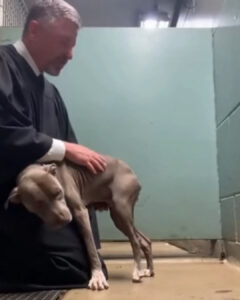
They stopped in front of a kennel, where a technician carefully prepared to open the door. Inside was the dog described in the report, a pit bull whose appearance reflected the challenges he had faced.
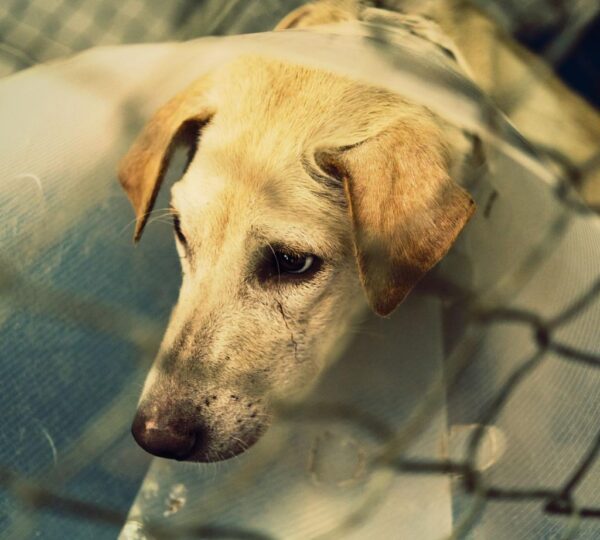
The animal’s frame was noticeably thin, and his posture suggested caution. His head remained low, and his eyes appeared distant, as though he were still adjusting to an unfamiliar and uncertain environment.
The technician spoke softly, explaining that the dog had not yet shown much response to human interaction. He was weak, frightened, and still in the early stages of recovery.
Judge Ellis listened without interruption. The details he had read earlier now took on a different meaning as he observed the animal directly, witnessing the physical and emotional effects firsthand.
After a brief pause, he made a quiet but deliberate choice. He removed his judicial robe, folding it neatly and placing it aside, setting aside the symbol of authority for the moment.
He stepped closer to the kennel and slowly lowered himself to the ground. The movement was calm and unhurried, intended to reduce any sense of threat and create a more approachable presence.
Sitting on the concrete floor, he positioned himself at the dog’s level. His posture remained relaxed, and his hands were visible, resting gently in a way that signaled calm and patience.
He spoke in a soft, steady voice, offering simple words meant to reassure rather than overwhelm. The tone was quiet, measured, and consistent, avoiding sudden movements or loud sounds.
At first, the dog did not respond. The room remained still, with the shelter staff observing from a respectful distance. Moments passed without any visible change in the animal’s behavior.
Then, gradually, a small shift occurred. One of the dog’s ears moved slightly, a subtle sign that he had noticed the presence and was beginning to process the situation.
Judge Ellis remained still, maintaining the same calm tone and posture. He did not attempt to rush the interaction, understanding that trust, especially after distress, takes time to develop.
The dog shifted his weight cautiously, each movement slow and deliberate. It was as if he was testing the safety of the moment, unsure but curious enough to take a step forward.
Encouraged by the absence of pressure, the dog moved closer, inch by inch. His body language remained guarded, yet there was a gradual change in his stance that suggested a growing sense of ease.
When the distance between them closed, Judge Ellis slowly extended his hand. The gesture was careful and controlled, allowing the dog to approach on his own terms without feeling forced.
For a brief moment, the dog paused again, assessing the situation. Then, instead of retreating, he leaned slightly forward, accepting the presence rather than resisting it.
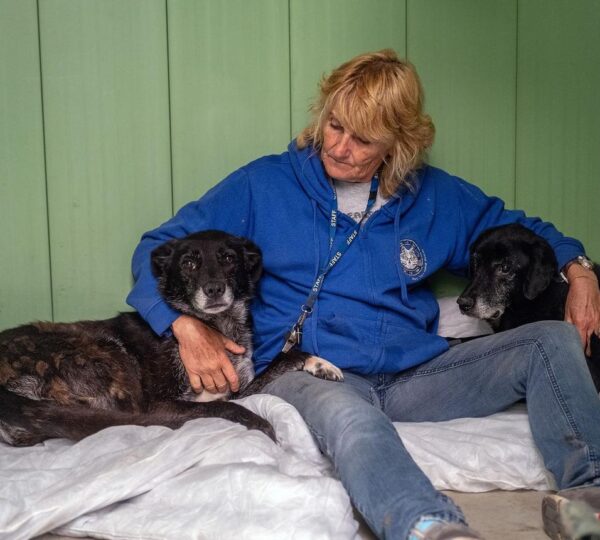
The judge’s hand rested gently on the dog’s shoulder. The contact was light, steady, and respectful, intended to provide reassurance without overwhelming the animal’s senses.
A noticeable change followed. The dog’s posture softened, and he leaned further, eventually resting part of his body against the judge’s leg. The shift was small but meaningful.
Shelter staff quietly observed the interaction, recognizing that this level of trust had not been shown before. The moment carried a sense of quiet significance within the otherwise still room.
Judge Ellis responded with the same calm presence, placing one arm gently around the dog without applying pressure. The gesture offered support while allowing the animal to remain comfortable.
He continued speaking softly, maintaining a consistent tone that reinforced the sense of safety. The dog’s breathing, once tense and uneven, began to slow and become more regular.

The atmosphere in the room changed subtly. What had begun as a cautious encounter gradually developed into a quiet moment of connection, built on patience and understanding rather than force.
The judge remained seated on the floor longer than expected, allowing the dog to adjust at his own pace. There was no urgency, only a steady presence focused on comfort and reassurance.
As time passed, the dog’s body language continued to relax. Although still physically weak, he appeared less guarded, showing signs that he was beginning to feel secure in the environment.
Eventually, the shelter staff prepared to move the dog to a recovery area with appropriate medical support. As they approached, the dog showed a brief moment of hesitation.
Judge Ellis gently reassured him with a calm touch and quiet words. The familiar tone seemed to ease the tension, allowing the staff to proceed without causing additional stress.
The dog was carefully lifted and carried toward a prepared space where veterinary care and monitoring would continue. The transition was handled with care to maintain the sense of calm.
As he was carried away, the dog’s gaze lingered briefly in the direction of the judge. It was a small detail, but one that did not go unnoticed by those present.
Afterward, Judge Ellis stood and retrieved his robe, returning to the role that defined his professional responsibilities. The legal process would continue as required, guided by evidence and procedure.
However, the experience in the shelter had added a deeper perspective. The case was no longer just a set of documents or legal arguments, but a situation connected to a living being.
Back in the courtroom, decisions would still be made with objectivity and adherence to the law. Yet the memory of that quiet interaction remained, offering a broader understanding of the case.
The moment served as a reminder that behind many legal matters are real circumstances that extend beyond written reports. Observing them directly can provide valuable insight.
Compassion does not replace the law, but it can exist alongside it. In certain situations, it helps inform a more complete understanding of responsibility and impact.
The interaction in the shelter was not dramatic or widely publicized. It was a simple, quiet exchange that demonstrated the importance of patience and empathy in unexpected places.
An animal that had experienced fear responded to a calm and non-threatening presence. The trust that developed, even briefly, highlighted the effect of gentle and consistent behavior.
For those who witnessed it, the moment reinforced the idea that small actions can have meaningful outcomes. Even in professional roles, moments of humanity can play a significant part.
Judge Ellis returned to his duties with the same commitment to fairness and responsibility. Yet the experience served as a reminder of the broader context in which justice operates.
In environments defined by structure and rules, there is still space for understanding and care. These qualities do not weaken decisions, but rather contribute to a more thoughtful approach.
The shelter visit did not change the legal process, but it added depth to it. It connected the facts of the case to a tangible reality that could not be fully captured on paper.
In the end, the moment was not about authority or judgment. It was about presence, patience, and a willingness to meet a situation with calm understanding.
Sometimes, meaningful change begins not with large actions, but with quiet choices. A decision to pause, to observe, and to respond with care can leave a lasting impression.
The experience in the shelter illustrated that even within structured roles, there is room for compassion. It showed that understanding often begins with simply taking the time to see clearly.
In that quiet room, under steady lights and within a moment of stillness, a connection formed. It was brief, but it carried a significance that extended beyond the immediate situation.
Not every case allows for such moments, but when they occur, they offer perspective. They remind us that behind every situation are details that deserve attention and care.
In conclusion, the story reflects the balance between responsibility and empathy. It demonstrates how a thoughtful approach can coexist with professional duty, creating a more complete understanding of the world around us.
