
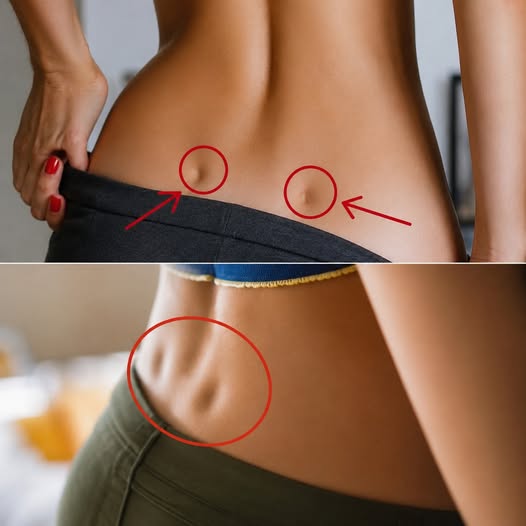
Have you ever noticed two small, symmetrical indentations on the lower back, just above the buttocks? These are commonly known as Venus dimples, a natural feature that has attracted curiosity because of their subtle and distinctive appearance. The term “Venus dimples” comes from Venus, the Roman goddess often associated with beauty and physical elegance. In men, similar marks are sometimes called Apollo dimples, but both refer to the same type of anatomical feature.
Although they are often considered aesthetically appealing, Venus dimples are not created through exercise, dieting, or lifestyle habits. They are primarily determined by genetics and the underlying structure of the pelvis. These dimples form where a short ligament connects the skin to the posterior superior iliac spine, a part of the pelvic bone. This connection creates a natural inward pull in the skin, forming the visible indentation.
Because this is a structural feature of the skeleton and connective tissue, it cannot be developed through training or physical activity. A person either naturally has them or does not based on their anatomy. From a medical perspective, Venus dimples are considered completely normal and are not classified as a health condition. They are simply one of many harmless variations in human body structure.
Some people believe these dimples may indicate certain health benefits, but scientific research has not established any direct connection between Venus dimples and specific medical advantages. What is known is that they may appear more visible in individuals with lower body fat levels, since less tissue covers the natural indentation formed by the ligament and bone structure. However, their visibility should not be interpreted as a sign of better health, fitness, or physical strength.
They are purely anatomical traits rather than functional indicators. Genetics is the primary factor in whether someone has Venus dimples. If present, they are inherited and remain unchanged throughout life, regardless of age or physical condition. Unlike skin features that change over time, such as wrinkles or pigmentation, Venus dimples remain stable because they are tied to bone structure rather than surface appearance.
There is no scientific evidence linking Venus dimples to improved circulation, posture, or back strength, despite some popular claims suggesting otherwise. They should be understood as a neutral anatomical variation, similar to differences in hand shape, ear structure, or facial bone symmetry among individuals. Although they have no medical significance, Venus dimples have often been associated with beauty due to their symmetry and location on the lower back.
In classical art and sculpture, lower back contours were frequently emphasized as part of idealized human proportions, which contributed to their aesthetic reputation. However, this association is cultural and visual rather than scientific, and does not reflect any measurable health or biological advantage. From a health standpoint, overall wellness depends on lifestyle factors such as movement, nutrition, posture, and cardiovascular health rather than external anatomical features.
Regular physical activity, including walking, stretching, and strength training, plays a far greater role in maintaining spinal health and circulation. As people age, maintaining core strength and flexibility becomes especially important for mobility and comfort, regardless of whether Venus dimples are present. These dimples do not change with age, meaning they remain visible throughout life if they are genetically present.
This consistency often makes them noticeable, as many other physical traits naturally evolve over time. It is important to understand that any pain or discomfort in the lower back is unrelated to Venus dimples themselves and should be evaluated separately if it occurs. Such symptoms are typically linked to muscles, joints, or spinal health rather than skin or ligament attachment points.
Recognizing this distinction helps prevent unnecessary concern and confusion about normal anatomical features. Venus dimples are not a sign of illness or dysfunction and should not be used as a diagnostic indicator of health. Instead, they represent a simple and harmless variation in how the human skeleton and connective tissues are formed.
Some individuals may have prominent dimples, while others may have faint or none at all, and all variations are completely normal. This diversity reflects the natural differences in human anatomy that exist across populations worldwide. Ultimately, Venus dimples are best understood as an anatomical trait rather than a medical or functional characteristic.
They highlight how small differences in bone structure and ligament attachment can create visible variation in the human body. While often admired for their appearance, their significance lies in anatomy and genetics rather than health or performance. True wellness is determined by overall physical and mental health habits, not by isolated physical features.
When viewed objectively, Venus dimples are simply one of many natural traits that contribute to the uniqueness of each individual. They neither define beauty nor health on their own, but they do illustrate the complexity and variation of human anatomy. In conclusion, whether a person has Venus dimples or not, it has no impact on their health status or physical abilities.
They remain a harmless, natural feature that reflects genetic and structural differences in the human body. What truly matters is maintaining a healthy lifestyle, while appreciating the fascinating details that make every body different and unique.

