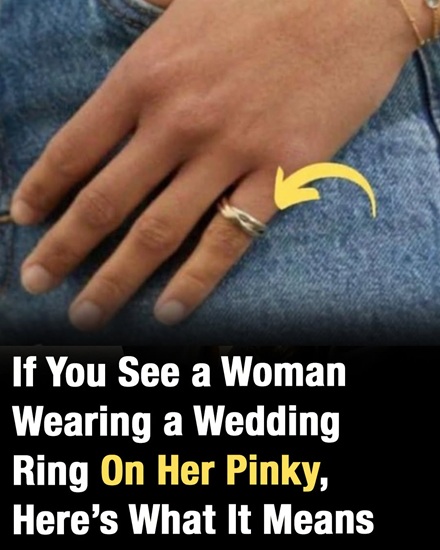
When people notice a ring on someone’s hand, they may instinctively wonder whether it carries a special meaning. Engagement and wedding rings are the most familiar examples, although even those traditions differ between cultures and countries. A ring worn on the little finger, or pinky, can be more difficult to interpret. Pinky rings have been used for fashion, family traditions and professional symbolism for generations, but a modern jewelry campaign has also given them another possible meaning: a personal commitment to self-love and self-worth.
Before interpreting anyone’s jewelry, an important distinction should be made. A woman wearing a pinky ring is not automatically announcing anything about her relationship status or personal beliefs. She may simply like how the ring looks on that particular finger. The jewelry could also be an heirloom, a gift, a professional symbol or something with an entirely private meaning. There is no universal social rule that allows strangers to determine why someone wears a ring simply by observing its position.
The self-love interpretation that became popular online is closely associated with the jewelry brand Fred + Far and its co-founder Melody Godfred. The project promoted what became known as the Self Love Pinky Ring. Rather than using a ring exclusively as a symbol of commitment between romantic partners, Godfred developed the concept around making a commitment to oneself.
Godfred has explained that the idea emerged while she was thinking about her own identity and well-being. Like many people balancing relationships, work and other responsibilities, she felt she had allowed her own needs to receive less attention. She wanted a physical object that could serve as a reminder that caring for herself deserved a place among the commitments she made to other people.
The little finger seemed particularly appropriate to her because she had not previously worn a ring there. In an interview about the concept, Godfred compared the overlooked pinky with the way women can sometimes become overlooked within their own lives. By deliberately placing a meaningful piece of jewelry on that finger, she transformed it into a symbol of paying attention to herself.
There was another important idea behind the choice. Rings are already strongly associated with commitment. An engagement ring traditionally represents a promise involving another person, while a wedding ring represents marriage in many cultures. Godfred’s concept borrowed that familiar language of jewelry and redirected it inward: a ring could also symbolize a promise to respect and care for oneself.
That message was never intended to suggest that romantic love and self-love are incompatible. Godfred herself was married and continued wearing her engagement ring. She described the two pieces of jewelry as representing commitments that could exist together rather than competing with each other.
This detail is important because some simplified versions of the trend can create the impression that a pinky ring means a woman has rejected relationships or marriage. That is not the message Fred + Far promoted. Someone could be married, single, dating or in another relationship situation and still choose to wear a self-love ring.
The original Fred + Far design also had recognizable visual features. It incorporated an inverted triangular stone, a shape the brand connected with feminine symbolism. Different versions were offered using various materials and gemstones. The commercial design helped give the movement a recognizable identity as people began sharing photographs and stories online.
However, the underlying idea does not require one particular ring. Someone who likes the symbolism can attach the same personal meaning to an existing piece of jewelry. The significance comes from the intention of the wearer rather than the price, gemstone, manufacturer or material used to make the ring.
Social media helped the concept reach a much larger audience. People began sharing images of their pinky rings while discussing what self-commitment meant in their own lives. Some connected the jewelry with personal growth or greater confidence. Others treated it as a reminder to establish healthier boundaries or make time for their own well-being.
The term “self-love” can itself mean many different things. It does not necessarily involve constant confidence or believing that everything about one’s life is perfect. In everyday conversation, it can refer to acknowledging personal worth, taking reasonable care of one’s needs and refusing to make external approval the sole measurement of value.
A ring obviously cannot accomplish those things by itself. It is simply an object. But people have long used physical objects to remind themselves of values, relationships, achievements and responsibilities. A pinky ring used intentionally for self-commitment fits within that much older tradition.
In fact, rings have carried symbolic meanings for thousands of years. Depending on the culture and historical period, they have represented marriage, authority, family lineage, mourning, friendship, professional status and membership in particular organizations. They have also always existed as decoration, which means symbolism should never automatically be assumed.
The history of pinky rings is especially varied. Signet rings, for example, have often been worn on the little finger, particularly in British and European traditions. Historically, signet rings could display family crests, initials or other identifying marks. Some were once functional seals, while later examples became symbols of family heritage or social identity.
There are professional examples as well. Canadian engineers have a tradition involving the Iron Ring, normally worn on the little finger of the working hand. It serves as a reminder of professional responsibilities and ethical obligations. That tradition is completely unrelated to romantic relationships or the modern self-love movement.
These examples demonstrate why assigning one universal meaning to pinky jewelry would be misleading. Two people can wear rings on exactly the same finger for entirely different reasons. One may be following a family tradition, another may be recognizing a professional achievement, and someone else may simply enjoy the appearance.
Historical claims about women and pinky rings should also be treated carefully. Online articles sometimes state that Victorian women commonly wore rings on their left pinkies specifically to announce that they were single and had no intention of marrying. The reality of Victorian jewelry customs is more complicated than that simple explanation suggests.
Jewelry during the Victorian era could communicate mourning, affection, remembrance, friendship and family connections. Styles and meanings also changed substantially during Queen Victoria’s long reign. Although rings could certainly convey social information, there is not enough evidence to treat the modern claim about left-pinky rings as a universal code followed by Victorian women.
The broader idea that jewelry could communicate relationship information is historically reasonable. People have long used clothing and accessories to signal aspects of identity and social position. But such practices differed by time, community and individual circumstances, making broad rules unreliable.
Even wedding-ring customs demonstrate that problem. Many people in the United States and other countries traditionally wear a wedding ring on the left ring finger. Elsewhere, the right hand is customary. Religious practices, regional traditions and family preferences can all influence which hand is used.
Modern fashion has made ring placement even less predictable. People frequently wear several rings across both hands, stack multiple rings on one finger or select a finger simply because the jewelry fits comfortably there. In that environment, interpreting someone’s relationship status based on an unfamiliar ring becomes particularly unreliable.
The self-love pinky-ring concept is therefore better understood as an optional symbol rather than a new social code. Fred + Far offered people a specific meaning they could choose to adopt. It did not establish a rule under which every pinky ring should automatically be interpreted in the same way.
For people who intentionally use the symbolism, the little finger can nevertheless be a convenient location. Hands remain visible throughout much of the day. People see them while typing, preparing food, working, driving or performing countless ordinary tasks. A ring can consequently provide a recurring visual reminder of whatever intention the wearer has attached to it.
The concept also expands the reasons people might purchase meaningful jewelry. Rings are often associated with romantic milestones, but jewelry is also used to celebrate graduations, birthdays, career achievements, friendships and personal milestones. A self-commitment ring simply adds another possibility.
There is no requirement that such a symbol be expensive. The emotional significance of jewelry does not necessarily increase with its monetary value. A simple ring can carry enormous personal importance, while an expensive piece may be worn purely because someone appreciates its design.
It is also worth separating the symbolic concept from medical or psychological claims. Wearing a self-love ring cannot treat depression, anxiety, trauma or another health condition. Someone who needs professional support should not view jewelry as a substitute for appropriate care. The ring functions as a personal symbol, not a treatment.
Its appeal instead comes from the idea behind it. People regularly make commitments to employers, partners, relatives and friends. The self-love pinky-ring movement asks wearers to consider whether they also make commitments concerning their own well-being and boundaries.
That idea can be meaningful without becoming selfish. Caring about one’s own needs does not inherently mean caring less about other people. Godfred specifically presented self-love as something that could coexist with strong relationships, arguing that taking care of oneself can contribute to healthier connections with others.
This explains why her engagement ring and pinky ring could remain on the same hand without contradiction. One represented a commitment involving her partner. The other represented a commitment involving herself. Neither required the rejection of the other.
For some people, that distinction became the most appealing part of the campaign. Jewelry traditionally used to celebrate being chosen by someone else was supplemented with jewelry symbolizing the decision to value oneself. The message was not that one type of commitment mattered more, but that both could deserve recognition.
Still, observers should avoid reading that message into every ring they encounter. A woman wearing a pinky ring may never have heard of Fred + Far. She may not identify with the self-love campaign at all. Asking respectfully, when appropriate, is more reliable than assuming that an accessory reveals someone’s personal story.
The modern pinky ring therefore has no single definition. It can be a fashion choice, an heirloom, a signet, a professional symbol or an object representing a private memory. For some women influenced by the self-love movement, it can also symbolize a promise to prioritize their own worth and well-being.
That variety is actually consistent with the broader history of jewelry. Objects gain meaning because people and cultures give meaning to them. The same design can signify different things across generations, and a symbol can evolve as new communities adopt it.
Fred + Far’s contribution was not the invention of pinky rings but the popularization of a particular modern interpretation. Melody Godfred took the familiar idea of a commitment ring and asked whether that symbolism could be directed toward the person wearing it.
For people who connected with the message, the answer was yes.
Ultimately, noticing a pinky ring should inspire curiosity rather than certainty. It does not automatically tell you whether the wearer is single or married, nor does it reveal her personality or beliefs. Its meaning belongs primarily to the person who chose to wear it.
And for those who intentionally embrace the self-love symbolism, the message can be remarkably simple. The small ring serves as a visible reminder that relationships, careers and responsibilities may all deserve attention, but personal well-being should not automatically disappear beneath them. In that sense, a pinky ring can represent a quiet commitment that requires no public announcement at all: remembering to value the person wearing it.
