
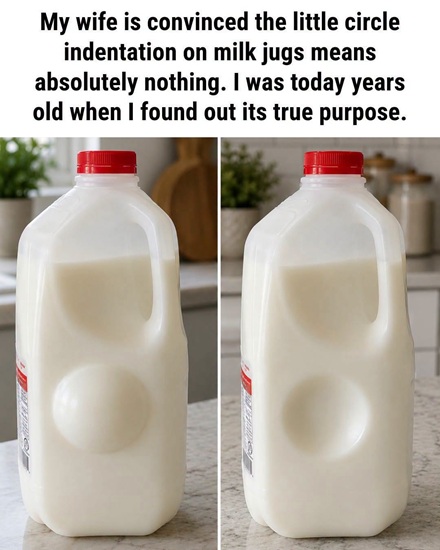
A plastic milk jug is such an ordinary household object that most people rarely stop to examine its design. Yet one feature often attracts attention once it is noticed: the large circular indentation molded into the side of many gallon-size containers. Online explanations sometimes describe this circle as a special pressure valve or even a built-in warning that milk has spoiled. Those claims simplify a more complicated piece of packaging engineering.
The recess is better understood as part of the jug’s overall structural geometry rather than as a universal freshness indicator. Many translucent milk containers are manufactured from high-density polyethylene, usually known as HDPE. This material is widely used in food packaging because it is relatively lightweight, durable and suitable for forming containers with complicated shapes. A typical milk jug is produced using blow molding, a manufacturing process in which heated plastic is expanded and shaped inside a mold.
This allows the handle, neck, corners, curves and recessed areas to be produced as parts of the same container. That means the circular area is not normally a separate component added after the jug has been manufactured. It is molded directly into the sidewall. To understand why that matters, it helps to consider how much is expected from an extremely lightweight piece of plastic. A gallon of milk is much heavier than its empty container, yet the jug needs to remain easy to carry, inexpensive to manufacture and sufficiently durable for normal distribution and household use.
Manufacturers could theoretically increase strength by simply using much thicker plastic.
Doing so, however, would require more raw material for every jug. Because milk containers are manufactured in very large quantities, even a small increase in the amount of resin used for each package can become significant when multiplied across millions of units.
Packaging engineers therefore make extensive use of shape.
A thin, perfectly flat plastic panel can respond to forces differently from a panel containing molded curves, ribs or recesses. Changing the geometry of a surface can affect its stiffness and the way stresses are distributed through the material.
The circular indentation changes the geometry of a relatively broad sidewall.
Rather than leaving that section completely flat, the molded recess introduces additional contours into the panel. Depending on the particular jug design, those contours can influence how the wall bends or deforms when forces are applied.
This general engineering principle is not unique to milk containers.
Look closely at many plastic bottles and packages and you will find ridges, grooves, curves and recessed panels. These features can help engineers create useful structural properties without relying exclusively on additional material.
The same principle appears outside packaging as well.
A sheet containing carefully designed folds or curves can behave differently from an otherwise identical flat sheet. Geometry can provide rigidity in some directions while allowing controlled flexibility in others.
That helps explain why describing the milk-jug circle as purely decorative misses an important point.
Its shape forms part of the physical structure of the container.
However, it is also important not to go too far in the opposite direction by assigning one exact purpose to every circular recess found on every milk jug.
Different packaging manufacturers can use different molds, wall thicknesses, materials and dimensions. A design used by one dairy or container supplier may not behave identically to another.
For that reason, the common claim that every circular indentation is specifically designed as a pressure-release valve should be treated cautiously.
The circle is not a valve in the conventional mechanical sense.
There is no opening through which pressure is intentionally released, and there is no separate moving mechanism that opens and closes. The jug remains sealed by its walls and closure.
Plastic containers can nevertheless deform.
Milk moves through several temperature environments between production and consumption. It is processed and chilled, transported, placed in refrigerated retail displays, carried home and stored in a household refrigerator.
Temperature changes can influence both liquids and the gases inside containers.
The flexible walls of a lightweight plastic package can respond to changing internal and external conditions. A recessed panel is part of those walls and can therefore participate in deformation.
This is where the popular pressure explanation likely becomes attractive.
People may notice that the circular section can move or change position and conclude that it exists solely to manage pressure. In reality, container performance depends on the complete geometry of the package rather than one isolated feature.
The sidewalls, corners, handle, neck, base and recessed regions all contribute.
Engineers can test finished packages to understand how they respond to filling, handling, transportation and storage. They can then adjust the design to provide acceptable performance while limiting unnecessary material.
Shipping is an important part of that process.
Before a jug appears in a supermarket refrigerator, it has already passed through filling equipment and various stages of distribution. Containers may move along conveyor systems, be grouped together and travel in refrigerated transportation before reaching a store.
Normal transportation creates vibration and movement.
Packages also experience forces when employees and consumers lift, reposition and carry them. The jug needs enough structural integrity to tolerate those ordinary conditions without becoming unnecessarily heavy or rigid.
The handle creates its own set of forces.
When someone picks up a full gallon by the handle, the weight of the liquid places stress on the plastic surrounding that region. The container’s overall geometry must help distribute those forces while maintaining a comfortable and practical shape.
A well-designed package therefore represents a compromise.
It should use enough material to perform reliably, but not substantially more than necessary. It should remain strong enough for ordinary handling while still being lightweight. It should also be manufacturable at high speed and at a reasonable cost.
Molded structural features help engineers pursue that balance.
The circular recess should be viewed within that broader context.
Another popular internet claim concerns spoiled milk.
According to some versions of the story, the circular indentation will automatically pop outward when the milk becomes unsafe to drink. This is sometimes presented as though the jug contains a hidden freshness indicator.
Consumers should not rely on that claim.
Microbial activity can sometimes produce gas in food products, and an abnormally swollen sealed package can be a legitimate reason for caution. Internal pressure can alter the shape of flexible packaging.
But that does not turn the circular panel into a dependable spoilage detector.
Its position can potentially be affected by several conditions unrelated to spoilage, including temperature changes or physical deformation during handling.
The opposite problem is equally important.
Milk can become unsuitable for consumption without producing an obvious change in the circular indentation. A recessed circle therefore cannot confirm that the product is fresh simply because it has not moved.
Food safety should be evaluated using appropriate storage and handling guidance.
Milk needs to be refrigerated properly. Consumers should also pay attention to the condition of the package, its storage history and any obvious signs that the product may no longer be suitable.
A leaking or unusually swollen container should not simply be ignored.
Likewise, milk that has been left under unsuitable temperature conditions should not automatically be considered safe because the jug still looks normal.
When there is genuine uncertainty about the safety of a perishable food, a molded feature on its packaging should not replace established food-safety practices.
This distinction makes the real engineering of the jug more interesting rather than less.
The circle does not need to be a secret freshness sensor to serve a useful structural purpose.
Its value comes from geometry.
The indentation is created during manufacturing without requiring an additional component, electronic sensor or mechanism. Once the jug leaves the mold, that geometry remains part of the container throughout filling, transportation, retail display and household use.
This kind of efficiency is common in packaging design.
A manufacturer can potentially improve a container’s mechanical behavior simply by changing its shape rather than adding another piece.
Consider the ribs visible on some water bottles.
Similar geometric ideas appear on detergent bottles, juice containers and other plastic packages. Recessed grip areas can improve handling, while ribs and contours can influence rigidity.
Even the bottom of a bottle can contain carefully shaped geometry.
These details illustrate how packaging designers use three-dimensional form to achieve specific performance goals with relatively thin materials.
Material reduction can also have broader benefits.
Using less plastic per container reduces the amount of resin required to manufacture that container. When production volumes are extremely large, relatively small savings per package can accumulate.
Lighter empty packaging can also require less material to transport before filling.
These benefits should be kept in perspective because the milk itself accounts for most of the weight of a filled jug. Still, minimizing unnecessary packaging material remains a legitimate engineering and manufacturing objective.
There is also an economic incentive.
Plastic resin costs money. If a manufacturer can maintain adequate container performance while reducing material, the savings across a large production run can be meaningful.
The challenge is ensuring that material reduction does not make the package unreliable.
A jug that frequently leaks or fails during normal use would create waste rather than prevent it. Damaged containers can result in lost product, cleanup requirements and additional packaging or transportation needs.
Engineering therefore involves finding an appropriate balance.
The goal is not simply to make the thinnest possible jug. It is to create a container that performs its intended function efficiently.
Structural geometry contributes to that goal.
The circular recess is one of the easiest features for consumers to see, but it works as part of a much larger design.
This is also why viral explanations about everyday objects can be misleading.
A visible feature invites a simple story. Someone notices the circle, observes that it can sometimes move and concludes that it must be a pressure button or spoilage alarm.
The explanation sounds convincing because it connects an observation with an apparently logical purpose.
But engineering designs rarely need to have only one simplistic explanation.
Features can influence stiffness, deformation, material distribution and manufacturing performance simultaneously. Their exact behavior may also differ depending on the container design.
Without specifications from a particular manufacturer, it is better to avoid claiming that every milk-jug indentation has one identical purpose.
What can reasonably be said is that the molded recess forms part of the jug’s structural geometry.
It changes the shape of the sidewall and can affect how that thin plastic panel responds to forces and deformation.
That alone makes it more than a random decoration.
The feature also demonstrates how much engineering can be hidden inside objects people handle every day without thinking about them.
A milk jug looks simple because good packaging is supposed to feel simple to the consumer.
You pick it up by the handle, pour the milk and put it back in the refrigerator.
Behind that ordinary experience are decisions involving materials, manufacturing, structural behavior, cost, transportation and usability.
The circular indentation is one visible reminder of those decisions.
So if you notice the circle the next time you open your refrigerator, there is no need to treat it as a secret button or guaranteed warning system.
It is better understood as part of a carefully molded plastic container whose geometry helps determine how the package behaves.
And if the circle ever appears unusually distorted, the safest response is not to use that feature alone to decide whether the milk is good or bad.
Consider the condition of the entire package and whether the milk has been stored appropriately.
The most interesting truth about the circle is therefore less dramatic than many viral explanations but more useful.
It shows how manufacturers can use shape rather than simply adding material to influence the behavior of lightweight packaging.
Something that looks like an insignificant dimple can be part of a much larger engineering solution.
The humble milk jug must securely hold a heavy liquid while remaining lightweight, convenient and economical to manufacture.
Its molded curves, handle, corners and recessed panels all contribute to meeting those requirements.
The circular indentation is simply one of the most noticeable examples.
Rather than being a mysterious spoilage detector, it provides a small window into the practical engineering behind an object millions of people use without ever giving its design a second thought.

