
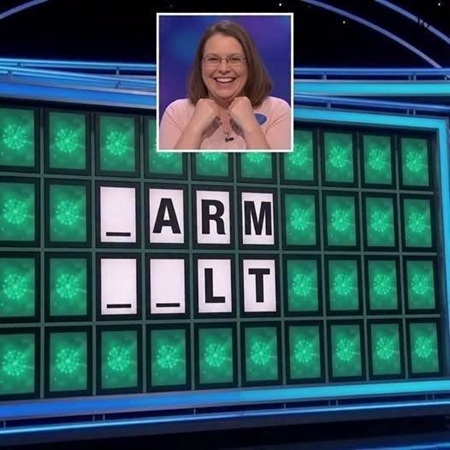
Televised game shows have always fascinated audiences because they place ordinary people in high-pressure situations where thinking speed, memory, and intuition are tested in real time. Among the most engaging formats are puzzle-based competitions, where contestants are challenged to solve word or logic problems with limited clues and strict time constraints. In these environments, viewers usually expect a gradual process of elimination.
Contestants often begin by carefully analyzing visible information, testing possible answers, and working step by step toward a solution. This method is considered the standard and most reliable approach, especially when dealing with incomplete or partially revealed puzzles. However, not all solutions emerge gradually. In some cases, contestants appear to arrive at answers almost instantly, creating moments that surprise both the audience and the host. These situations are often described as “lightbulb moments,” where understanding seems to appear suddenly after a brief period of observation.
The Role of Intuition and Pattern Recognition in Fast Problem Solving
Psychological research suggests that the human brain is capable of processing complex information at both conscious and subconscious levels. While deliberate thinking involves careful step-by-step reasoning, the subconscious mind continuously analyzes patterns based on past experience, memory, and learned associations.
This means that in certain situations, a person may reach a conclusion without being fully aware of each step that led them there. This process is often referred to as intuitive insight. It can feel sudden, even though it is usually the result of accumulated knowledge being processed in the background.
In word puzzles and logic games, this ability can be especially noticeable. Partial letters or incomplete clues may be enough for the brain to recognize familiar patterns and predict likely solutions. When this happens quickly, it can appear as if the answer came “out of nowhere,” even though it is grounded in prior cognitive processing.
Pressure, Performance, and Decision-Making on Stage
Game show environments add another layer of complexity to problem-solving: pressure. Contestants are often performing in front of a live audience, with cameras recording every movement and reaction. This setting can influence how people think, sometimes slowing down decision-making, while in other cases sharpening focus.
Some individuals perform better under pressure, entering a state of heightened concentration where distractions fade and cognitive processing becomes more efficient. Others may experience hesitation or overthinking, which can make simple problems feel more difficult than they actually are.
When a contestant solves a challenging puzzle very quickly, it often creates a strong contrast with audience expectations. Viewers anticipate a long and difficult process, so a sudden solution feels surprising and memorable.
How Viral Game Show Moments Spread Online
In the digital age, short clips from television shows can spread rapidly across social media platforms. A single moment of unexpected success is often replayed, analyzed, and discussed by thousands or even millions of viewers within a short time.
These clips are usually shared because they evoke strong emotional reactions such as surprise, admiration, or disbelief. As they circulate, different viewers may interpret the same moment in different ways. Some focus on skill and preparation, while others emphasize intuition or luck.
Over time, these discussions can grow beyond the original context of the game and become broader conversations about intelligence, human potential, and decision-making under pressure.
The Science of “Aha Moments” in Problem Solving
Cognitive scientists often refer to sudden moments of clarity as “aha moments” or insight experiences. These occur when the brain reorganizes information in a way that reveals a solution that was previously not obvious.
Unlike slow analytical thinking, insight-based solutions often feel instantaneous. However, research suggests they are usually preceded by unconscious mental processing. The brain continues working on a problem even when a person is not actively focused on it.
This explains why solutions sometimes appear suddenly after a brief pause or shift in attention. The mind has been processing information in the background and then brings it into conscious awareness once a coherent pattern is formed.
Why These Moments Captivate Audiences
Audiences are naturally drawn to moments that feel extraordinary or unexpected. When a contestant solves a difficult puzzle in a short amount of time, it challenges assumptions about how problem-solving should work.
These moments are memorable because they combine suspense with resolution in a very short time frame. Instead of watching a long process of trial and error, viewers witness an immediate outcome, which creates a strong emotional impact.
They also encourage reflection, as viewers often imagine how they would perform in the same situation. This personal connection helps explain why such clips are widely shared and discussed online.
Intelligence, Intuition, and Human Cognition
Game shows provide a unique environment for observing human thinking under pressure. They reveal how both analytical reasoning and intuitive insight play important roles in problem-solving.
While structured thinking is essential for many types of challenges, sudden moments of clarity demonstrate the brain’s ability to process information in complex and sometimes unexpected ways. These instances highlight the balance between conscious reasoning and subconscious pattern recognition.
Ultimately, these “instant solution” moments remind us that intelligence is not always slow or linear. In many cases, the mind works quietly in the background, assembling information until a solution appears fully formed. This combination of intuition and reasoning is what makes human problem-solving both fascinating and unpredictable.

