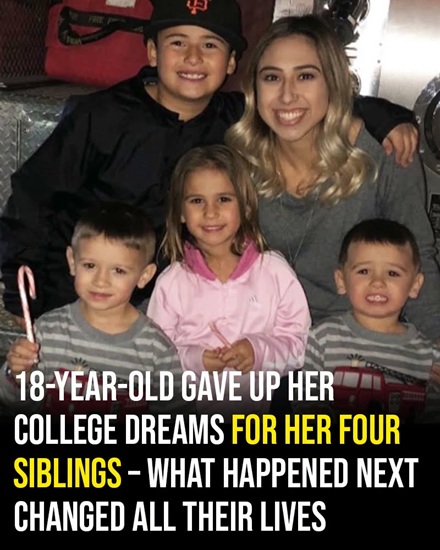
At 18 years old, Baylee Laine was standing at the beginning of a future she had worked hard to build.
She was a talented softball player.
College was waiting.
And leaving home offered something else she desperately wanted: the opportunity to build a life away from the instability that had shaped much of her childhood.
For many teenagers, the decision would have seemed obvious.
Baylee could leave.
She could focus on school, athletics and her own future.
But every time she imagined going, the same thought returned.
What would happen to her four younger siblings?
Eventually, that question became more important than the future she had planned.
Baylee stayed.
But staying was only the first decision.
What followed would take years.
Her Childhood Had Already Been Complicated
Baylee grew up in a family situation that changed considerably during her early years.
Her parents separated when she was young and later divorced.
By the time Baylee was eight, Child Protective Services had become involved with the family.
Eventually, Baylee and one of her brothers lived with their father.
Her mother later had four additional children.
Those younger children became an increasingly important part of Baylee’s life.
As she grew older, she spent significant amounts of time helping care for them.
At first, helping was simply something an older sister could do.
Over time, however, the responsibility became much bigger.
And Baylee was still a child herself.
Summers Began Looking Very Different
While other teenagers could use school breaks for sports, friends and ordinary summer activities, Baylee often found herself helping with childcare.
Her younger siblings needed attention.
Her mother needed help.
And Baylee frequently stepped in.
Then twins arrived.
The additional responsibility became overwhelming.
Baylee eventually reached a point where she knew she could not continue structuring her entire future around helping raise someone else’s children — even when those children were her siblings.
She began pulling back.
For perhaps the first time, she seriously considered what she wanted for herself.
And she already had a plan.
Softball Could Have Taken Her Somewhere New
Baylee had invested years in softball.
Her work had created an opportunity to continue playing in college.
For her, leaving was not simply about athletics.
It represented independence.
College could give her space to develop her own identity.
She could study.
She could play the sport she loved.
And she could finally experience a life that did not constantly revolve around family instability.
During her senior year of high school, that was the future Baylee expected to pursue.
Then the doubts began.
She could leave the situation.
But her siblings could not.
She Could Not Stop Thinking About the Children
The farther Baylee looked into her own future, the more she worried about theirs.
She began imagining what might happen if she left.
Would the children have stability?
Who would make sure they were safe?
Who would be there consistently?
Eventually, Baylee came to a conclusion that would redirect her entire life.
She would stay.
And if she stayed, she wanted to pursue something much bigger than occasionally helping her mother.
Baylee wanted her siblings with her.
It was an enormous goal for an 18-year-old.
And wanting it was very different from being legally allowed to do it.
She Had to Rebuild Her Plans Almost Immediately
Baylee adjusted her educational path.
Instead of simply leaving for the college experience she had imagined, she enrolled closer to home.
She also worked to support herself and prepare for the possibility of caring for the children.
Money became a constant concern.
Four children require food, clothing, housing and countless other necessities.
Baylee was barely entering adulthood.
She did not have the financial foundation of someone who had spent decades building a career.
So she worked.
At different points, she held multiple jobs.
Friends and other supporters also stepped forward.
A fundraising effort helped provide additional financial support.
But money was only one obstacle.
The larger challenge involved the legal and foster-care system.
Baylee Had to Prove She Could Provide a Home
Being the children’s older sister did not automatically give Baylee the authority to become their caregiver.
There were requirements to meet.
There was paperwork.
There were evaluations and legal steps.
Baylee worked with legal assistance as she tried to become approved as a foster parent.
The process took time.
And her age made the challenge particularly unusual.
She was asking the system to trust a teenager with responsibility for four younger children.
Baylee later described how intensely she worked on the process.
There were long days.
There were financial pressures.
There were moments when almost every part of her life revolved around getting the children into a safer and more stable situation.
Then, in 2017, the effort reached a turning point.
October 25 Changed the Household
On October 25, 2017, Baylee’s four younger siblings were placed in her care through the foster-care system.
Baylee was 19 years old.
The children were finally with her.
That moment represented a major victory.
But it was not the ending.
In many ways, it was the beginning of the hardest part.
Baylee now had four children depending on her every day.
She had to create routines.
She had to manage practical responsibilities.
And she had to help children who had experienced instability understand that they were safe.
There was also another major problem.
Their future together was not yet permanent.
The Children Were Afraid They Could Be Taken Away
Moving into Baylee’s home did not immediately erase everything the children had experienced before arriving there.
According to Baylee, they struggled with fear.
They worried that someone could appear and remove them.
That uncertainty affected the entire household.
Baylee wanted them to understand that she intended to keep them together.
But legal permanence had not yet been established.
At the same time, she was learning how to function as their primary caregiver.
The transition demanded enormous sacrifices.
Her education was affected.
Her work changed.
And the emotional pressure became difficult to process.
Baylee Said She Became “Robotic”
There was always another task waiting.
Someone needed food.
Someone needed help.
Documents had to be handled.
Appointments had to be remembered.
Problems needed solutions.
Baylee later described reaching a point where she almost stopped processing her own emotions.
She became focused on the job in front of her.
In her words, she became “robotic.”
There was simply too much to do.
She had fought to get the children into her home.
Now she needed to keep everything functioning.
And meanwhile, another legal process was continuing.
Baylee wanted to adopt them.
Foster Care Was Only One Stage
Baylee did not want the children’s future to remain uncertain indefinitely.
She wanted permanence.
That meant pursuing adoption.
But the process required additional legal steps involving the rights of the children’s biological parents.
It took approximately two more years before the next major milestone arrived.
By then, Baylee had already been functioning as a parent.
She was raising the children.
She was responsible for their everyday lives.
But eventually, the legal relationship caught up with the reality inside their home.
The adoption was finalized.
Baylee was 21.
She Became Their Sister and Their Legal Parent
At an age when many people are finishing college or beginning their first full-time careers, Baylee became the adoptive mother of four children.
They were also her siblings.
That unusual combination of relationships did not change the history they shared.
Baylee remained their older sister.
But legally and practically, she was also responsible for raising them.
The adoption gave the family something they had desperately wanted.
Permanence.
Still, a judge’s decision could not instantly erase years of uncertainty.
The children needed time before they truly believed they were safe.
And surprisingly, one of the periods that helped them develop that security came during a global crisis.
The Pandemic Slowed Everything Down
When the COVID-19 pandemic disrupted ordinary life in 2020, families everywhere faced unfamiliar circumstances.
Schools closed.
Schedules changed.
People spent far more time at home.
For Baylee’s family, the period created an unexpected change.
They were suddenly together much more consistently.
The constant outside movement slowed.
Baylee has recalled taking evening walks with the children.
They spent long stretches of time simply being a family.
That consistency began doing something important.
The children started settling.
The fear that their home could suddenly disappear gradually became less dominant.
For Baylee, it was a turning point.
The family she had fought so hard to create was beginning to feel secure.
Years Later, Everything Looks Different
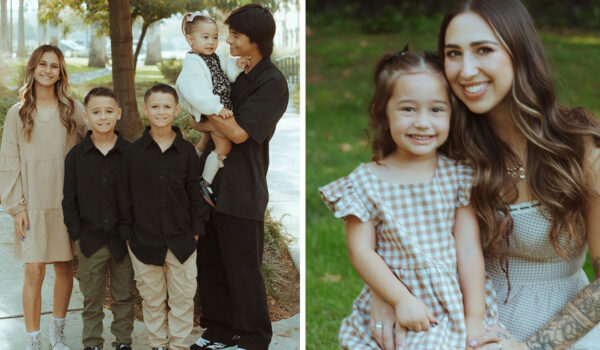
Baylee is now 28.
The four children she adopted are no longer the small children who arrived at her home in 2017.
Her brother is now 17.
Another sibling is 14.
The twins are 12.
Baylee has also become a biological mother.
She has a three-year-old daughter.
That means the teenager who once wondered whether she could possibly take responsibility for four children is now raising a family of five.
According to Baylee, her adopted children have moved beyond much of the fear and instability that once affected them.
The change did not happen quickly.
It took years.
And until recently, much of that journey remained largely unknown outside the people who knew them.
Then Baylee made a TikTok video.
She Put Years of Their Lives Into One Video
Baylee came across a social-media trend involving photographs that showed people’s lives changing over time.
She realized she had photographs capable of telling a powerful story of their own.
She gathered images of her siblings.
Some showed them when they were younger.
Others showed the family years later.
Together, the photographs revealed a transformation that had taken nearly a decade.
Baylee posted the video.
Then something unexpected happened.
People began watching.
A lot of people.
The video eventually accumulated millions of views.
But the number itself was not what affected Baylee most.
It was what viewers began telling her.
Strangers Recognized Their Own Families
Messages started arriving from people who understood parts of Baylee’s experience.
Some had raised younger siblings.
Some had been raised by older brothers or sisters.
Others were grandparents, aunts or extended family members who had stepped into parental roles.
Their exact circumstances were different.
But their stories contained familiar elements.
For years, Baylee had wanted her family to feel normal.
She knew their structure was unusual compared with many of the families around them.
Then millions of views brought her into contact with people whose lives were not so different after all.
That realization changed the way she thought about normality.
Maybe her family did not need to fit somebody else’s definition.
Maybe they were already normal in their own way.
Then People Began Asking How She Did It
The attention brought another consequence.
People started contacting Baylee for advice.
Some were considering taking responsibility for younger siblings.
Others were already in difficult family situations and wanted to understand what Baylee had experienced.
Her story naturally provides encouragement.
But there is an important distinction.
Baylee’s experience is her own.
Custody, foster-care and adoption requirements vary according to circumstances and applicable law.
Her story should not be treated as universal legal advice or a guarantee that another case would follow the same path.
Baylee herself acknowledges that what she did was difficult.
Very difficult.
Her encouragement does not erase that reality.
The Inspirational Headline Leaves Out a Lot
It is easy to summarize Baylee’s story in one sentence.
A young woman gave up her plans and adopted her four younger siblings.
But that sentence skips almost everything that made the experience difficult.
There were years of uncertainty.
There were multiple jobs.
There were financial worries.
There was fundraising.
There were legal proceedings.
There were children struggling to feel secure.
There were sacrifices to Baylee’s education and athletic ambitions.
And there were periods when she felt she had to shut down her own emotions simply to keep going.
The adoption did not magically fix everything.
Building a stable family required years after the paperwork was signed.
That is what makes the outcome more meaningful.
The Biggest Change Was Not Legal
October 25, 2017, mattered because the children entered Baylee’s care.
The adoption date mattered because their family became legally permanent.
But another transformation happened much more slowly.
The children stopped expecting to lose their home.
They began trusting that they could stay.
That kind of security cannot necessarily be created by paperwork alone.
It develops through ordinary days.
Meals.
School mornings.
Birthdays.
Arguments.
Walks.
Bedtimes.
Years of seeing the same person still there.
Baylee gave them that consistency.
Eventually, the family began to believe in it.
Her Original Future Disappeared
At 18, Baylee thought she was choosing between two lives.
One involved leaving.
College and softball were waiting.
The other involved staying close to four children whose future worried her.
She chose the second path.
That decision cost her opportunities and changed the direction of her education and early adulthood.
But the decision also created something she could not fully see at the time.
A family.
At 19, Baylee welcomed her siblings into her home through foster care.
At 21, she legally adopted them.
At 28, she is raising those four children alongside her own young daughter.
The frightened children who once worried that someone could take them away are now growing into teenagers.
And the young woman who wondered whether she could handle the responsibility is still there.
The Payoff Took Years to Arrive
There was no single moment when everything suddenly became easy.
Not when Baylee decided to stay.
Not when the children arrived.
Not even when the adoption became official.
The real payoff came slowly.
It appeared when the children began feeling secure.
It appeared when years passed and they remained together.
It appeared when Baylee looked back at old photographs and realized how far the family had come.
And eventually, it appeared in messages from strangers who told her something she had not expected to hear.
They understood.
Baylee had spent years wondering whether her family’s unusual circumstances meant they would never experience an ordinary life.
The viral response helped her see things differently.
Their family did not need to look like everyone else’s to be real, stable or meaningful.
The Decision at 18 Was Only the Beginning
Baylee’s story is sometimes described as the story of one extraordinary choice.
In reality, it required many choices.
She chose to stay.
She chose to work.
She chose to pursue foster approval.
She chose to continue through the legal process.
She chose to adopt.
Then she continued choosing the family through all the ordinary days that followed.
That is the part a short viral video cannot completely capture.
At 18, Baylee changed the future she had imagined.
At the time, she could not know exactly what that decision would cost or where it would lead.
Years later, she can see the answer.
Four younger siblings who once faced an uncertain future grew up together.
Baylee became a mother of five.
And after years of fighting for stability, the children eventually gained something far simpler than the dramatic story surrounding their adoption might suggest.
They gained the confidence that when they went home, it really was home.
And this time, they could stay.
