
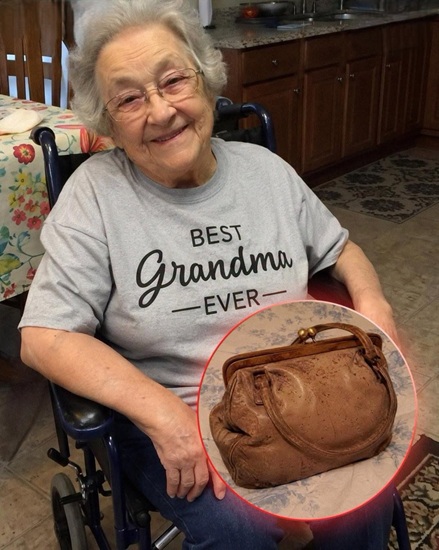
There were eleven grandchildren in our family, yet Grandma Nancy had an unusual gift for making each of us feel as though we held a special place in her heart. Whenever we visited, she remembered the smallest details about our lives. She asked about school exams, new jobs, relationships, hobbies, and problems we had mentioned months earlier. Her home was filled with family photographs and little keepsakes collected over decades. But among everything she owned, one object was treated differently from all the others: an old brown handbag kept on the highest shelf of her bedroom closet.
The handbag itself appeared completely ordinary. Its brown leather had faded, the handle showed signs of years of use, and its brass clasp was scratched and dull. Grandma owned several newer purses that looked far more valuable, but she never guarded those. The old handbag was different. Nobody was allowed to open it, move it, or examine what was inside. Even harmless questions about it could cause Grandma’s cheerful expression to become unexpectedly serious.
Her instructions never changed. “If something happens to me,” she would say, “make sure that handbag stays with me. Everything inside it goes too.” When we asked what could possibly be so important, she usually avoided giving a direct answer. Sometimes she smiled and changed the subject. Other times she simply reminded us that the contents were private. Eventually, most family members stopped asking because it was obvious that the handbag represented something deeply personal to her.
There was one incident that ensured nobody would forget the rule. Several relatives were helping Grandma reorganize her bedroom when my uncle noticed the handbag. He jokingly reached toward the shelf and announced that perhaps it was finally time to solve the family mystery. Before he could touch the handle, Grandma quickly pushed his hand away. The room became silent. Nobody had expected such a strong reaction from a woman who rarely became angry.
“I asked you not to touch it,” she told him firmly. My uncle immediately apologized and stepped away. Grandma’s mood softened soon afterward, but the message had been unmistakable. Whatever she was protecting inside that handbag was important enough that she wanted complete control over who saw it and when. From that day forward, even the most curious members of the family respected the boundary.
Naturally, that did not stop us from wondering. Over the years, different theories circulated during family gatherings. Someone suggested that Grandma might have kept old love letters inside. Another relative wondered whether there was jewelry from her younger years. Someone else jokingly imagined a hidden collection of money. None of us had evidence supporting those ideas, so they remained exactly what they were—family guesses about an object whose contents Grandma had chosen to keep private.
As the years passed, Grandma became increasingly frail. She walked more slowly and needed help with tasks she had once completed without thinking. Despite those changes, her memory remained remarkably sharp, especially when it came to her family. She could remember birthdays, anniversaries, childhood stories, and conversations from decades earlier. Every few months, she also returned to the same subject.
“Don’t forget my handbag,” she would remind me.
“I won’t, Grandma,” I always answered.
One afternoon, while we were sitting together in her living room, I finally asked the question that had followed me since childhood. “Why is that bag so important?”
Grandma looked toward the hallway leading to her bedroom. Then she turned back toward me with a small smile.
“You’ll understand when you’re supposed to understand,” she said.
It was exactly the kind of answer that created even more questions, but I decided not to push her. The handbag belonged to Grandma, and she was entitled to keep its contents private. Whatever explanation existed would have to wait until she was ready to share it.
Grandma Nancy died peacefully in her sleep at seventy-eight. Although our family knew she had become weaker, losing her still felt sudden. The following days were filled with arrangements, telephone calls, flowers, photographs, and relatives arriving to say goodbye. Memories were shared constantly. Some made us laugh, while others brought tears. With eleven grandchildren and a large extended family, there was no shortage of stories about the woman who had somehow remained connected to everyone.
On the morning of the funeral, almost every seat was occupied. Relatives were speaking quietly while the final preparations were being completed. I was standing near my mother when a thought suddenly entered my mind so clearly that everything else seemed to disappear.
The handbag.
We had forgotten it.
My stomach tightened as I remembered Grandma’s repeated request. She had reminded us for years, yet during the confusion surrounding her death, nobody had thought about it.
“We forgot Grandma’s bag,” I whispered to my mother.
She looked at me, then toward the clock. Everything was already prepared, and people were waiting. For a moment, she seemed ready to suggest that we leave things as they were. But I could not ignore a promise Grandma had taken so seriously.
“I need to get it,” I said.
There was little time to argue. I grabbed my purse, hurried outside, and drove back to Grandma’s house. The journey was short, but my mind was filled with memories of every conversation we had ever had about that mysterious handbag. For the first time, I began wondering whether Grandma had expected this exact moment.
When I entered her house, the silence immediately felt strange. During Grandma’s lifetime, there was almost always some sound—the television playing quietly, dishes being moved in the kitchen, a radio, footsteps, or her voice calling from another room. Now there was nothing.
I walked directly to her bedroom.
The closet door was partially open. I pulled a wooden chair across the floor, placed it beneath the highest shelf, and climbed onto it carefully. There it was: the same faded brown handbag that had fascinated our family for years.
I lifted it from the shelf.
It was heavier than I remembered.
For several seconds, I simply stood there holding it. I knew Grandma had specifically told us not to look inside while she was alive. But she had also told me that one day I would understand. With her final request now needing to be carried out, I wondered whether that day had finally arrived.
I sat on the edge of her bed and placed the handbag beside me. The brass clasp made a quiet clicking sound when I opened it.
My heart began beating faster.
What I saw was nothing like the dramatic possibilities our family had imagined.
There was no hidden fortune. There were no expensive diamonds, mysterious documents, or evidence of some secret life. Instead, the handbag contained several carefully arranged bundles tied with ribbon. Beneath them were envelopes, photographs, greeting cards, small drawings, folded pieces of paper, and tiny objects that initially appeared to have almost no monetary value.
I picked up the first bundle.
My name was written on it.
For a moment, I simply stared.
I carefully untied the ribbon and found a birthday card I had made for Grandma when I was a little girl. The letters were uneven, several words were misspelled, and a large crooked heart covered most of the page. I had completely forgotten creating it.
Grandma had not.
Behind the card was a school photograph of me smiling with two missing front teeth. There was a tiny ribbon from a childhood gift, an old postcard I had mailed while traveling with my parents, and a short handwritten note thanking Grandma for helping me through a difficult school assignment.
Each object brought back a memory I had not thought about in years.
Then I noticed another name.
It belonged to one of my cousins.
There were eleven bundles.
One for every grandchild.
I opened another carefully. It contained children’s drawings, a graduation announcement, several photographs, and a small handmade ornament. Another bundle held an old movie ticket beside a note explaining that Grandma and one of my cousins had gone to see the film together. There were wedding invitations, postcards, birthday messages, school pictures, hospital visitor stickers, and tiny souvenirs from ordinary family outings.
The handbag was not hiding Grandma’s secret life.
It was preserving ours.
Every grandchild had a collection.
Some contained dozens of items. Others contained only a few, but each had clearly been selected because it represented a specific memory. Grandma had saved objects most of us would have thrown away without hesitation. To her, however, they were pieces of moments she never wanted to forget.
Then I reached the bottom of the handbag.
There was one final envelope.
My name was written across the front in Grandma’s familiar handwriting.
My hands began trembling as I opened it.
Inside was a short letter explaining why she had kept the handbag private. Grandma wrote that people sometimes measured a person’s life by houses, money, jewelry, or expensive possessions. She had never seen things that way. To her, the most valuable things she owned were reminders of moments spent with the people she loved.
Suddenly, everything made sense.
Grandma had not protected the handbag because she was hiding something shameful or frightening. She had guarded it because the contents were deeply personal. They represented birthdays, childhood visits, graduations, family celebrations, ordinary afternoons, handwritten notes, and countless moments that might have seemed insignificant to everyone else.
To Grandma, they were priceless.
I could barely finish reading the letter before tears filled my eyes.
For years, our curiosity had transformed the handbag into something mysterious. We imagined that secrecy had to mean there was an extraordinary revelation inside. The reality was quieter and far more emotional.
Grandma had created a private archive of her family.
I began returning everything exactly where I had found it. Each ribbon was retied. Each photograph went back into its original bundle. I resisted the temptation to take my childhood card or photograph with me. Those things had been given to Grandma, and her final request had been clear.
The handbag was supposed to remain together.
Before closing it, I looked once more at the eleven bundles.
That was when another realization struck me.
For years, each grandchild had joked that Grandma loved them best. We had treated it as one of those harmless family competitions. But looking at the care she had given each collection, I understood why every one of us had felt special.
Grandma had paid attention.
She remembered.
She listened.
She saved evidence of moments that even we had forgotten.
I closed the handbag and held it against my chest for several seconds before leaving the bedroom. Then I hurried back to the funeral.
When I arrived, my mother immediately approached me.
“Did you find it?”
I nodded.
“And?”
I struggled to explain what I had discovered without becoming emotional again.
“It wasn’t what we thought,” I finally said. “It was us.”
My mother looked confused.
I told her about the eleven bundles, the photographs, the drawings, the cards, and Grandma’s letter. Her expression changed almost immediately. She covered her mouth with one hand and looked down at the handbag.
Other relatives eventually learned what had been inside as well. Some cried when they heard which childhood objects Grandma had preserved. Others laughed through their tears while remembering the stories connected to those items. My uncle became especially quiet when someone reminded him of the afternoon he had tried to grab the handbag from the shelf.
He had once believed Grandma was guarding a secret.
In a way, she was.
But it was not the kind any of us had imagined.
Within this fictional story, the family ultimately chose to respect Grandma’s final request. Nobody removed their personal bundle, even though many of us desperately wanted to keep the photographs and letters. Grandma had spent decades creating the collection, and separating it after her death would have gone against the meaning she had given it.
That decision was surprisingly difficult.
Before opening the handbag, those objects had seemed meaningless because we did not know they existed. After discovering them, every faded photograph and handwritten note suddenly felt priceless. Yet the value came from what Grandma had seen in them, not from physically possessing them ourselves.
In the weeks that followed, our family continued talking about the handbag.
The conversations gradually became less about the mystery and more about Grandma herself. We began remembering how carefully she had listened whenever someone spoke. We remembered the birthday cards she displayed long after the celebration ended. We remembered how reluctant she was to throw away photographs, even blurry ones.
Looking back, the truth had never been completely hidden.
We simply had not understood the clues.
The handbag also changed my understanding of why people keep seemingly insignificant objects. A ticket stub might look like trash to one person while representing an unforgettable afternoon to someone else. A badly drawn picture might have no financial value but become precious because of the child who created it. An old postcard might matter because it preserves the handwriting of someone who is no longer there.
Objects do not create those memories.
They help us return to them.
Grandma seemed to understand that better than anyone.
Her collection was not about material value. It was about relationships. Every bundle represented time spent caring about another person. That explained why she had been so protective of the handbag and why she wanted everything inside it to remain together.
There was another lesson hidden in the experience as well.
Privacy does not automatically mean wrongdoing.
For years, some relatives assumed that Grandma’s refusal to let anyone look inside the handbag meant she must have been hiding something dramatic. Yet we had no evidence for those assumptions. They were simply stories created by curiosity.
The real explanation was much more ordinary.
And much more meaningful.
Grandma had wanted one small part of her life to remain hers until the end.
Respecting that boundary had been the right thing to do.
If we had secretly opened the handbag years earlier, we might have discovered the same objects, but the experience would have carried an entirely different meaning. Instead, we waited until the moment Grandma had anticipated.
Only then did her words make sense.
“You’ll understand when you’re supposed to understand.”
I finally did.
What remained with me afterward was not the initial surprise of opening the handbag. It was the realization that some of the strongest expressions of love are incredibly quiet.
Grandma never announced that she was building a collection.
She never displayed it for visitors.
She never used it to prove how much she cared.
She simply kept adding memories.
Year after year.
Birthday after birthday.
Grandchild after grandchild.
By the end of her life, the old handbag had become a record of decades spent loving a family.
That is why the mystery surrounding Grandma Nancy’s brown handbag ultimately had such a simple answer. She had not been protecting money, jewelry, or a shocking secret. She had been protecting reminders of the people who had made her life meaningful.
The discovery also gave the family a different perspective on their own relationships. Instead of focusing only on major celebrations, they became more aware of ordinary moments. A short visit, a handwritten card, a family photograph, or an unexpected conversation could someday become a memory someone treasures.
Time has a way of changing the value of things.
What seems ordinary today may become precious years later.
Grandma apparently understood that long before the rest of us did.
And although the handbag eventually fulfilled its purpose within this fictional story, the lesson it represented remained with the family.
Love is not always preserved through expensive gifts or dramatic gestures.
Sometimes it survives in faded photographs.
Sometimes it remains in children’s drawings.
Sometimes it is hidden inside an old birthday card with misspelled words and a crooked heart.
And sometimes an ordinary brown handbag, sitting untouched on the highest shelf of a closet for years, can contain an entire family’s history.
That was the truth Grandma had protected.
And when I finally understood it, the mystery that had followed our family for years disappeared.
In its place was something far more valuable: the realization that Grandma had spent her life collecting reminders of us because, to her, we had always been the greatest treasure she owned.

