
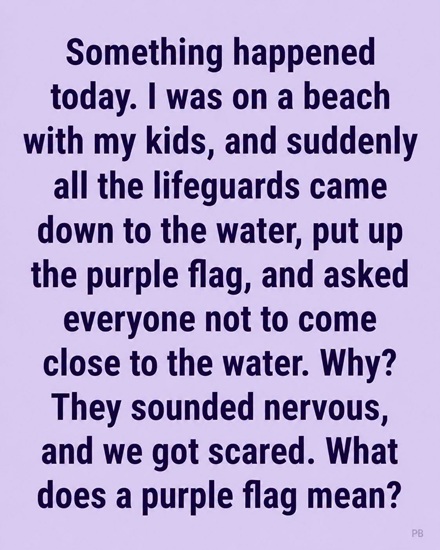
A purple flag at the beach can be easy to ignore when the sky is clear, the waves look gentle, and the shoreline appears peaceful. In some beach-warning systems, however, that purple flag means potentially dangerous marine life may be present in or near the water. Depending on the location, the concern could involve jellyfish, Portuguese man o’ war, stingrays, sea urchins, or other marine organisms capable of causing painful injuries. The warning does not necessarily mean the beach is closed or that every swimmer will be harmed.
It means conditions deserve extra attention and that visitors should check local guidance before entering the water. The safest approach is to understand the flag as a warning to become more cautious, not as a reason to panic. One of the most important things to remember is that beach flags can have different meanings depending on the country, state, municipality, or beach authority using them. A purple flag is commonly associated with dangerous or stinging marine life in some U.S. coastal systems, including parts of Florida.
That does not mean the same color carries an identical meaning on every beach around the world. Travelers should always read posted signs, speak with lifeguards, or check the official local beach-safety information before assuming what a flag means. Local instructions are more reliable than a general internet explanation. This simple step can prevent confusion and help visitors respond appropriately. Purple flags are especially useful because marine-life hazards are not always easy to see.
A swimmer can stand at the shoreline and see nothing unusual while jellyfish or other organisms are present farther out or beneath the surface. Stingrays may rest partially buried in sand, while some jellyfish can be difficult to notice in bright sunlight or moving water. A warning flag gives beachgoers information that may not be obvious simply by looking at the water. That is why dismissing the flag because the ocean “looks safe” can be a mistake. Appearance alone does not reveal every hazard in a natural environment.
Jellyfish are among the most familiar marine animals associated with painful stings. They can be carried closer to shore by currents, winds, and changing water conditions. Some species are relatively mild, while others can cause more significant pain or reactions. Even a jellyfish that has washed onto the sand may still be capable of stinging if its tentacles remain active. Detached tentacles can also sometimes cause injury. Because of that, beach visitors should avoid touching unfamiliar jellyfish or other marine organisms, even when they appear motionless.
Portuguese man o’ war are another marine organism that can create concern along some coastlines. They are often mistaken for jellyfish because of their floating appearance and long tentacles. Their stings can be extremely painful, and portions of the tentacles may be difficult to see in the water. A person does not have to deliberately touch one to be injured. If beach authorities report their presence, visitors should take the warning seriously and follow local instructions. Children should also be taught not to pick up unusual marine animals or objects they find along the shoreline.
Stingrays create a different type of risk. Many stingrays spend time in shallow, sandy areas and may partially bury themselves. They generally do not seek out people, but accidental injuries can happen if someone steps on or very near one and the animal reacts defensively. Some beaches may recommend specific ways of walking through shallow water when stingrays are present. However, those recommendations can vary according to the species and local conditions. Beachgoers should follow the advice of trained lifeguards or local authorities rather than assuming one technique is appropriate everywhere.
Sea urchins can also cause injuries when people step on their spines or touch them while exploring rocks and reefs. Their presence is another example of why marine-life warnings should be taken in context. A purple flag does not automatically identify one specific animal. It simply signals that marine organisms capable of causing injury may be present. The exact reason should be confirmed locally whenever possible. Knowing the actual hazard can help people choose the most appropriate precaution.
A purple flag may also appear at the same time as another warning flag. This is important because more than one hazard can exist at once. Marine life may be present while strong currents, rough surf, or other dangerous water conditions are also affecting the beach. Visitors should therefore look at every flag that is displayed instead of focusing only on one color. A marine-life warning does not mean currents are safe. In the same way, a calm-looking sea does not guarantee that wildlife-related hazards are absent.
Parents and caregivers should pay special attention to these warnings. Children are naturally curious and may not recognize which marine animals are dangerous to touch. They may also become distracted while playing and fail to notice changes in the water. Keeping children close and actively supervising them is important regardless of the flag color. When a marine-life warning is posted, adults should explain what it means in simple terms and make sure children understand why they should avoid unfamiliar animals. Close supervision is one of the most practical ways to reduce preventable injuries.
The first thing a visitor should do after seeing a purple flag is find out what caused it. If a lifeguard is present, ask directly. Lifeguards may know whether the concern involves jellyfish, stingrays, man o’ war, or another organism. They may also know whether the problem is concentrated in one area or affecting the entire beach. This kind of immediate, local information is far more useful than guessing. It also allows swimmers to adjust their plans without unnecessary fear.
If beach authorities recommend avoiding the water, that advice should be respected. If they say swimming is still possible with caution, visitors should follow the specific precautions provided. Sometimes the safest choice may be moving to another section of the beach. In other cases, waiting until conditions change may be more appropriate. The correct response depends on the local situation. There is no single rule that applies to every purple-flag warning.
Protective clothing can provide some additional protection in certain circumstances, but it should never be treated as a guarantee. Rash guards cover more skin than standard swimwear, and water shoes can protect the bottoms of the feet from some sharp objects or surfaces. However, they do not make a swimmer immune to jellyfish tentacles, stingray injuries, or other marine-life encounters. Protective clothing is best seen as one layer of precaution. It does not replace checking warnings or listening to lifeguards.
The same principle applies to common beach-safety advice found online. Tips such as moving carefully through shallow water can be useful in the right context, but they should not be treated as universal rules. Different animals behave differently, and coastal environments vary widely. A safety practice recommended in one region may not be relevant in another. Confirming the local hazard before acting is always more reliable than assuming every purple flag means the same thing. Context matters.
If someone is stung or injured, leaving the water and seeking appropriate help is a sensible first step. Lifeguards may be able to provide immediate assistance and help identify what caused the injury. Treatment can differ depending on the marine organism involved, so random home remedies should be avoided unless they are recommended by a reliable medical or local authority. Serious symptoms should be treated seriously. Difficulty breathing, fainting, severe swelling, chest symptoms, or rapidly worsening reactions may require urgent medical attention.
Not every sting becomes a medical emergency. Many marine-life encounters cause pain, redness, or irritation without leading to severe complications. Still, it is important not to minimize symptoms that appear serious or unusual. A person’s medical history can also affect how they respond to a sting. Children, older adults, or people with known allergies may require extra caution. When in doubt, professional medical advice is safer than relying on social-media claims.
Beach safety is also about avoiding unnecessary contact with wildlife. Marine animals are not invading a human swimming pool. People are entering a natural ecosystem where those animals already live. Most marine organisms do not actively seek out humans. Many injuries happen because a swimmer accidentally touches, steps on, or approaches an animal too closely. Giving wildlife space reduces risk and shows respect for the environment.
This perspective helps keep the warning in proportion. A purple flag does not mean the ocean has become dangerous in every possible way. It means there is a specific reason for increased caution related to marine life. The warning exists to help people make better decisions before an encounter happens. It is a preventive tool, not a symbol designed to create fear. Understanding that difference makes it easier to respond calmly.
Another common mistake is assuming that no visible jellyfish or stingrays means the warning is no longer relevant. Marine organisms can move quickly with currents, and some may be difficult to see from shore. Beach staff may have received multiple reports or observed activity in areas that are not visible from one spot. The fact that one swimmer sees nothing does not invalidate the information being provided. Flags are meant to reflect broader conditions, not just what one person can see.
Conditions can also change during the day. A beach that was calm in the morning may have different wildlife activity by the afternoon. Wind direction can shift, tides can change, and currents can move floating organisms toward or away from shore. That is why visitors should recheck the flags if they leave and return later. A warning posted in the afternoon may not have been necessary earlier in the day. Beach-safety systems work best when people pay attention to updates.
It is equally important not to spread unsupported claims online. Seeing a purple flag does not automatically mean sharks, deadly jellyfish, or any other specific animal is present. Unless local officials have identified the hazard, it is better to describe it as a dangerous-marine-life warning rather than inventing details. Social-media posts can easily transform an uncertain observation into a dramatic rumor. Sticking to verified information helps prevent unnecessary fear and misinformation.
Photographs can also be misleading when shared without context. An image showing dozens of jellyfish from another year or another coastline does not prove that identical conditions exist at the beach currently displaying a purple flag. Images should be connected to the correct location and date before being treated as evidence. General photos can help readers understand what certain organisms look like, but they should not be presented as proof of a specific current event unless they actually document it. Accuracy matters more than dramatic presentation.
For families planning a beach trip, a few habits can make a meaningful difference. Check official beach conditions before leaving when reliable information is available. Look at the flags again when you arrive. Identify the lifeguard station. Ask about any warning you do not understand. Keep children actively supervised and avoid touching unfamiliar wildlife. These steps are simple, but they reduce the chance of avoidable problems.
Strong swimmers should follow the same precautions. Swimming ability does not protect someone from a jellyfish sting, accidental contact with a stingray, or changing marine conditions. Experience in a swimming pool also does not automatically prepare someone for the ocean. Open water is dynamic and can change quickly. Respecting warning systems is useful for experienced swimmers as well as beginners.
A green or calm-looking beach should not create a false sense of security either. Open water always carries some degree of risk. Currents, waves, depth changes, weather, marine life, and fatigue can all affect safety. Warning flags provide important information, but they do not eliminate the need for judgment. The absence of a purple flag does not mean every possible marine-life risk has disappeared. Beachgoers should remain aware of their surroundings at all times.
The larger lesson is about humility rather than fear. The ocean is a natural environment that humans temporarily enter for recreation. It is not controlled in the same way as a swimming pool. Animals move through it according to natural conditions, not according to human plans. Accepting that reality makes beach warnings easier to understand. A flag is simply one way of communicating when those natural conditions deserve additional caution.
Respecting the warning does not ruin a beach day. It may simply mean swimming in a different area, staying closer to shore, waiting for conditions to change, or choosing another activity for a while. Those are small adjustments compared with the discomfort or medical concern that can follow a preventable marine-life injury. Good safety decisions often involve changing plans rather than abandoning them completely. Flexibility is part of enjoying natural environments responsibly.
The purple flag is most useful when people understand what it does and does not mean. It does not guarantee that someone will be injured. It does not necessarily mean the water is closed. It does not identify one specific animal unless local authorities provide that information. It does mean that potentially dangerous marine life may be present and that visitors should seek current local guidance. That balanced interpretation avoids both panic and carelessness.
If you see one, the best response is simple. Stop before entering the water. Look for posted information. Ask the lifeguard what has been observed. Find out whether the warning affects the entire beach or only certain areas. Then decide what to do based on the information available.
That approach is more useful than reacting to a dramatic headline. Safety warnings work best when they help people replace uncertainty with practical action. A purple flag is not there to make people afraid of the ocean. It is there to give them information they may not otherwise have. Used properly, that information can help visitors enjoy the beach with fewer unnecessary risks.
Ultimately, the message is about awareness, respect, and proportion. Notice the warning. Verify what it means locally. Follow the advice of trained beach staff. Keep children close, avoid touching unfamiliar marine life, and seek medical help when symptoms are serious. Those habits turn a simple flag into a useful part of a safer beach visit.
The sea will always contain things people cannot fully see or control. That is part of what makes it beautiful and unpredictable. A purple flag is a reminder that enjoying the ocean responsibly means paying attention to the environment rather than assuming it will always behave as expected. Respect the signal, respect the wildlife, and make decisions based on current local information. A few moments of caution can help ensure that a day at the beach ends with good memories instead of an avoidable injury.

