
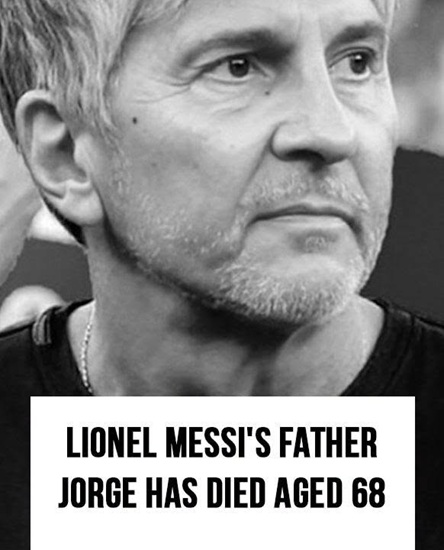
Jorge Messi, the father and longtime representative of football star Lionel Messi, has died at the age of 68 after a period of illness. He died in Rosario, Argentina, where he had been receiving medical care. News of his death prompted condolences from the football community and renewed attention on the important role he played throughout his son’s life and professional career. Newell’s Old Boys, the Rosario club closely associated with Lionel Messi’s childhood development, was among those that publicly paid tribute to Jorge following the news.
For many football supporters, Jorge was known primarily as the father and representative of one of the sport’s most accomplished players. His involvement in Lionel’s career, however, stretched back to long before international fame arrived. As Lionel’s football ability became increasingly evident during childhood in Rosario, his parents supported the decisions that eventually allowed him to pursue opportunities outside Argentina. Jorge later became closely involved in managing his son’s professional interests and remained an important figure behind the scenes for decades.
A decisive chapter for the family came when Lionel was still young and an opportunity emerged for him to continue his development in Spain. Barcelona became interested in the talented Argentine youngster, and Lionel eventually relocated from Rosario to pursue his football career. Jorge accompanied and supported his son through this major transition. Those early years were challenging for the family, but they ultimately became the foundation for a career that would take Lionel to extraordinary heights in club and international football.
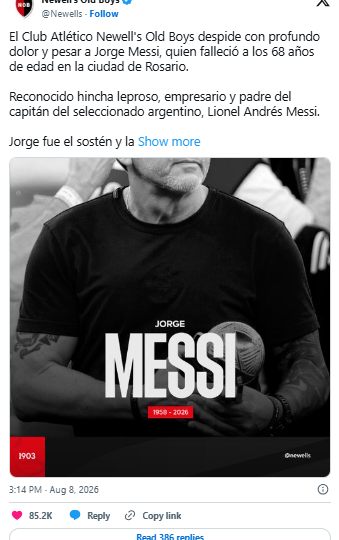
Lionel subsequently developed through Barcelona’s youth system before establishing himself in the senior team and becoming one of the defining footballers of his generation. Over the years, Jorge continued to participate in major decisions surrounding his son’s career. His responsibilities included representing Lionel’s interests and being involved in negotiations as the player moved through different stages of his professional life. Although Lionel was the public figure on the pitch, his father remained an influential presence away from the spotlight.
Newell’s Old Boys emphasized that relationship in its tribute to Jorge. The club highlighted the support that he and his wife, Celia Cuccittini, provided throughout Lionel’s journey from his earliest football experiences to the highest levels of the sport. Jorge’s contribution was largely made behind the scenes, where family guidance and professional representation became important parts of Lionel’s career. His death therefore resonated not only with people close to the family but also with football supporters familiar with Messi’s remarkable story.
Concerns About Jorge’s Health During the World Cup
Jorge’s health had become a matter of public concern during the 2026 World Cup. Lionel appeared visibly emotional during Argentina’s 3-0 victory against Algeria in June, despite the positive result for his national team. Following the match, Messi briefly explained that his emotions were connected to something outside football. He described the preceding days as difficult and complicated without immediately revealing extensive details about the personal situation affecting him.
More information emerged afterward indicating that Jorge was dealing with serious health problems and receiving medical attention. The development helped provide context for Lionel’s emotional reaction during the tournament. Rather than being connected to Argentina’s performance or circumstances on the pitch, the situation involved a deeply personal family matter. Messi largely avoided discussing his father’s condition publicly in detail, allowing the family to maintain a degree of privacy during a difficult period.
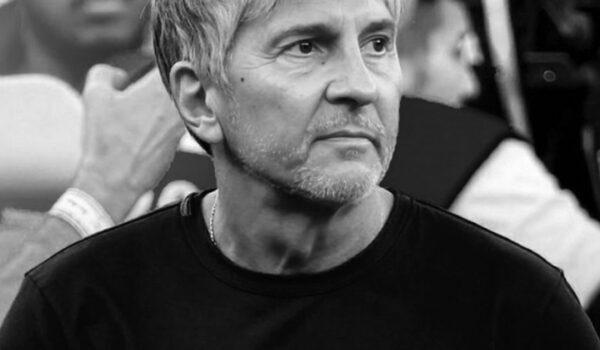
For Lionel, the circumstances meant continuing to compete internationally while dealing with concern over someone who had been closely involved in virtually every stage of his football journey. Jorge had supported his son from childhood football in Rosario through his development in Spain and the many major career decisions that followed. That history made the situation particularly personal for Messi, even as he continued fulfilling his responsibilities with Argentina during one of football’s biggest international competitions.
An Incorrect Death Announcement Weeks Earlier
Jorge’s illness had also been at the center of a significant media controversy only weeks before his actual death. During a live broadcast in June, Argentine television presenter Florencia Peña incorrectly announced that Jorge Messi had died. The information was false at the time. Because Lionel Messi is one of the world’s most recognizable athletes, the incorrect claim quickly spread beyond the original broadcast and began circulating through social media and other online platforms.
Messi’s family subsequently clarified that Jorge was alive and receiving medical treatment. The incident demonstrated the consequences that can follow when sensitive information concerning someone’s health is reported before being properly verified. In cases involving internationally known figures, inaccurate reports can travel across countries within minutes, making corrections significantly more difficult once an incorrect claim has already reached a large audience.
Peña publicly apologized following the mistake and acknowledged her responsibility for announcing the information during the broadcast. She explained that the information had reached her through the program’s production process, but nevertheless accepted that reporting it publicly had been an error. She later ended her involvement with Luzu TV. The broadcaster also addressed the incident as criticism grew over how such sensitive information had reached the air without adequate confirmation.
The fact that Jorge actually died only weeks after the erroneous announcement makes the earlier incident especially sensitive. It is important to distinguish clearly between the two events: the announcement made during the June broadcast was incorrect at the time, while Jorge’s subsequent death after his illness was separately confirmed. Keeping that distinction clear is essential when discussing the chronology, particularly because older posts containing the false report may still remain visible online.
A Father Who Remained Closely Connected to His Son’s Career
Jorge’s influence on Lionel Messi’s story extended across several decades. He witnessed his son progress from a gifted young player in Rosario to a Barcelona star and eventually an international champion with Argentina. During that transformation, Jorge continued serving as both a father and professional representative. While much of that work occurred away from cameras, his presence became familiar to people who followed the negotiations and major decisions surrounding Lionel’s career.
The relationship also illustrates how much of an elite athlete’s journey can take place outside public view. Lionel’s achievements belong to him as a player, but his family provided support throughout the difficult decisions and major transitions that accompanied his development. Moving continents at a young age, adapting to life in Europe and navigating an increasingly complex professional career were all significant experiences for the Messi family long before Lionel became a worldwide sporting icon.
As tributes continue, much of the public discussion will naturally focus on Jorge’s connection to Lionel’s extraordinary football career. Yet for the Messi family, his death is first and foremost a personal loss. Behind the trophies, records, contracts and worldwide attention was a father who had accompanied his son through an unusually long journey from childhood football to the highest level of the sport.
Jorge is survived by his wife, Celia, and their children. His public legacy will remain closely connected with Lionel Messi’s career, particularly the support and representation he provided over many years. The tributes following his death reflect that history while also recognizing that his most important role existed within his family. His passing marks the end of a significant chapter in a story that began in Rosario decades before Lionel Messi became one of the most celebrated footballers in history.

