
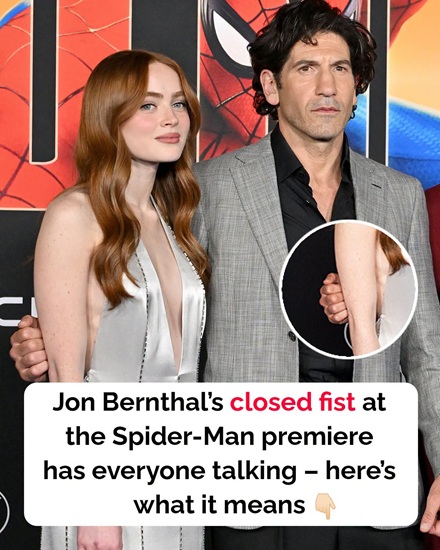
A brief moment involving Jon Bernthal and Sadie Sink at the Spider-Man: Brand New Day premiere attracted far more attention online than anyone might have expected from an ordinary red-carpet photograph. While posing together for photographers, Bernthal placed an arm around his co-star while appearing to keep his hand closed rather than resting an open palm directly against her. The positioning was subtle, but social-media users quickly noticed it and began discussing whether the gesture had been intentional.
Some viewers interpreted Bernthal’s hand position as a considerate way of maintaining physical boundaries while still posing naturally for photographers. Others thought there was no reason to attach a deeper meaning to a moment that could simply have been an ordinary pose captured by cameras. Importantly, there is no verified public explanation from Bernthal establishing exactly why his hand was positioned that way. Any specific meaning attributed to the gesture should therefore be understood as interpretation rather than confirmed fact.
The discussion nevertheless became interesting because of the contrast between Bernthal’s public image and many of the characters he has portrayed. The actor has become particularly associated with intense, physically intimidating and sometimes violent roles. Audiences know him as Frank Castle in Marvel’s The Punisher and Shane Walsh in The Walking Dead, among numerous other performances. Away from fictional roles, however, Bernthal has spoken extensively about personal responsibility, family and the difficult experiences that shaped him before his acting career became successful.

That history became part of the conversation as the premiere photograph circulated. Bernthal has never presented his younger years as especially peaceful or straightforward. In interviews, he has openly discussed getting into fights, making poor decisions and repeatedly placing himself in situations that could have produced much more serious consequences. He told The Guardian in 2022 that he had made many mistakes and had traveled down paths from which he felt fortunate to have returned.
Bernthal grew up in the Washington, D.C., area and has described himself as having been something of a “black sheep” within his family. He has spoken about being attracted to dangerous situations and testing limits when he was younger. At the same time, his accounts of that period include recognition that he had advantages many struggling young people do not have, particularly a supportive family. Looking back as an adult, Bernthal has generally discussed those experiences as mistakes and lessons rather than achievements worth celebrating.
Physical training also became an important part of his development. Bernthal spent significant time boxing and later incorporated different forms of physical preparation into his acting career. His appearance and athletic abilities eventually became useful professionally, particularly as he began receiving roles involving soldiers, police officers and other physically demanding characters. Yet acting ultimately provided something broader than a place to use those skills. Bernthal has described discovering the profession as a turning point that finally gave his considerable energy and determination a productive direction.

His path toward becoming an actor was unconventional. Bernthal attended Skidmore College before studying at the Moscow Art Theatre in Russia. After returning to the United States, he continued developing his craft and spent years working in theater and accepting smaller screen opportunities. Success was not immediate. Like many working actors, he experienced a long period in which professional opportunities were uncertain before television roles eventually brought him greater recognition.
The Walking Dead became one of the projects that significantly raised Bernthal’s profile. His portrayal of Shane Walsh presented audiences with a complicated character whose anger, fear and increasingly extreme behavior became central to the series’ early story. Bernthal later found another defining role as Frank Castle, also known as the Punisher. Castle’s grief, rage and willingness to use extreme violence made the character particularly demanding, and Bernthal’s performance became closely associated with Marvel’s screen interpretation of the antihero.
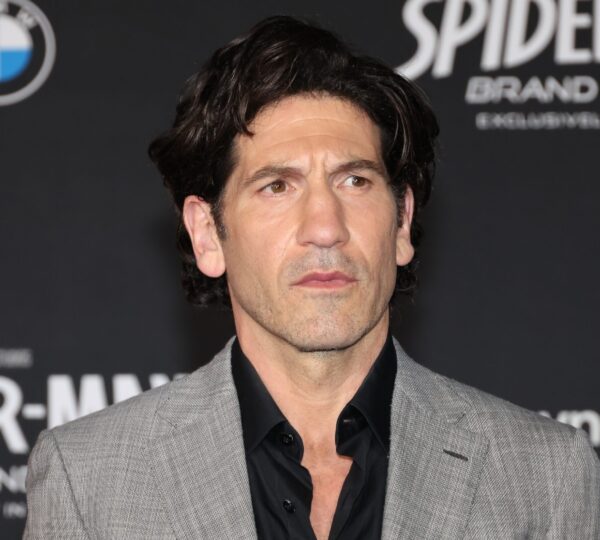
The intensity of those performances sometimes creates an understandable tendency for audiences to associate Bernthal himself with the personalities he portrays. His interviews, however, show a much more complicated distinction between performance and personal life. Bernthal has acknowledged knowing how to access anger and aggression for his work while emphasizing the importance of expressing those emotions safely. That distinction is particularly meaningful given his willingness to discuss moments from his own past when anger had real consequences.
One especially serious episode occurred in 2009, when Bernthal became involved in an altercation in California. He has discussed the incident publicly and explained how frightening its possible consequences became. According to previous reporting about his account, the situation resulted in probation and a civil case that was ultimately settled. Bernthal subsequently discussed therapy and efforts to better understand and control his anger. He has treated the incident as part of a period that forced him to reconsider how he responded to confrontation.
His personal life also changed considerably as his professional career developed. Bernthal married Erin Angle in 2010 after the couple had been together for years. Angle has worked as a trauma and ICU nurse, and Bernthal has spoken publicly about the support she provided during periods when acting offered little financial certainty. The couple have three children, and Bernthal has repeatedly described his wife and children as central to his life.
When discussing his priorities, Bernthal has often presented them in remarkably uncomplicated terms: family and work occupy most of his attention. He has also spoken humorously about continuing to make an effort in his marriage even after many years together. These comments offer a different image from the volatile characters audiences frequently see him portray. Rather than attempting to erase his past, he has publicly acknowledged that maturity required him to reconsider some of the attitudes and behaviors he carried when he was younger.
Bernthal has also discussed what he wants his children to understand about strength. In interviews and conversations about masculinity, he has rejected the idea that kindness necessarily represents weakness. His comments have instead emphasized responsibility and the ability to control aggression. Those ideas are particularly notable coming from an actor whose professional identity has been strongly connected to characters who frequently solve problems through intimidation or violence.
His interests outside traditional acting have provided another venue for those conversations. Through his podcast and interview work, Bernthal has spoken with people whose experiences involve policing, incarceration, military service and other complicated areas of American life. These discussions are generally presented as opportunities for extended conversation rather than simple judgments about the people involved. They have allowed Bernthal to explore subjects that overlap with many of the worlds depicted in his acting roles.
Against that documented background, some social-media users interpreted the photograph with Sink as another small example of self-control and consideration. A viral discussion suggested that the difference between Bernthal’s fictional characters and his real-world behavior was meaningful. Supportive commenters described the hand position as respectful and argued that avoiding unnecessary physical contact can be a considerate choice when posing with another person.
Comparisons were also made online with the so-called “hover hand,” a pose associated with celebrities who place an arm behind someone without actually touching them. Keanu Reeves has frequently been mentioned in internet discussions about this practice because photographs have shown him apparently leaving space between his hand and people posing beside him. Similar poses can be seen in photographs involving many public figures, although the motivation behind any individual example should not be assumed without confirmation from the person involved.
Not everyone considered Bernthal’s pose noteworthy. Some commenters questioned why an ordinary interaction between two professional colleagues had become the subject of extensive analysis. Others argued that if someone wanted to avoid contact completely, they could simply keep their arm at their side. A few people suggested that celebrity culture encourages audiences to search for hidden meanings in photographs that may represent nothing more than a fraction of a second.
That skepticism is worth considering. Red-carpet photographers typically capture many images very quickly, meaning a person’s hands, eyes and facial expressions can appear differently from one frame to the next. A photograph freezes an instant that might have lasted less than a second. Without an explanation from the people involved, it is difficult to determine whether a particular hand position was deliberate, habitual or completely incidental.
For that reason, the most accurate description of the viral moment is relatively simple: photographs showed Bernthal posing beside Sink while his hand appeared closed, and people online offered different interpretations of the gesture. Claims that the pose definitively demonstrates a particular belief or motivation go beyond what the photograph itself can establish. Appreciating what some viewers found positive about the image does not require presenting speculation as fact.
The discussion nevertheless brought renewed attention to Bernthal’s personal development. His own interviews provide much stronger evidence of that story than a single red-carpet photograph. He has publicly acknowledged making serious mistakes, discussed the dangers of uncontrolled anger and described acting as an outlet that helped redirect his life. He has also repeatedly emphasized the importance of his wife, children and professional responsibilities.
Bernthal’s journey is particularly striking because his greatest professional successes often depend on portraying exactly the type of uncontrolled intensity he has worked to separate from his personal life. Frank Castle and Shane Walsh can be impulsive, aggressive and dangerous. Bernthal’s job is to make those characters believable. Being able to portray that behavior convincingly, however, should not be confused with endorsing it outside a fictional story.
The red-carpet photograph with Sadie Sink ultimately offers no definitive explanation of Bernthal’s intentions. Some people will continue seeing the closed hand as a thoughtful gesture, while others will regard it as an insignificant pose that happened to be photographed at the right moment. Both reactions can exist without transforming speculation into established fact.
What is documented more clearly is Bernthal’s willingness to speak openly about how his life changed. He has described difficult periods without romanticizing them, acknowledged consequences from past behavior and credited acting, family and personal work with helping him move in a different direction. That story does not depend on interpreting one photograph.
Perhaps that is the most useful distinction to make when discussing viral celebrity moments. A photograph can start an interesting conversation, but it cannot automatically explain the intentions of the people pictured. Bernthal’s closed-fist pose may have looked meaningful to many viewers, but its precise motivation remains his own unless he chooses to explain it. His documented comments about family, responsibility, anger and personal growth provide a much firmer basis for understanding the person behind the tough characters audiences see on screen.

