

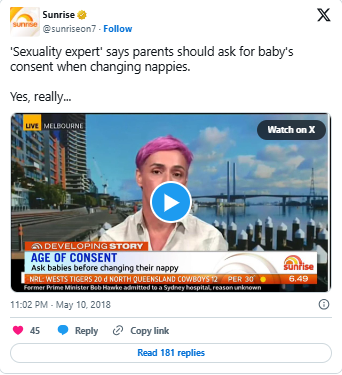
A recent discussion involving an Australian sexuality educator has sparked a widespread online debate after she suggested that parents should ask a baby for consent before changing a diaper. The idea quickly gained attention across social media platforms, where it was met with both curiosity and criticism. While some interpreted it as a progressive approach to early childhood communication, others questioned its practicality and meaning in real-life parenting situations.
The educator, Deanne Carson, has explained that her suggestion is intended to promote what she calls a “culture of consent” from the earliest stages of life. According to her perspective, the aim is not to expect a verbal response from infants, but rather to encourage parents to communicate openly about what they are doing. This may include speaking to the child during care routines and observing their non-verbal reactions.
Supporters of this approach argue that early exposure to communication and respectful interaction can help children become more aware of personal boundaries as they grow. They believe that consistently explaining actions, such as diaper changes, may contribute to building trust and emotional understanding between caregiver and child. In this view, the emphasis is placed on awareness and communication rather than literal permission.
However, the idea has also been widely challenged by critics who argue that infants are not developmentally capable of understanding or providing consent. From this perspective, basic caregiving tasks such as diaper changing are essential responsibilities that do not require approval from a child. Many believe that introducing the concept of consent in this context may lead to confusion about parental duties and child development.

As the topic spread online, it quickly became a subject of heated discussion. Social media users shared a variety of reactions, ranging from confusion and humor to strong disagreement. Some questioned whether similar logic would apply to other caregiving situations, including everyday responsibilities involving young children or even pets. These comparisons contributed to the viral nature of the debate.
At the same time, others defended the broader intention behind the idea, even if they disagreed with its wording or framing. Supporters suggested that speaking to infants during daily routines can still be beneficial, as it encourages interaction and helps build early communication patterns. They emphasized that babies respond to tone, attention, and routine, even if they cannot understand language in a formal sense.
Experts in early childhood development often highlight the importance of responsive caregiving. This includes noticing a baby’s cues, such as crying, movement, or facial expressions, and responding appropriately. In this context, talking to infants during care activities is generally considered positive, as it supports bonding and emotional development. However, professionals typically distinguish between communication and the concept of consent.
Critics of the proposal argue that applying adult frameworks like consent to infant care may not accurately reflect developmental realities. They emphasize that infants rely entirely on caregivers for their needs, including hygiene, feeding, and safety. From this viewpoint, essential care routines are not optional actions but necessary responsibilities that ensure a child’s well-being.
The debate has also highlighted how differently people interpret parenting philosophies. For some, the suggestion represents an effort to encourage respectful communication and awareness from an early age. For others, it appears to be an unnecessary complication of routine childcare practices. These contrasting views reflect broader differences in how people approach parenting and child development.
Another important aspect of the discussion is the role of language and interpretation. Because the idea was presented in a symbolic or conceptual way, it allowed for multiple readings. Some viewed it as a metaphor for respectful engagement, while others interpreted it more literally, leading to disagreement and misunderstanding.
Despite the controversy, many participants in the discussion agree on certain core principles. Most acknowledge that children benefit from attentive, responsive, and emotionally aware caregiving. Even those who disagree with the specific framing often support the idea of speaking to children, explaining actions, and maintaining a calm and respectful environment.
The situation also reflects a broader trend in modern parenting discussions, where psychological concepts and communication theories are increasingly applied to everyday childcare practices. While this has introduced new ways of thinking about child development, it has also led to debates about where practical caregiving ends and theoretical approaches begin.
Ultimately, the conversation surrounding this topic is less about a specific instruction and more about differing perspectives on parenting philosophy. It demonstrates how ideas about communication, respect, and child development can be interpreted in very different ways depending on personal beliefs and experiences.
In conclusion, the debate over asking for consent during diaper changes has become a reflection of wider discussions about parenting styles and early childhood communication. While opinions remain divided, it has encouraged ongoing dialogue about how caregivers can best support healthy emotional development while balancing practical daily responsibilities.

