
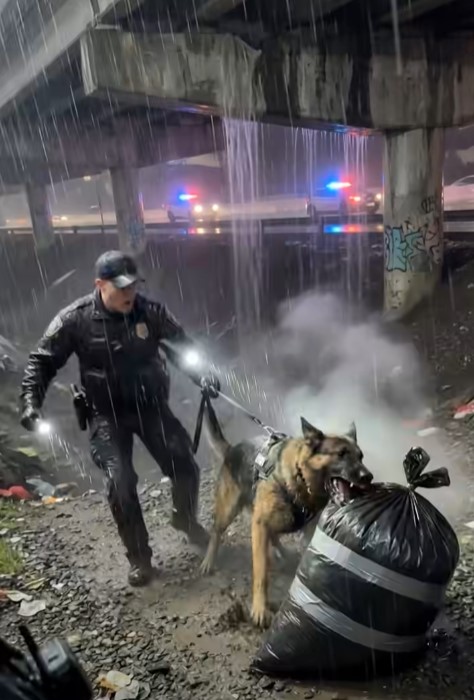
Officer Jack Vance had spent most of his career working night patrols in and around Everett, Washington, where long stretches of highway, dense forest edges, and unpredictable weather made every shift feel slightly uncertain. Over the years, he had grown accustomed to the quiet tension of nighttime duty—the hum of passing cars, the glow of distant streetlights, and the occasional radio call breaking the silence. His constant companion through it all was his K9 partner.
Bear, a highly trained German Shepherd known within the department for his discipline, intelligence, and unusually calm temperament in high-pressure situations. Bear was not the type of police dog that reacted impulsively. He had been trained for controlled detection work, tracking, and support during patrol operations. Because of his steady behavior, Jack trusted him completely, often relying on subtle signals rather than loud reactions. That trust was built over years of working together, responding to incidents ranging from missing persons cases to traffic stops that escalated unexpectedly.
On most nights, their patrols passed without incident, but Jack had learned that Bear’s instincts were rarely wrong when he did react. On one particular Tuesday night, the weather over Everett was cold and damp, with steady rain falling across the roads and forested areas near Miller Creek Bridge. Visibility was limited, and the roads were mostly empty, creating an atmosphere of isolation that was typical for late shifts in that region. Jack was completing a routine patrol route when he noticed a sudden change in Bear’s behavior inside the patrol SUV. At first, it was subtle—slight restlessness, shifting weight, and low whining that did not match his usual calm state.
Within minutes, Bear’s behavior escalated. He began scratching at the divider between the front and rear compartments of the vehicle, pacing in a confined space, and focusing intensely toward the direction of the nearby wooded area. Jack initially assumed the dog might have picked up the scent of wildlife, which was common in rural patrol zones. However, when Bear began barking sharply and persistently toward the tree line, Jack realized this was not a routine reaction. The dog’s intensity suggested something far more significant.
The situation escalated further when Bear physically pushed against the interior barrier, then grabbed onto Jack’s sleeve as soon as the officer opened the door. It was not aggression—it was urgency. Bear was attempting to guide him out of the vehicle. Recognizing the seriousness of the behavior, Jack activated his flashlight, secured his equipment, and followed the dog into the rain-soaked terrain. The mud made each step heavier as they moved away from the road and into the dense brush surrounding Miller Creek Bridge.
As they advanced deeper into the wooded area, Bear remained focused and determined, pulling ahead with increasing urgency. The environment grew quieter the farther they went, until only the sound of rain and distant traffic remained. After roughly a quarter mile, they reached the underside of the old bridge, a location known for being isolated and largely unused at night. There, tucked beneath broken debris, scattered wood, and discarded trash, Bear suddenly stopped.
The K9 fixated on a large black contractor bag partially hidden near the base of the bridge structure. His posture changed instantly—alert, rigid, and focused. He began whining softly and pawing at the object, signaling that whatever was inside required immediate attention. Jack approached cautiously, scanning the area with his flashlight, aware that such discoveries could range from illegal dumping to something far more serious. As he knelt beside the bag, he noticed faint movement from within.
Carefully, Jack cut through the sealed plastic, expecting the worst. Instead, what he found caused him to freeze. Inside the bag was a newborn baby girl, wrapped in a damp and poorly secured blanket. The infant was weak, cold, and barely responsive, showing signs of distress from exposure. Without hesitation, Jack lifted the child into his arms, immediately requesting emergency medical assistance over his radio while attempting to keep her warm under his jacket.
Bear stayed close, circling the area and maintaining alert posture, as if ensuring no additional threats were nearby. While Jack focused on the infant, something small fell from the folds of the blanket onto the wet concrete. It was a silver heart-shaped locket. When Jack picked it up and saw the visible scratch across its surface, he felt a sudden emotional shock that stopped him in place. The locket was identical to one that had belonged to his daughter, Lily, who had disappeared years earlier under unresolved circumstances.
The discovery immediately transformed the situation from a rescue operation into something deeply personal and emotionally overwhelming. Lily’s disappearance had occurred three years earlier and had remained unsolved despite extensive investigation efforts. Jack and his former wife Sarah had lived through years of uncertainty, grief, and unanswered questions. Seeing the locket again brought those memories rushing back with intense force, raising immediate questions about how it had ended up at this location.
As paramedics arrived and took the infant for emergency treatment, Jack remained focused on the implications of the discovery. The coincidence was too significant to ignore. The presence of the locket raised troubling questions about whether there was a connection between the abandoned baby and his daughter’s disappearance. At the same time, Bear’s behavior suggested that the dog may have sensed something unusual long before the visual discovery was made.
In the days that followed, Jack began reviewing old case files, reopening aspects of the investigation that had long gone cold. What he uncovered suggested links to broader criminal activity that had not been fully resolved during the original investigation years earlier. There were references to organized operations, missing evidence, and warnings that had not been properly followed up at the time. The deeper he looked, the more complex and dangerous the situation appeared.
At the same time, unusual events began occurring around him. Strange notifications appeared in systems he accessed, and Bear occasionally reacted to stimuli that had no clear source. These inconsistencies suggested that the situation might not be isolated and that external involvement could still be ongoing. Trust within his professional environment began to feel uncertain as Jack questioned who had access to information about the original case.
As pressure increased, Jack found himself drawn toward a final location tied to unresolved activity—a deteriorating waterfront structure that had once served as a recreational area but had since been abandoned. There, in an environment filled with rusted equipment and decaying infrastructure, he encountered the final confrontation tied to the long-standing mystery surrounding his daughter’s disappearance.
Bear played a critical role during this final phase, remaining focused and responsive throughout the situation. His training and instincts helped Jack navigate dangerous conditions and identify critical details that would otherwise have been missed. The resolution of the case ultimately led to answers that had remained hidden for years, bringing closure to one of the most painful chapters of Jack’s life.
In the aftermath, the discovery of Lily and the resolution of the investigation changed everything for Jack and his family. The emotional impact of reuniting after years of uncertainty marked a turning point in their lives. Jack eventually stepped away from active duty, choosing a quieter life with Sarah, Lily, and Bear in a calmer environment away from the pressures of law enforcement.
Although the events of that night remained permanently imprinted in his memory, Jack often reflected on how differently things might have turned out without Bear’s instinctive reaction under the bridge. What began as a routine patrol had become the moment that altered the entire course of his life, highlighting the unpredictable nature of police work and the extraordinary role that K9 partners can play in critical situations.
In the end, the silence that once represented uncertainty and loss gradually transformed into something more peaceful. For Jack, that peace came not from forgetting the past, but from finally understanding it—and from the loyal partner who never stopped sensing what others could not see.

