
For a long time, I believed being a good neighbor meant helping whenever I could. If someone next door needed a ladder for an afternoon, a cooler for a family gathering, or something from my kitchen, I rarely saw a reason to refuse. Denise had lived beside us for six years, and our families had always been friendly. Our children had spent time together when they were younger, and whenever one of us traveled, the other would sometimes keep an eye on the house or water the plants.
Because of that history, lending her something always seemed like a small favor between people who knew each other well. Over time, however, I began noticing a pattern. Denise borrowed things regularly, but returning them with the same amount of care was another matter. My ladder once came back with mud dried around the bottom. A roasting pan returned with a new dent near the corner. A cooler that had been perfectly clean when it left my garage came back smelling strongly of fruit punch.
Several kitchen items were returned later than promised, and once or twice I had to ask where a missing lid had gone. None of these incidents seemed serious enough on their own to justify a confrontation, so I kept letting them go. Whenever I mentioned something, Denise always seemed to have an explanation ready. She would say she had planned to clean it but became busy, or that a scratch might have already been there, or that one of the children must have misplaced something.
Most of the time, I accepted the explanation even when I was not completely convinced. The truth was that I disliked uncomfortable conversations more than I disliked cleaning a muddy ladder or scrubbing someone else’s dried food from a dish. Saying yes seemed easier than creating tension with the person living only a few yards away. Eventually, that habit of avoiding conflict led me to lend Denise something I never really wanted anyone else using.
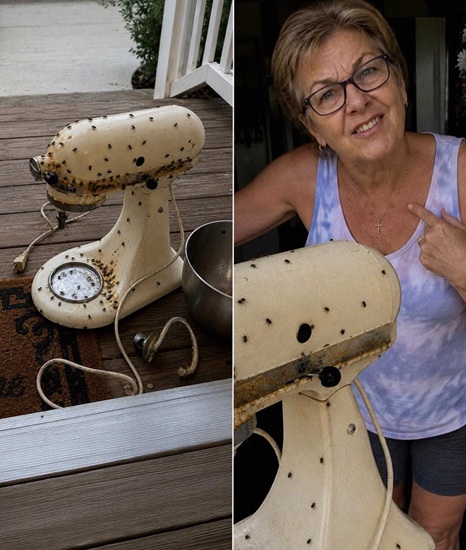
One afternoon, she came to my door because she needed a stand mixer for a cake. She had apparently been trying to use a hand mixer and wanted something more powerful. Before she even finished explaining, she remembered the cream-colored mixer on my kitchen counter. My reaction was immediate. I told her I would rather not lend that particular appliance because it had belonged to my mother. The mixer had been in my family for decades.
My mother bought it in 1989 and used it for countless Sunday desserts and family meals. It was not in perfect cosmetic condition. There were scratches near the bottom, and a tiny piece of enamel had chipped away years earlier when my father accidentally knocked a metal measuring cup against it. After my mother died, my sister and I divided many of the things from her kitchen. I chose the mixer because it carried memories that had little to do with its financial value.
Every time I turned that machine on, the sound reminded me of being in my parents’ kitchen. I remembered my mother measuring ingredients, checking the oven, and preparing ordinary family meals that seemed insignificant at the time but became meaningful years later. Because of that, my first answer to Denise was no. I explained why. She assured me repeatedly that she would be careful and that she needed it for only one cake. After enough persuasion, I did what I had done too many times before. I ignored my own hesitation and agreed.
I asked her to return it clean and told her again that it was important to me. Denise promised she would take care of it. A few days later, on Saturday morning, I opened my door and found the mixer sitting on the porch beside the mat. Denise had not knocked or handed it back to me. It had simply been left outside. Before I even carried it into the house, I could see dried ingredients around the machine.
There was hardened cream trapped along one of the seams, something sticky had dried onto part of the cord, and the attachment inside the bowl was still coated with old icing. My daughter Sophie followed me into the kitchen and immediately noticed the mess. I tried not to become angry. Instead, I cleaned everything carefully. It took much longer than it should have because some of the dried mixture had worked its way into narrow areas around the mixer head.
Once the machine was finally clean, I plugged it in. The moment I moved the switch, I knew something was wrong. Instead of the smooth mechanical sound I had heard for years, the mixer produced a low grinding noise. The head moved suddenly, hesitated, and then stopped. I turned it off immediately. After waiting for a moment, I tried one more time. The same thing happened.
Sophie was standing nearby when she asked whether her grandmother’s mixer was broken. Hearing her describe it that way made the situation feel even worse. I unplugged the machine and walked next door to speak with Denise. At that point, I still expected a relatively simple conversation. I imagined that she would tell me something had gone wrong, apologize for leaving it dirty, and explain exactly what had happened.
Instead, she seemed almost irritated that I had come over. When I told her the mixer was no longer working properly, she said it had started making a strange noise while she was preparing frosting. According to her, it eventually stopped turning. I asked whether she had turned it off when the unusual noise began. Her response suggested that she had continued because she had guests waiting and wanted to finish what she was making.
Then the conversation became even more frustrating. Denise pointed out repeatedly that the mixer was more than thirty years old. She said appliances did not last forever and suggested that I should simply buy a modern replacement. From her perspective, the machine had apparently reached the end of its life at an inconvenient moment. From mine, it had worked normally before leaving my kitchen and returned damaged after being used despite obvious signs that something was wrong.
I went home without continuing the argument. Sophie asked what Denise had said, and I told her that Denise believed the age of the mixer was the real problem. Before deciding what to do, I wanted an expert opinion. The following Monday, I took the mixer to an appliance repair shop and explained that someone had borrowed it and that it stopped working afterward.
The technician examined the machine, opened the housing, and inspected the motor. He told me that what he saw was consistent with the motor becoming overheated while working under a heavy load and continuing to operate after it had begun struggling. He explained that an older appliance could naturally develop problems, but in his assessment this did not appear to be ordinary age-related failure alone. Once the machine began making unusual noises or straining, the safest choice would have been to switch it off.
The repair estimate came to $347. I photographed the estimate and sent it to Denise along with a short message explaining what the technician had told me. I asked her to reimburse me for the repair. Denise refused. She said she was not going to spend hundreds of dollars repairing a mixer that had been manufactured in the 1980s. She also suggested that I should see the situation as an opportunity to replace it with something newer.
That response made something very clear to me. Continuing to debate whether the mixer was old was not going to solve the real problem. The issue was responsibility. I had spent years lending things without creating any consequences when they were returned late, dirty, or damaged. Denise had become accustomed to the idea that borrowing something from me involved very little responsibility because I would eventually clean it, repair it, or ignore the problem.
I paid the repair bill myself, but I decided that my lending habits were going to change immediately. A few days later, Denise came over because she was preparing a graduation celebration for her niece. She expected a fairly large group of guests and asked to borrow my large cooler, crock pot, and two folding tables. In the past, I would have opened the garage and helped her load everything without another conversation.
This time, I walked inside and returned carrying a clipboard. On it was a simple lending agreement I had prepared. I listed the items she wanted, noted an estimated replacement value for each one, and included basic conditions. Everything had to be returned by an agreed time, cleaned and completely dry, and in the same condition in which it had been borrowed. I also required a refundable security deposit.
Under the deposit information, I included the outstanding $347 repair cost for the mixer. Denise initially laughed because she thought I was joking. When she realized I was serious, she became annoyed. She told me it was ridiculous to require paperwork after years of lending her things informally. I told her she was free to decline. No one was forcing her to borrow anything from me.
She argued that she had always returned my belongings. I reminded her that returning something eventually was not the same as returning it on time and in good condition. When she once again described the mixer as an old appliance, I told her that its age had never been the point. It had personal meaning to me, it had worked before she borrowed it, and she had returned it dirty without telling me it was damaged.
Denise finally decided she would rent what she needed instead and walked back home. I assumed the conversation was finished. On the morning of the graduation party, however, she returned to my door looking stressed. Something had gone wrong with her rental arrangement, and she still needed tables and a cooler before the guests arrived.
I did not argue with her or make fun of the situation. I simply brought out the same clipboard. The conditions had not changed because she was suddenly under pressure. After some hesitation, Denise agreed. She signed the form, provided the requested money, and borrowed the items. She later asked for an outdoor drink dispenser as well, so I added it to the agreement before handing it over.
I even helped carry the tables across the yard. My purpose had never been to sabotage her celebration or embarrass her in front of anyone. I wanted something far simpler: if she borrowed my belongings, I wanted her to have a reason to treat them carefully. For the first time, part of her own money depended on everything being returned properly.
The change was impossible to miss. On Sunday afternoon, Denise brought everything back ahead of the deadline. The cooler had been cleaned and thoroughly dried. The crock pot was spotless. The folding tables were neatly closed and appeared exactly as they had before the party. Even the drink dispenser looked unusually clean.
I inspected the items and returned the refundable portion of her deposit. The amount covering the mixer repair remained because that money had already been used to pay for damage. Denise was clearly unhappy about it, but our conversation eventually became quieter. She said she had genuinely believed the mixer had stopped working simply because it was old.
I explained that even if she had been right, there was another part of the situation that bothered me more. If she truly believed the machine had broken naturally, she still should have knocked on my door and told me. Instead, she had left an appliance she knew was no longer working on my porch with dried frosting and cream still attached to it. That was the part that made me feel as though something important to me had been treated as disposable.
For once, Denise did not immediately argue. After a moment, she admitted that she should not have returned it that way. She said she had been stressed because people were visiting and the cake had become another problem during an already busy day. Then she acknowledged that blaming me afterward had been unfair. Finally, she apologized.
The apology did not magically erase everything, but it changed the tone between us. A short time later, the repair shop called and told me the mixer was ready. When I picked it up, the technician plugged it in and switched it on. The motor ran smoothly again. The familiar steady sound filled the shop, and for a moment I felt far more emotional than I expected to feel about a kitchen appliance.
That weekend, Sophie and I used the mixer to make a simple chocolate cake similar to one my mother used to prepare. Sophie measured the flour while I handled the mixer. When the motor began turning normally, she smiled and commented that it sounded like it used to. She was right. Watching the paddle move brought back memories of my mother standing in her kitchen years earlier.
The mixer still had the same scratches and the same little chip in the enamel. Repairing the motor had not made it look new, and I did not want it to look new. Those marks were part of its history. Its importance had never come from its resale value or from how modern it looked. It mattered because of the memories connected to it.
For several months after that incident, Denise stopped asking to borrow things. Eventually, one afternoon, she came over and asked whether I still owned the pressure washer. I told her I did. After hesitating for a moment, she asked whether I still had my lending forms. I smiled and told her that I absolutely did.
She signed the agreement without another major argument. When the pressure washer came back, it was on time, clean, and ready for the next use. The difference was almost funny. Denise had always been capable of taking proper care of borrowed belongings. What had changed was that there was finally a clear expectation and a consequence attached to the responsibility.
I still believe neighbors should help one another when they reasonably can. Lending someone a tool, appliance, or table can be a kind and practical thing to do. But generosity and boundaries are not opposites. Being generous does not require pretending that repeated carelessness has no effect simply because you want to avoid an uncomfortable conversation.
For years, I had worried that refusing a request or setting conditions would make me seem unfriendly. Instead, my silence had created resentment while teaching Denise that I would tolerate almost anything. Once I established reasonable boundaries, our interactions actually became clearer. She knew exactly what I expected, and I no longer felt anxious every time she walked toward my door asking to borrow something.
The experience also reminded me that we do not get to decide what another person’s possessions should mean to them. Something that looks old, inexpensive, or replaceable to one person can hold decades of memories for someone else. Respecting borrowed property is not only about protecting an object. It is also about respecting the person who trusted you enough to place that object in your hands.
My mother’s mixer is still sitting on my kitchen counter. It still carries the marks of years of use, and it still produces the familiar sound I remember from Sunday mornings long ago. I could buy a newer machine tomorrow, but a replacement could never carry the same history. The lesson I eventually learned was simple: helping people is good, but generosity works best when it is accompanied by respect, responsibility, and boundaries.

