American political life in recent years has been marked by deep divisions that influence not only elections but also everyday public conversation across communities, media platforms, and cultural institutions. These divisions are often discussed through the lens of competing ideologies, but many analysts argue that the underlying causes are far more complex and rooted in long-term social and economic transformation.
Within this environment, public figures such as Michelle Obama are frequently referenced in discussions about unity, civic engagement, and the importance of maintaining democratic stability in moments of national tension. Her public appearances over the years have consistently highlighted themes related to empathy, shared responsibility, and the need for citizens to recognize one another’s humanity despite political disagreements.
These messages are often interpreted by commentators as calls to reduce hostility in political discourse and to focus instead on constructive participation within democratic systems. At the same time, political analysts continue to examine the broader cultural and economic conditions that shape voter behavior across the United States. One of the most widely discussed topics in this context is the rise of populist political movements, including the MAGA movement associated with former President Donald Trump.
Support for such movements is often analyzed through multiple factors, including economic dissatisfaction, cultural identity concerns, and perceptions of institutional change. Researchers and commentators frequently emphasize that voter motivations are rarely uniform, and that individuals may support a political candidate for a wide range of personal, local, and national reasons. In many cases, political allegiance is shaped by lived experience, including employment conditions, community changes, and perceived access to opportunity in a rapidly evolving economy.
This complexity makes it difficult to reduce large groups of voters to simple explanations, which is why political scientists often caution against overly generalized interpretations. At the same time, discussions about political rhetoric remain highly sensitive, especially when addressing issues such as polarization, misinformation, and public trust in democratic institutions. Public discourse in the United States has become increasingly influenced by digital media platforms, where information spreads quickly and often lacks full context or verification.
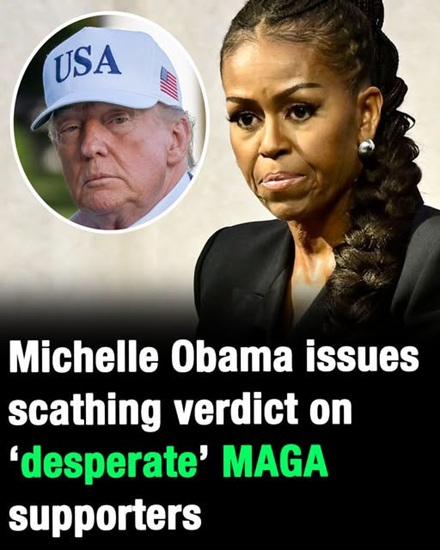
This environment can amplify emotional responses and contribute to misunderstandings about what public figures actually say or represent in their official statements. In this context, Michelle Obama is often cited symbolically in broader debates about unity versus division, even when specific claims attributed to her are not directly supported by official transcripts or documented speeches.
Her established public messaging generally focuses on encouraging civic participation, education, and respectful engagement across political differences, rather than promoting confrontation or partisan hostility. Many observers interpret her approach as part of a broader effort to encourage citizens to see beyond political labels and recognize shared national identity. However, it is important in public analysis to distinguish between interpretation and factual quotation, especially when discussing sensitive political topics involving major social movements.
Misrepresentation or exaggeration of public statements can contribute to misinformation, which in turn may deepen existing divisions rather than encourage constructive dialogue. Political analysts often argue that the increasing polarization in American society is not caused by a single factor but is instead the result of overlapping economic, cultural, and technological developments. Economic inequality, shifting labor markets, and regional disparities are frequently cited as structural influences that shape political attitudes over time.
Cultural change, including evolving norms around identity, media consumption, and public discourse, also plays a significant role in how individuals interpret political events. Together, these factors create a complex environment in which political messaging can be interpreted in multiple and sometimes conflicting ways. Within this framework, calls for unity and mutual understanding are often emphasized as necessary components of maintaining democratic stability.
Civic leaders and commentators frequently highlight the importance of dialogue that does not dehumanize political opponents, even in moments of strong disagreement. This perspective does not eliminate ideological differences but instead encourages a shared baseline of respect that allows democratic debate to continue constructively. Michelle Obama’s public legacy is often associated with this type of civic messaging, particularly in relation to encouraging young people and communities to remain engaged in democratic processes.
Her influence is commonly discussed in terms of cultural impact rather than specific political policy positions, reflecting her role as a public figure and former First Lady. In broader societal discussions, her name is often used as part of conversations about empathy, national unity, and the responsibilities of citizenship in a divided political climate. These discussions tend to reflect wider concerns about how democratic societies can maintain cohesion while still allowing for robust disagreement and political competition.
As polarization continues to shape public debate, many analysts stress the importance of accurate representation of public statements and careful distinction between fact and interpretation. This approach helps ensure that public discourse remains grounded in verified information rather than assumptions or politically charged narratives. Ultimately, the broader issue highlighted by these discussions is the challenge of sustaining democratic unity in a society characterized by rapid change and increasing ideological separation.
Addressing this challenge requires not only political leadership but also civic awareness, media responsibility, and a willingness among citizens to engage with differing perspectives. In conclusion, conversations that reference Michelle Obama in the context of American political divisions are best understood as part of a wider analysis of democracy, social cohesion, and voter behavior rather than as literal or verified quotations.
The ongoing debate reflects a society attempting to balance disagreement with unity, while navigating the pressures of economic uncertainty, cultural transformation, and technological change. As these dynamics continue to evolve, the importance of factual accuracy, respectful dialogue, and critical thinking becomes even more central to maintaining a stable and informed public sphere.
