
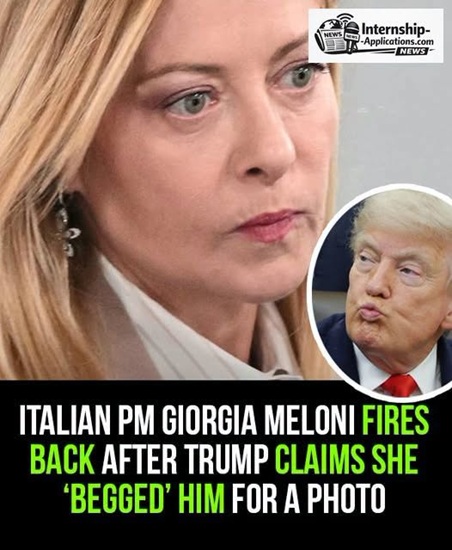
A recent exchange involving former U.S. President Donald Trump and Italian Prime Minister Giorgia Meloni has attracted widespread international attention, prompting discussion across political and media circles in both countries. What initially appeared to be a brief remark related to a photograph quickly developed into a broader diplomatic discussion, highlighting how fast public statements can influence international perception. The situation began after comments made by Trump during an interview with La7, in which he referred to a photograph taken with Meloni.
His remarks included a specific interpretation of how the interaction occurred, suggesting that Meloni had shown interest in the photo opportunity. These comments were rapidly circulated online and in news coverage, leading to immediate debate over their accuracy. Shortly after, Prime Minister Giorgia Meloni responded publicly. She addressed the claims through social media, firmly rejecting the version of events described in the interview.
Her response made clear that she did not agree with the statements and considered them inaccurate. The quick reaction indicated that she viewed the matter as significant enough to correct publicly. Meloni’s statement quickly gained attention in Italy, where it became a subject of political and public discussion. In her response, she emphasized disagreement with the portrayal of events and rejected any implication that Italy or its leadership would need to act in such a manner. Many interpreted her message as a defense of national dignity and diplomatic respect.
Following her response, Italy’s Foreign Minister Antonio Tajani also commented on the situation. His involvement added further importance to the issue, as he expressed concern regarding the remarks and their broader implications. Reports indicated that he adjusted or canceled planned diplomatic travel to the United States, signaling that Italian officials viewed the matter seriously.
This development elevated the situation from a personal exchange into a diplomatic issue with wider implications. Observers noted that public disagreements between leaders of allied countries are relatively uncommon and can create additional strain on already complex international relations.
The incident also comes against the backdrop of a relationship that has experienced multiple points of disagreement in recent months. Despite shared political similarities in some areas, differences have emerged regarding foreign policy, international security, and strategic decision-making. These disagreements have contributed to periodic tension between the two sides.
One earlier point of friction involved military cooperation and the use of strategic facilities in Europe. Disputes regarding access to a military air base in Sicily were reported as a key example of differing perspectives between the United States and Italy. These issues generated public discussion and added to growing attention on the state of the relationship.
In addition to security matters, broader geopolitical differences have also played a role. While disagreements between allied nations are not unusual, the public nature of recent exchanges has increased scrutiny. Analysts often note that when diplomatic disagreements are expressed publicly, they tend to gain greater political and media impact.
Another contributing factor has been the increasingly direct style of political communication. Statements shared through interviews, social media, and public appearances can quickly reach global audiences, sometimes amplifying tensions or misunderstandings. This dynamic has made modern diplomacy more visible and, at times, more sensitive.
Public reaction to the latest exchange has varied, particularly in Italy. Some individuals viewed Meloni’s response as a strong defense of national respect and international standing. Others saw the situation as an example of how quickly political remarks can escalate once they enter the public sphere.
Political commentators have pointed out that modern diplomatic relationships are shaped not only by policy but also by communication style and public perception. In today’s media environment, statements made by high-profile leaders can influence public opinion and international discourse almost instantly.
Despite occasional disagreements, the United States and Italy continue to maintain strong economic, security, and diplomatic ties. These long-standing relationships provide a stable foundation for cooperation, even when political differences arise at the leadership level.
However, repeated public disputes can complicate communication between governments. When disagreements become highly visible, they may influence diplomatic tone and create additional pressure on both sides to respond publicly rather than privately.
The current situation is therefore being viewed by analysts as part of a broader pattern of evolving political interaction. While individual incidents may be isolated, together they reflect the growing influence of media and public messaging on diplomatic relations.
Looking ahead, observers suggest that the future tone of relations will depend on how both sides manage communication and resolve disagreements. Diplomatic partnerships often go through periods of tension followed by stabilization, and it remains possible that relations could return to a more cooperative tone over time.
At the same time, the speed at which information spreads today means that even small incidents can quickly gain symbolic importance. The photograph-related controversy illustrates how modern political narratives can expand beyond their original context and become broader discussions about respect and diplomacy.
In conclusion, the exchange between Donald Trump and Giorgia Meloni highlights the intersection of politics, media, and international relations in the modern era. What began as a comment about a photograph evolved into a wider discussion about communication, perception, and diplomatic sensitivity.
While the immediate controversy may eventually fade, it has already contributed to ongoing conversations about how public statements by political leaders can influence international relationships and shape global perception.

