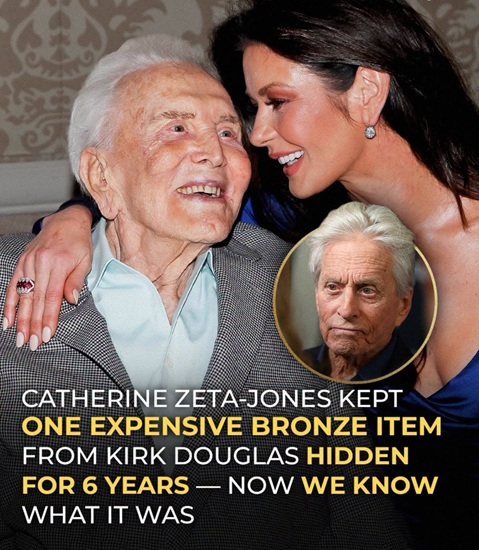
When Kirk Douglas died at 103, he left behind far more than the films that had made him one of Hollywood’s most recognizable stars.
There were awards from a career stretching across generations.
There was valuable art.
There were sculptures, personal belongings and memorabilia collected during decades spent with his wife, Anne Douglas.
Some objects represented Hollywood history.
Others represented national recognition.
And when details from the family’s trust were reported in August 2026, it became possible to see where many of those pieces were intended to go.
Michael Douglas received important artwork.
Joel Douglas was left one of his father’s most recognizable Hollywood honors.
Grandchildren received awards and other personal pieces.
But Catherine Zeta-Jones was assigned something noticeably different.
It was not an Oscar.
It was not a presidential honor.
Its significance was much quieter.
And its title made it especially difficult to overlook.
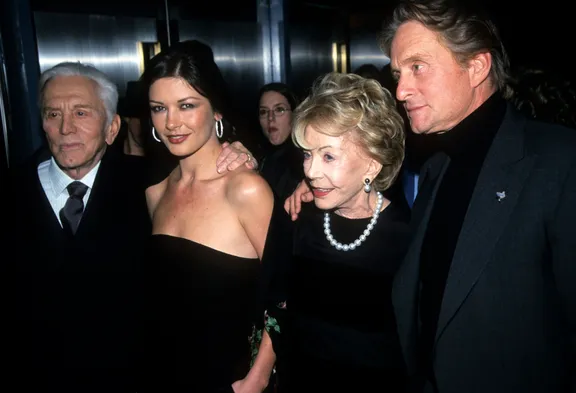
Kirk Douglas Lived More Than a Century
Kirk Douglas died on February 5, 2020.
He was 103.
Born Issur Danielovitch in 1916, Douglas rose from an impoverished childhood to become one of the defining actors of Hollywood’s postwar era.
His filmography included Champion, The Bad and the Beautiful, Lust for Life, Paths of Glory and Spartacus.
He received three Academy Award nominations for Best Actor.
He became a producer.
He wrote books.
He participated in philanthropy.
And his decision to publicly credit screenwriter Dalton Trumbo on Spartacus became part of the history surrounding Hollywood’s blacklist.
But his personal life extended far beyond filmmaking.
In 1954, he married Anne Buydens.
Their marriage lasted until Kirk’s death, more than 65 years later.
Anne died in 2021.
She was 102.
Together, they had accumulated an extraordinary collection of belongings.
Years later, details about where some of those possessions went became public.
The Estate Contained Much More Than Movie Memorabilia
A Hollywood career as long as Kirk’s naturally generated an enormous archive.
There were professional awards.
There were personal keepsakes.
There was artwork collected by Kirk and Anne.
There were sculptures displayed around their property.
There were objects associated with their marriage and family.
Some were financially valuable.
Others carried a kind of value that cannot be measured by an auction estimate.
The trust documents reported in 2026 showed that different family members were designated to receive different parts of that history.
And the choices were remarkably varied.
Michael Douglas Received Works of Art
Michael Douglas inherited several sculptures.
The group reportedly included a rectangular wooden piece and multiple outdoor sculptures.
Among the works described in the documents were a tall bronze female figure, a smaller sculpture depicting a young girl with braids and another work featuring two children.
But one artist’s name stood out immediately.
Marc Chagall.
Michael was designated to receive 19 lithographs from Chagall’s Bible Series.
The series draws inspiration from biblical narratives and forms part of Chagall’s extensive engagement with religious imagery.
For Michael, the works represented more than the name of an internationally celebrated artist.
They had also belonged to his father and stepmother.
That family history cannot be separated from their artistic value.
But one item many people might have expected Michael to inherit went to his brother instead.
Kirk’s Oscar Went to Joel
Kirk Douglas never received a competitive Academy Award despite being nominated three times for Best Actor.
In 1996, however, the Academy presented him with an honorary Oscar.
The award recognized his extraordinary contribution to cinema across roughly half a century.
It became one of the most visible symbols of his career.
According to the reported trust documents, that Oscar went to Joel Douglas.
Joel was also designated to receive paintings and a three-dimensional miniature featuring Kirk and Anne.
The combination preserved both sides of Kirk’s life.
One object represented the movie star.
Another represented the couple.
Peter Douglas also received paintings from the collection.
But the three surviving sons were given another opportunity as well.
The Brothers Could Select Additional Memorabilia
Michael, Joel and Peter were reportedly allowed to select up to $100,000 worth of memorabilia each.
That created a different kind of inheritance.
Rather than simply receiving an object chosen in advance, they could make selections from material associated with their parents’ lives.
For Michael, that could mean something different than it did for Joel or Peter.
Each son had his own relationship with Kirk and Anne.
Each had his own memories.
And the object with the greatest emotional importance would not necessarily be the one with the highest financial value.
That theme continued elsewhere in the estate.
Anne Remembered People Outside the Immediate Family
After Anne’s death, members of the household staff were reportedly given an opportunity to select belongings from her closets and drawers.
Compared with an Oscar or a Chagall lithograph, that provision might initially sound small.
But personal belongings work differently.
An item does not need to be famous to carry a memory.
For someone who had worked closely with Anne, an ordinary possession could preserve a connection to her.
The arrangement extended the estate beyond conventional inheritance.
People who had been part of the couple’s everyday life were remembered too.
Meanwhile, several of Kirk’s grandchildren were receiving pieces connected directly to his public achievements.
Cameron Received a Presidential Honor
Michael’s son Cameron Douglas was designated to receive Kirk’s Presidential Medal of Freedom.
President Jimmy Carter presented the honor to Douglas in 1981.
It represented a form of recognition extending beyond the movie industry.
Another grandson received Kirk’s 1983 Jefferson Award.
Additional honors went to other grandchildren.
Jewelry was also distributed within the family.
Piece by piece, different chapters of Kirk and Anne’s lives were moving into the hands of another generation.
There was art.
There were awards.
There was jewelry.
There was memorabilia.
Then came Catherine Zeta-Jones.
Her inheritance belonged to a different category.
Catherine Was Given a Sculpture
Catherine was designated to receive a bronze sculpture by artist John Kennedy.
Its title was The Friendship Bench.
That name immediately separated it from the other high-profile objects.
An Oscar represents professional achievement.
A Presidential Medal of Freedom represents public recognition.
The Friendship Bench suggests something else entirely.
Connection.
But the title alone does not tell the whole story.
The artist who created it had a distinctive way of expressing relationships.
John Kennedy’s Figures Communicated Without Detailed Faces
Kennedy became known for elongated bronze human forms.
His figures were elegant and unusually slender.
Detailed facial features were often unnecessary.
Instead, Kennedy communicated emotion through posture.
Two people leaning toward one another.
A head angled gently.
Figures placed close together.
A hand.
A shoulder.
The space between two bodies.
Those choices allowed viewers to interpret affection and companionship without needing elaborate expressions.
The Friendship Bench uses that same visual language.
The work depicts elongated figures seated together.
Its title provides the emotional framework.
But another detail makes Catherine’s inheritance more interesting.
Kirk collected Kennedy’s work.
Kirk Was One of Kennedy’s Collectors
Kennedy’s sculptures attracted prominent collectors during his career.
Kirk Douglas was among them.
That means the bronze Catherine was designated to receive was connected to an artist her father-in-law personally appreciated.
The sculpture also had a history outside the Douglas collection.
The Friendship Bench was included among Kennedy works associated with a public installation in Brea, California, in 1998.
Other works connected with that installation included Sympatico, Girl Reminiscing and Iron Bench.
Kennedy’s art also appeared in other prominent public settings.
But before he became known for sculpture, his life had taken several unexpected turns.
Kennedy’s Career Did Not Begin in an Art Studio
John Kennedy was born in Rangoon, Burma, now Yangon, Myanmar, in 1931.
His father was Scottish.
His mother was Burmese.
His childhood included the disruption of World War II.
Experiences in Asia would later influence the proportions and visual character of his figures.
But sculpture was not his first profession.
Kennedy spent time in the British Merchant Navy.
He later moved into journalism and photography.
He worked as a photojournalist.
He established an international news and photography operation in London.
His career also crossed into entertainment and business.
Only later did sculpture become his defining artistic identity.
Eventually, his elongated bronze figures became recognizable in their own right.
And decades later, one of them would be assigned to Catherine.
Catherine Had Joined the Douglas Family in 2000
Catherine Zeta-Jones married Michael Douglas in November 2000.
By then, Kirk was already a Hollywood legend.
But Catherine’s public interactions with him rarely suggested a distant relationship with a famous father-in-law.
She called him “Pappy.”
They appeared together at family events.
She celebrated his birthdays.
And her social-media posts showed considerable affection.
One particular photograph became especially memorable.
It was taken during Kirk’s final birthday.
His 103rd Birthday Produced a Wonderful Photograph
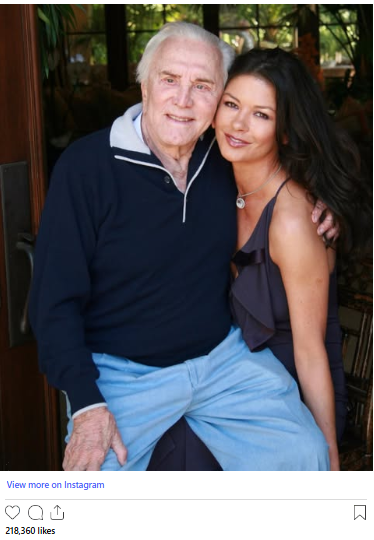
Kirk turned 103 on December 9, 2019.
Catherine shared a playful picture marking the occasion.
In it, Kirk was sitting on her lap.
The image reversed what people might normally expect from a family birthday photograph.
Here was one of Hollywood’s legendary leading men, more than a century old, happily sitting on his daughter-in-law’s knee.
Catherine affectionately called him Pappy and expressed how deeply she loved him.
At the time, it was a joyful birthday post.
Then the meaning changed.
Kirk died less than two months later.
Suddenly, the photograph represented one of the final public glimpses of their relationship.
That Memory Changes How the Sculpture Feels
Years later, the estate documents revealed that Catherine was designated to receive The Friendship Bench.
It is tempting to turn that fact into a dramatic conclusion.
Perhaps Kirk intended the sculpture as a final message.
Perhaps its title represented exactly how he thought about Catherine.
But there is a problem with making that claim.
The documents do not establish it.
There is no publicly documented explanation from Kirk saying precisely why he chose that particular work for Catherine.
So the interpretation needs to remain careful.
What can be said is more limited.
And arguably more meaningful.
The Documented Facts Already Tell Enough
Kirk collected John Kennedy’s work.
Catherine was designated to receive The Friendship Bench.
Kennedy’s sculpture focuses on human connection.
Catherine publicly demonstrated affection for Kirk and called him Pappy.
Those are documented pieces of the story.
Whether Kirk deliberately intended the sculpture’s title as a message is something only he could have explained.
There is no need to invent an answer.
The contrast with the other inheritances already makes the gift stand out.
Other Heirlooms Represented Kirk’s Public Life
Think about what went elsewhere.
An honorary Oscar.
A Presidential Medal of Freedom.
A Jefferson Award.
Chagall lithographs.
Hollywood memorabilia.
Those objects are connected with achievement.
They tell the story of Kirk Douglas the public figure.
The actor.
The producer.
The celebrity.
The nationally honored artist.
Catherine’s sculpture does not need to represent any of those things.
It sits on a bench.
Its subject is friendship.
That is a quieter legacy.
Kirk’s Family Had Already Inherited Something Larger
Physical objects were only one part of what Kirk and Anne left behind.
The couple had also become major philanthropists.
Their charitable work supported numerous causes over the years.
The Douglas Foundation became an important vehicle for their giving.
That broader philanthropic history means the estate story cannot be reduced simply to the financial value of the items given to individual relatives.
Many of the objects described in the trust were family possessions.
Their significance often came from memory rather than market price.
And that distinction becomes particularly important with artwork.
Financial Value Is Only One Measurement
A gallery can put a price on a sculpture.
An auction can determine what a collector is willing to pay.
Insurance can assign a replacement value.
But none of those numbers can calculate what an inherited object means to a family member.
If a sculpture sat in a relative’s home for years, its emotional value can exceed whatever number appears beside it in a catalog.
If the person who owned it specifically designated it for someone else, another layer is added.
That is why The Friendship Bench cannot be understood simply by asking what it is worth.
The more interesting question is what it represents.
And that answer is not entirely financial.
Catherine’s Relationship With Kirk Lasted Nearly Two Decades
By the time Kirk died, Catherine had been married to Michael for almost 20 years.
She had spent birthdays with Kirk.
She had attended family gatherings.
She had shared photographs with him.
She had publicly expressed affection for him.
The title “Pappy” itself suggested familiarity.
That relationship gives context to the sculpture.
But again, context is not proof of private intention.
The responsible way to tell the story is to preserve that distinction.
The gift can feel meaningful without pretending to know Kirk’s private thoughts.
Then the Payoff Arrives
Among all the objects listed in the estate, Catherine’s gift initially sounds less spectacular than some of the others.
Joel received Kirk’s Oscar.
Cameron received the Presidential Medal of Freedom.
Michael received 19 Chagall lithographs and several sculptures.
Other relatives received awards, artwork and jewelry.
Catherine received a bench.
Except it was not simply a bench.
It was a bronze sculpture by an artist Kirk collected.
It depicted human connection.
And it carried the title The Friendship Bench.
Suddenly, the difference becomes the interesting part.
Some Objects Celebrate What a Person Did
Kirk’s Oscar tells people he mattered to cinema.
His Presidential Medal of Freedom tells people his influence extended beyond film.
His other honors document achievements accumulated during an extraordinary life.
Those objects answer a public question.
Who was Kirk Douglas?
A major actor.
A Hollywood figure.
A philanthropist.
A man recognized at the highest levels of his profession and country.
But personal heirlooms can answer another question.
Who was he to the people around him?
That is harder to put on a trophy.
The Sculpture Speaks More Quietly
John Kennedy’s work does not need a speech.
His figures communicate through proximity.
People sit together.
They lean toward each other.
Their physical arrangement creates the emotion.
That makes The Friendship Bench an unusually gentle object within an estate containing some enormous symbols of achievement.
There is no gold statuette.
No presidential seal.
No famous Hollywood title.
Just figures sharing space.
And perhaps that is why the piece attracts attention.
The Estate Became a Map of Different Relationships
Michael received art.
Joel received the Oscar and other objects.
Peter received paintings.
Grandchildren received honors and personal possessions.
Household staff were given opportunities to select belongings associated with Anne.
Catherine received The Friendship Bench.
Each item represents a different fragment of a very long life.
Taken together, the trust does not simply distribute property.
It disperses memories.
A career goes in one direction.
Art goes in another.
Family keepsakes move elsewhere.
The collection is divided, but the history remains connected.
Kirk’s Hollywood Story Was Extraordinary
Few actors experienced a career quite like his.
He rose from poverty.
He became a major film star.
He worked with some of cinema’s most important directors.
He became closely associated with characters defined by ambition, conflict and intensity.
He survived a serious helicopter crash.
He later suffered a major stroke and worked through a difficult recovery.
He continued writing and appearing publicly into old age.
And he lived to 103.
That extraordinary public history makes the simplicity of some personal possessions even more striking.
Anne Was Part of That Story for More Than 65 Years
Kirk’s later life cannot be separated from Anne.
They married in 1954.
Their partnership lasted until his death.
They raised a family.
They collected art.
They supported charitable causes.
They built a life that continued long after the peak of old Hollywood.
When Anne died the following year, another chapter closed.
The belongings described in the trust therefore represented both of them in different ways.
Some objects were unmistakably Kirk’s.
Others reflected Anne.
Still others belonged to the shared world they created.
A Family Keeps History Differently Than a Museum
A museum might display Kirk’s Oscar under glass.
A gallery might carefully catalog the Chagall lithographs.
A historian might focus on the Medal of Freedom.
Family inheritance works differently.
A painting can hang in a son’s home.
Jewelry can be worn by a granddaughter.
A sculpture can become part of Catherine and Michael’s surroundings.
The objects continue living with people who knew the original owners.
That changes their meaning.
They are no longer simply artifacts.
They become heirlooms.
And One Heirloom Stands Apart
Catherine’s sculpture is not necessarily the most valuable item described.
It is not the most famous.
It does not represent Kirk’s biggest professional achievement.
But it has something the others do not.
A title that sounds almost conversational.
The Friendship Bench.
Placed beside Catherine’s public affection for “Pappy,” the name naturally carries emotional resonance.
It is reasonable to notice that.
It is not reasonable to claim more than the documents establish.
That distinction keeps the story both meaningful and factual.
No Invented Final Message Is Necessary
Celebrity estate stories can easily become exaggerated.
A gift becomes a secret message.
A sculpture becomes a final declaration.
A family decision becomes evidence of a hidden relationship.
None of that is necessary here.
The documented story already contains enough emotion.
Kirk Douglas owned the sculpture.
He collected Kennedy’s work.
Catherine was designated to receive this particular piece.
She had publicly shown warmth toward him for years.
And the work is called The Friendship Bench.
Those facts can stand on their own.
The Most Personal Things Are Not Always the Most Expensive
That may be the broader lesson hidden inside the estate documents.
Money can be divided mathematically.
Memories cannot.
A nationally significant award may be priceless to one relative.
A piece of jewelry may mean more to another.
An old item from a closet may matter deeply to someone who cared for Anne.
And a bronze sculpture can carry significance that has little to do with its market price.
For Catherine, the work now comes with another layer of history.
It belonged to Pappy.
One Photograph Makes the Story Hard to Forget
The 2019 birthday photograph remains particularly poignant.
Kirk was 103.
Catherine had him sitting on her knee.
The moment was playful rather than solemn.
She told him she loved him.
Nobody viewing the picture needed to know the details of a future trust.
It simply showed affection.
Then Kirk died less than two months later.
Years afterward, the estate documents revealed which sculpture had been designated for Catherine.
That does not prove the two things were deliberately connected.
But together they create a striking portrait of their relationship.
Hollywood Honors Fade Into Family Memories
Kirk Douglas will remain part of film history.
