

A widely circulated incident from New York City’s NBA championship celebrations has sparked significant online discussion after videos allegedly showed a woman involved in an unusual and controversial act during the parade. According to multiple social media posts and news-style reports, the situation quickly escalated from a viral moment into a broader conversation about workplace consequences, public behavior, and online accountability.
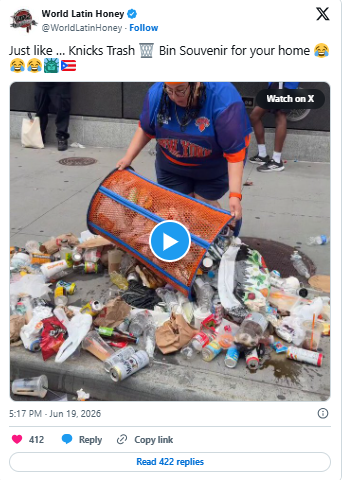
The incident reportedly took place during the Knicks’ championship parade, where large crowds gathered to celebrate the team’s success. In the midst of the festivities, a video began circulating online showing a woman interacting with a Knicks-themed city trash can in a way that quickly attracted public attention. As with many viral moments, the clip spread rapidly across social media platforms, gaining millions of views within a short period.
The Alleged Incident During the Parade
According to viral footage and online reports, the woman—identified in some media coverage as Angie Báez—was seen emptying the contents of a city trash can onto a sidewalk in Manhattan. The same reports claim that she then walked away with the trash can itself, turning what was initially a celebration scene into a widely discussed controversy.
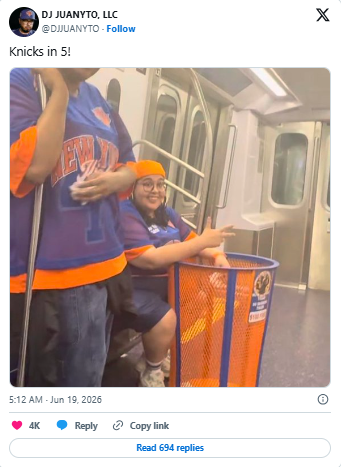
Additional images shared online allegedly showed her later transporting the trash can on public transit. These details, while widely circulated, originate primarily from social media posts and tabloid-style reporting rather than official police documentation released in full public detail.
The unusual nature of the incident contributed heavily to its viral spread. Many viewers expressed shock that such behavior occurred during a highly public, heavily monitored city event, while others questioned the accuracy or context of the footage being shared online.
Media Identification and Employment Claims
Following the viral spread of the video, several entertainment and news-style outlets reported on the identity of the individual involved. In some of these reports, the woman was identified as a corporate employee working in a senior role within a financial institution.
One widely circulated claim suggested that she held a position connected to community engagement and consumer-focused initiatives. Other reports linked her to previous roles in marketing and diversity-related programs within media or lifestyle organizations. However, it is important to note that such employment details come from media reporting and public online profiles, and should be treated as unverified unless confirmed directly by the employer or official records.
In similar viral cases, online identity attribution can sometimes be incomplete or misinterpreted, especially when based on social media matching rather than formal confirmation.
Reported Workplace Consequences
As the story continued to spread online, several outlets claimed that the individual’s employer responded to the situation. According to these reports, the company allegedly stated that the employee was no longer working there following the incident.
However, corporate statements in viral situations are often brief and carefully worded, and full context is not always publicly disclosed. As a result, the exact circumstances surrounding employment decisions are not always independently verifiable at the time of reporting.
Online discussions quickly focused on the broader implications of personal behavior in public spaces and how viral content can affect professional reputations. Many commentators noted that incidents captured on video can escalate rapidly, often leading to real-world consequences before all details are fully understood.
City Response and Official Comments
According to statements attributed to the New York City Department of Sanitation, dumping trash onto public streets and removing city property is considered illegal and inappropriate behavior. In remarks shared through media coverage, officials emphasized that such actions are not acceptable during public events or otherwise.
Some reports also indicated that fines were issued in relation to the incident, including penalties related to littering and interference with city operations. However, specific enforcement details may vary depending on official documentation and case processing.
The department also reportedly commented on the incident in strong language, criticizing the behavior as irresponsible and unnecessary, especially given the public nature of the event.
Social Media Reaction and Public Debate
As with many viral incidents, public reaction online was immediate and divided. Social media users shared a wide range of opinions, with some expressing criticism of the behavior and others questioning the severity of the response.
Some commenters focused on the professional consequences reported in the media, arguing that public actions captured on video can have long-term impacts on employment and reputation. Others used humor or sarcasm to react to the unusual nature of the incident, reflecting how viral content often becomes entertainment as well as discussion material.
The situation also sparked broader conversations about accountability in the digital age, where personal actions can quickly become global news through social media platforms.
Return of the Trash Can and Ongoing Attention
Reports later suggested that the Knicks-themed trash can involved in the incident was eventually returned to city authorities. According to updates shared online, the item was recovered and restored to its original location or custody.
City officials and social media accounts associated with sanitation services reportedly acknowledged the return in a lighthearted or symbolic manner, highlighting the unusual journey of the object from public use to viral fame and back again.
While the incident itself was brief, its online lifespan extended much longer due to continued sharing, commentary, and debate across platforms.
Broader Context: Viral Culture and Real-World Consequences
This incident reflects a growing pattern in which brief moments captured on video can rapidly escalate into major online discussions. In today’s digital environment, viral content can lead to widespread attention within hours, often blending entertainment, criticism, and public judgment.
Experts and commentators frequently note that social media amplification can significantly impact individuals involved in such incidents, regardless of intent or context. Once a video spreads widely, it becomes difficult to control the narrative, and outcomes can include reputational harm, job loss, or legal scrutiny.
At the same time, discussions like these highlight ongoing debates about privacy, accountability, and fairness in how viral incidents are interpreted by the public.
The reported Knicks parade trash can incident has become another example of how quickly public behavior can turn into a national talking point in the age of social media. While various reports attribute specific actions, identities, and consequences to the individuals involved, much of the information remains based on media coverage and online circulation rather than fully verified official documentation.
What remains clear is that the story has sparked widespread discussion about conduct in public spaces, workplace accountability, and the powerful role of viral media in shaping modern narratives.
As with many viral events, interpretations vary widely, and the full context may only become clearer as more verified information emerges.

