
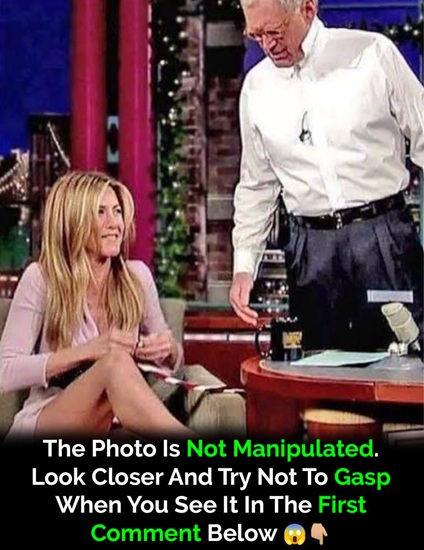
David Letterman spent decades as one of the most influential personalities in American late-night television. His interviewing style combined dry humor, unexpected questions and deliberately awkward exchanges that frequently produced memorable television. Many celebrities appeared on his programs repeatedly, including Friends star Jennifer Aniston. While numerous conversations were treated as ordinary entertainment when they originally aired, several moments involving Aniston have attracted renewed attention years later as old television clips have circulated online.
One frequently discussed appearance occurred in 2006, when Aniston visited The Late Show with David Letterman while promoting The Break-Up. The romantic comedy starred Aniston alongside Vince Vaughn and followed a couple attempting to navigate an increasingly complicated separation while continuing to share their Chicago condominium. The movie arrived during an especially visible period in Aniston’s career, when entertainment coverage frequently focused not only on her professional projects but also on her personal relationships.
During the interview, Letterman quickly began commenting on Aniston’s outfit and appearance. She was wearing a black ensemble that included shorts, and Letterman specifically praised her legs. What made the exchange memorable was that the subject did not disappear after one compliment. Letterman returned to Aniston’s legs several times as the interview progressed, occasionally interrupting other topics to comment on them again.
Aniston responded with laughter and attempted to keep the conversation moving. At one stage, she explained that the weather was warm and suggested that this was why she had chosen to wear shorts. Letterman nevertheless continued making complimentary remarks about her legs. The original footage documents the exchange, although interpretations of Aniston’s reactions should remain separate from confirmed facts. Viewers can observe her responses, but they cannot know exactly what she was thinking unless she has explicitly described it herself.
That distinction has become particularly important as clips from older television programs circulate on social media. Some modern viewers have described the conversation as uncomfortable because of Letterman’s repeated focus on Aniston’s physical appearance. Others see it within the context of the intentionally provocative style common to celebrity talk shows of that period. Either interpretation involves a degree of personal judgment, while the factual point remains that Letterman repeatedly commented on her legs during the interview.
The Conversation Turned Toward Vince Vaughn
The interview eventually moved toward Aniston’s relationship with her The Break-Up co-star Vince Vaughn. Their connection had attracted substantial attention because it developed following Aniston’s highly publicized separation and divorce from Brad Pitt. Aniston and Vaughn became romantically involved after working together, although their relationship eventually ended.
Letterman questioned Aniston about Vaughn and also discussed elements of the movie. At one point, he raised a question concerning nudity in The Break-Up and asked whether Vaughn had been responsible for the idea. Aniston redirected the question, suggesting that Letterman should have asked Vaughn when the actor had appeared on the program.
Even while discussing Vaughn and the movie, Letterman returned to the subject of Aniston’s legs. That repetition is one of the main reasons clips from the interview have attracted attention years later. What was originally broadcast as part of an entertainment interview has increasingly been examined through contemporary expectations regarding celebrity interviews and the way hosts discuss a guest’s appearance.
Aniston later spoke positively about Vaughn and the role he played during a difficult period in her life. Their relationship did not last permanently, but she has described him warmly when reflecting on that chapter. She has also spoken about making The Break-Up relatively soon after the end of her marriage and has described working on a movie centered around a relationship ending as unexpectedly cathartic.
An Earlier Letterman Interview Also Resurfaced
The 2006 appearance was not the only Aniston-Letterman interaction to receive renewed attention. An interview from 1998 resurfaced widely online more than two decades after its original broadcast. Aniston had appeared on The Late Show while promoting The Object of My Affection, released during the years when Friends had made her an internationally recognizable television star.
During that conversation, Aniston was telling Letterman a story when the host unexpectedly moved his chair closer to her. He approached her head and put a strand of her hair into his mouth before pulling away. Aniston questioned what he was doing as the unusual interaction unfolded.
Afterward, Letterman provided her with a tissue that she used on her hair. The exchange continued, as was typical of live or taped television interviews where guests often attempted to maintain the flow of the conversation despite unexpected moments.
When footage of the incident resurfaced online many years later, it received considerably more criticism than it apparently generated during its original television run. Numerous viewers described Letterman’s behavior as inappropriate and questioned how the interaction had once been treated as comedy.
The renewed reaction occurred during a broader reassessment of celebrity culture from the 1990s and early 2000s. Older interviews involving female entertainers were increasingly being circulated and reconsidered through modern expectations surrounding privacy, personal boundaries and intrusive questioning.
That broader context matters because Aniston was far from the only celebrity whose old interviews were reconsidered. Clips involving Britney Spears and other highly visible female entertainers also generated new discussions about how celebrity interviews were conducted during that period.
Aniston Continued Appearing on the Show
Despite awkward moments during earlier appearances, Aniston subsequently returned to Letterman’s program. Her continued appearances are an important part of the historical record, although they should not automatically be interpreted as evidence that she approved or disapproved of every earlier interaction.
One particularly memorable return occurred in December 2008, when Aniston appeared while promoting Marley & Me. The movie, starring Aniston and Owen Wilson, followed a married couple whose energetic Labrador retriever becomes an important part of their family life.
During this appearance, Aniston arrived with an unusual gift for Letterman.
She had recently participated in a memorable GQ magazine photoshoot in which she appeared wearing a red, white and blue necktie. Aniston brought the Brooks Brothers tie associated with the shoot to The Late Show and presented it to Letterman as an early Christmas gift.
The exchange created a much more openly playful television moment.
Letterman removed the tie he was already wearing and began putting on Aniston’s gift. Aniston helped him adjust it and enthusiastically joked about dressing the famous television host.
Letterman responded with jokes of his own when the tie appeared relatively short after he put it on. The interaction continued with both participants laughing, creating a segment quite different in tone from some of the older moments that have subsequently received criticism.
The tie itself carried additional significance because of the attention surrounding Aniston’s GQ cover. Her appearance had generated considerable entertainment coverage, and bringing the tie onto Letterman’s program allowed her to turn that publicity into a lighthearted promotional moment.
Aniston Was Under Intense Media Attention
Understanding the period also requires remembering how intensely Aniston’s personal life was covered during the 2000s. After becoming globally famous through Friends, she was routinely questioned about relationships, marriage, divorce and her appearance.
Her separation from Brad Pitt in 2005 became one of the most heavily covered celebrity stories of its era. Entertainment publications and photographers followed developments closely, and questions about Pitt continued appearing in interviews even when Aniston was promoting unrelated professional projects.
Her subsequent relationship with Vince Vaughn generated similar attention. When Aniston appeared to promote The Break-Up, questions about whether she and Vaughn were romantically involved competed with discussions about the movie itself.
Later, her relationship with musician John Mayer attracted another round of media attention. By the time she appeared on Letterman in 2008, personal questions had become an almost unavoidable feature of interviews involving her.
That environment helps explain why many older interviews shifted rapidly between professional projects and personal subjects. It does not determine whether individual questions were appropriate, but it provides important context for understanding the celebrity-media culture in which those interviews occurred.
Why Old Television Moments Can Feel Different Today
Late-night television has always relied heavily on personality. Hosts are expected to create entertaining conversations rather than simply ask predictable promotional questions. Letterman became particularly famous for refusing to conduct completely conventional celebrity interviews.
His humor could be sarcastic, unpredictable and intentionally uncomfortable. That style helped distinguish him from other hosts and contributed significantly to his influence on later generations of television comedians.
However, comedy standards and expectations regarding interviews change over time.
A segment broadcast to relatively little controversy decades ago can receive an entirely different response when rediscovered by a modern audience. Social media makes this especially noticeable because short clips can circulate independently of the original episode.
Viewers encountering a 1998 interview in the 2020s are bringing different cultural expectations to the footage than audiences watching television in 1998. Questions involving appearance, sexuality and relationships that were once common in celebrity interviews may now attract substantially more scrutiny.
The same applies to physical boundaries. Letterman putting Aniston’s hair into his mouth is clearly visible in the surviving footage. Modern viewers can reasonably discuss their reaction to that behavior without inventing claims about what either participant privately thought.
Separating Documented Events From Interpretation
This distinction is essential when older celebrity stories are rewritten online.
It is accurate to report that Letterman repeatedly commented on Aniston’s legs during the 2006 interview. It is also accurate to describe the 1998 interaction involving her hair because the incident was recorded on television.
It is equally reasonable to report that viewers later criticized those moments.
What should be avoided is presenting assumptions about Aniston’s internal emotional state as confirmed fact. A facial expression can be interpreted in several ways, and only Aniston can definitively explain what she was thinking at a particular moment.
For example, describing an exchange as “widely criticized by viewers who later watched the clip” is different from claiming that Aniston herself considered the interaction humiliating unless she has explicitly said so.
Maintaining that distinction produces a more accurate account and prevents commentary from gradually becoming presented as fact.
More Than a Few Viral Clips
Neither Aniston nor Letterman should be reduced entirely to a handful of resurfaced television moments.
Letterman’s career stretched across decades and fundamentally influenced American late-night television. Thousands of celebrities, musicians, athletes and public figures appeared on his programs, and his unconventional comedic approach influenced numerous hosts who followed him.
Aniston likewise built a career extending far beyond the tabloid attention surrounding her personal relationships. After becoming internationally famous as Rachel Green on Friends, she established a successful film career and later returned prominently to television with The Morning Show.
The interviews are therefore best understood as snapshots from a particular era rather than complete representations of either person’s career.
Still, examining them provides insight into how entertainment culture evolves.
The questions audiences ask today are different from those they might have asked twenty or thirty years ago. Behavior once treated simply as provocative comedy may now inspire conversations about boundaries and respect.
At the same time, historical context should not disappear completely. Late-night television of that era deliberately sought spontaneous, unpredictable exchanges, and celebrities frequently participated in interviews where teasing and personal questions were expected.
Recognizing that context does not require dismissing modern criticism.
Both ideas can exist together.
Looking Back With Context
Jennifer Aniston’s appearances with David Letterman offer an interesting example of how television moments can acquire entirely new meanings as decades pass. The original broadcasts were produced as entertainment, but clips now circulate among audiences who may never have watched The Late Show when those episodes originally aired.
Some viewers see the interviews as examples of outdated celebrity culture. Others consider Letterman’s behavior consistent with the deliberately unconventional humor that defined his television persona.
The surviving footage allows people to examine the interactions and form their own opinions.
What remains important is separating documented events from speculation.
Letterman did repeatedly compliment Aniston’s legs during her 2006 appearance. The earlier hair interaction also occurred on television. Both moments subsequently received renewed attention and criticism after resurfacing online.
Aniston also returned to the program and participated in lighter exchanges, including the memorable 2008 moment when she gave Letterman the tie connected with her GQ photoshoot.
Together, those appearances present a more complete picture than any single viral clip.
They show an evolving professional interaction between a major television host and one of Hollywood’s most recognizable stars during a period when celebrity interviews operated under different expectations.
Years later, audiences may understandably evaluate those moments differently.
That does not require exaggerating what happened or assigning undocumented emotions to the people involved. The footage, historical context and documented public reactions provide enough material for a thoughtful discussion on their own.
Ultimately, these resurfaced interviews demonstrate something larger than one host or one actress. They show how entertainment standards evolve and how television preserved moments that future generations would interpret through a different cultural lens.
What appeared to be an ordinary late-night exchange at the time can become a subject of discussion decades later.
And in the case of Jennifer Aniston and David Letterman, those old interviews continue to illustrate how dramatically audience expectations surrounding celebrity interviews, humor and personal boundaries have changed.

