
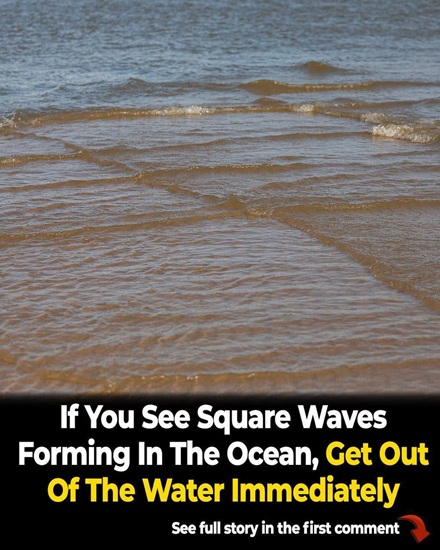
The ocean can produce some of the most impressive natural sights on Earth, particularly when different weather and wave systems interact. Most people who spend time at the beach are familiar with ordinary breaking waves, changing tides, and warnings about dangerous currents. Occasionally, however, the surface of the sea can take on a much more unusual appearance. Waves may seem to intersect in different directions, producing a pattern that resembles a giant checkerboard made of squares or diamonds.
These formations are commonly called “square waves” online, although the more appropriate term for the phenomenon is a cross sea. A cross sea occurs when two wave systems travel through the same area from different directions. Instead of every visible wave moving along approximately the same path, one set of waves intersects with another. When their directions differ significantly, the crossing crests can create a surprisingly organized-looking pattern on the surface.
Viewed from above, the result may look as though the ocean has been divided into moving squares. Despite the striking appearance, there are no actual fixed squares in the water because every part of the pattern continues moving and changing.Understanding how this happens requires remembering that waves can travel considerable distances across the ocean. Wind transfers energy to the water and creates waves, and some of those waves can continue traveling after leaving the area where they originally formed.
These longer-traveling waves are commonly experienced as swell. If another weather system generates waves from a different direction, both systems can eventually occupy the same stretch of ocean. A cross sea can therefore develop when an existing swell meets a newer wind-generated wave system or when separate swell systems arrive from different directions. The interaction can become especially noticeable when the wave systems cross at a large angle. Under suitable conditions, the crests form repeating intersections that create the famous checkerboard appearance. The pattern may appear highly organized even though it is the result of natural atmospheric and ocean processes.
The phenomenon is not supernatural, nor does the ocean permanently retain its geometric appearance. Wind direction can change, individual swells can weaken, and wave systems can gradually move beyond one another. As those conditions evolve, the visible pattern changes as well. This is why a dramatic cross sea photographed at one particular moment may look completely different only a short time later.
Cross seas have attracted scientific attention for reasons extending beyond their appearance. Multidirectional waves can create complicated conditions for ships because vessels may be affected by wave energy arriving from more than one direction. A ship traveling through a conventional swell already experiences motions such as rolling, pitching, and heaving. When strong waves approach from different angles, the resulting vessel motion can become considerably more complex.
Research into maritime accidents and dangerous sea states has therefore examined the interaction between wind-generated waves and swell. Certain combinations of wave height, direction, period, wind, and vessel characteristics can contribute to difficult operating conditions. This does not mean that simply seeing intersecting waves guarantees that a vessel is in immediate danger. Rather, crossing wave systems are among several factors maritime professionals may consider when evaluating sea conditions.
The size and strength of the waves are particularly important. A small pattern created by modest waves near the coast is not equivalent to a severe cross sea involving large swells in open water. Treating every photograph labeled “square waves” as evidence of an immediately deadly situation removes this important distinction. Ocean safety depends on the complete set of conditions present at a particular location and time.
This point is especially relevant to swimmers because dramatic claims about square waves frequently circulate on social media. Some posts suggest that the moment someone notices a checkerboard pattern, they are necessarily facing an extremely dangerous underwater current. That description is too simplistic. A strong and confused sea can certainly be unsafe for swimming, but the geometric appearance alone does not establish the exact level or type of danger.
Cross seas should also not be confused with rip currents. A rip current is a concentrated flow of water moving away from the shoreline, and it can carry swimmers farther from the beach. Rip currents are a recognized coastal hazard and do not need to create square-looking waves on the surface. Someone should therefore never assume that water without a checkerboard appearance is automatically safe.
For beach visitors, official and local safety information is more useful than attempting to diagnose conditions from a single visual pattern. Lifeguard instructions, warning flags, marine forecasts, weather information, wave conditions, and local restrictions can provide important guidance. A person should also take personal swimming ability and familiarity with the location into consideration before entering the water.
If the sea appears unusually rough or unpredictable, staying out of the water can be a sensible choice regardless of whether square patterns are visible. Conditions can change quickly, and unfamiliar coastal environments deserve particular caution. The same principle applies to recreational boating, where checking marine forecasts before departure is considerably more useful than relying solely on what the water looks like from shore.
One of the locations most frequently associated with photographs of cross seas is Île de Ré, an island off France’s Atlantic coast near La Rochelle. Images from the area have helped make the phenomenon widely recognizable. From elevated positions, intersecting wave crests can sometimes be seen forming spectacular patterns across the water.
The elevated perspective is important because the geometric pattern can be much easier to recognize from above. A person standing at beach level sees the ocean from a relatively low angle, making distant waves overlap visually. From a lighthouse, cliff, aerial viewpoint, or another elevated position, the directions of separate wave systems can become far more obvious.
This helps explain why photographs of cross seas can appear much more dramatic than the view experienced by someone standing close to the water. The photographer’s perspective does not create the phenomenon, but it can make the pattern considerably easier to see. Sunlight and shadows can further emphasize the wave crests, producing especially memorable photographs.
Île de Ré is sometimes described online as though its waters continuously display perfect square waves. That is not accurate. Like any coastal environment, its sea conditions change with wind, swell, tides, and weather. The famous checkerboard appearance occurs when suitable wave systems happen to interact rather than being a permanent feature surrounding the island.
Visitors should consequently treat viral photographs as examples of particular conditions rather than a guarantee of what they will see. The island has beaches and locations used for various recreational activities, and conditions differ from place to place. People participating in water activities should follow current local information and safety guidance rather than assuming conditions based on photographs taken at another time.
Another location frequently mentioned in discussions about dramatic interacting waters is Cape Reinga, or Te Rerenga Wairua, at the northern end of New Zealand. The area is known for the meeting of major marine influences associated with the Tasman Sea and Pacific Ocean. Offshore interactions can create highly visible areas of turbulent-looking water, foam, and breaking waves.
However, Cape Reinga should not simply be described as an identical example of every cross-sea photograph seen elsewhere. Ocean currents, wave systems, underwater geography, and weather can interact in different ways. Similar-looking surface patterns can have different physical details, making accurate descriptions preferable to placing every unusual ocean formation under the same label.
Te Rerenga Wairua is also a place of major cultural significance to Māori. Its importance extends far beyond the unusual appearance of the surrounding waters. Visitors are encouraged to respect the landscape and the cultural significance associated with the location while following official guidance when exploring the area.
The broader science behind crossing waves is equally fascinating. Waves are movements of energy through water, and their behavior can be influenced by wind, depth, coastline shape, currents, and other waves. When multiple systems occupy the same region, the resulting surface can become extremely complicated even if photographs make it appear neatly organized.
Scientists use mathematical models to understand how waves behave and interact. Nonlinear wave theory includes equations capable of describing different aspects of wave motion under particular conditions. The Kadomtsev–Petviashvili, or KP, equation is one mathematical model associated with the study of certain nonlinear wave phenomena.
It would nevertheless be an oversimplification to claim that every photograph of square-looking ocean waves is simply a direct demonstration of one equation. Real seas are complex environments containing many simultaneous influences. Researchers may need information about wave height, wavelength, period, direction, water depth, wind, and currents to understand a particular situation accurately.
The visual appeal of cross seas partly comes from how different they look from the waves people normally expect to see. At many beaches, incoming crests appear roughly parallel as they approach shallow water. When a second system cuts across them, that familiar arrangement suddenly changes. The resulting intersections can make the sea appear almost deliberately patterned.
There is nothing artificial about the pattern, however. Similar to intersecting ripples on a pond, waves can pass through the same area while continuing to propagate. The ocean simply operates on a much larger and more complicated scale. What looks like a collection of squares is the visible result of overlapping moving wave systems.
Weather occurring far from a coastline may contribute to the waves eventually reaching it. Swells generated by distant storms can travel across large stretches of ocean. A beach can therefore experience waves influenced by weather systems that are nowhere near the people observing them.
Meanwhile, local wind can create another wave system traveling in a different direction. When the distant swell and locally generated waves meet, crossing patterns may develop. This illustrates how the appearance of the ocean at one location can reflect atmospheric events occurring across a much broader region.
For sailors and boat operators, this complexity is one reason marine forecasts are important. Conditions that appear manageable from shore can be very different farther offshore. Vessel size, design, direction of travel, wave period, and wave height can all affect how a boat responds to a particular sea state.
Strong crossing seas may produce uncomfortable and potentially challenging vessel motions. Waves arriving from different directions can affect rolling and pitching in ways that require careful navigation. Professional operators therefore evaluate far more than whether the surface happens to resemble a checkerboard.
For swimmers, the same principle of looking at the complete situation applies. There is no universal rule stating that every cross sea is equally dangerous. Small intersecting waves under otherwise manageable conditions should not be treated as identical to large, powerful multidirectional swells during severe weather.
At the same time, people should not use that distinction as a reason to ignore visibly difficult water. Strong surf, large waves, currents, storms, restricted swimming areas, and warnings from lifeguards are all legitimate reasons for caution. If local authorities advise people to remain out of the water, that guidance should take priority over assumptions based on photographs or social-media explanations.
The safest approach is therefore neither panic nor complacency. Cross seas are genuine ocean phenomena, and powerful versions can contribute to hazardous maritime conditions. But sensational claims that every square pattern represents an immediate and unavoidable catastrophe are not an accurate explanation of the science.
This distinction demonstrates a wider problem with some viral safety information. A genuine natural phenomenon can be paired with an exaggerated caption, and the dramatic version may spread more quickly than the careful explanation. After enough reposting, people may remember the alarming warning while forgetting the conditions and qualifications behind it.
Accurate information can still be interesting without exaggeration. Two independent wave systems crossing one another across an enormous body of water is already an impressive physical phenomenon. The fact that their interaction can temporarily transform the ocean into something resembling a moving checkerboard makes the sight even more remarkable.
The phenomenon also demonstrates why photographs should sometimes be viewed with additional context. A still image captures only a fraction of an evolving situation. It cannot necessarily show wind strength, currents, water depth, wave period, changing weather, or what happened immediately before and after the photograph was taken.
Video and observational data can provide additional information, while professional marine forecasts offer an even broader picture of conditions. This is particularly important when the purpose is determining safety rather than simply appreciating an unusual photograph.
People who encounter a spectacular cross sea from a safe elevated location may be able to appreciate the phenomenon without approaching the water. From above, the different directions of the waves can become clearly visible, allowing observers to see the grid-like structure developing and changing across the surface.
Watching from a safe viewpoint also highlights just how dynamic the pattern really is. The “squares” do not remain fixed in place. Crests continue moving, intersections shift, and the entire arrangement changes as energy travels through the water.
This constant movement is one reason the term “square waves” can be slightly misleading. The phrase is useful for describing what the pattern looks like, but the ocean is not creating stable geometric objects. “Cross sea” better describes the underlying process because separate wave systems are crossing one another.
For anyone planning a day at the beach, there is no need to become an expert in wave mathematics. Basic precautions remain more practical: check conditions, pay attention to warnings, choose supervised swimming areas where available, understand personal limits, and avoid entering water that appears beyond one’s abilities.
Boaters face additional considerations and should use appropriate marine forecasts, safety equipment, and navigation practices. A beautiful ocean can become challenging quickly when weather and wave conditions change. Respecting that unpredictability is part of responsible activity on the water.
Cross seas therefore deserve both fascination and proper context. They can create some of the most unusual patterns visible on the ocean’s surface, and strong crossing wave systems can contribute to difficult maritime conditions. Yet the scientific reality is more nuanced than many viral warnings suggest.
Not every cross sea is identical, and not every checkerboard-looking pattern represents the same degree of danger. Wave size, direction, period, weather, currents, location, and the activity being undertaken all influence risk. A large vessel offshore and a swimmer near a sheltered beach are dealing with very different circumstances.
The most useful message is simple: appreciate unusual ocean conditions while respecting them. If water looks rough, confused, or unfamiliar, check reliable local information before entering it. If warnings are in place, follow them rather than relying on assumptions based on something seen online.
Nature does not need exaggeration to be impressive. Cross seas are an excellent example of ordinary physical processes combining to create something that looks extraordinary. Two wave systems arriving from different directions can temporarily transform the surface into a shifting pattern of squares and diamonds.
For scientists, sailors, photographers, and casual observers, the phenomenon provides different reasons for interest. Researchers can study the mechanics of interacting waves, mariners can consider their effects on vessels, photographers can capture extraordinary patterns, and visitors can simply admire the sight from an appropriate location.
Ultimately, “square waves” are best understood as a visually striking form of crossing seas rather than as a mysterious or universally deadly ocean event. Strong versions deserve serious caution, particularly in difficult maritime conditions, while smaller examples should be evaluated according to the complete local situation.
The next time an image of a checkerboard-like ocean appears online, there is therefore a fascinating scientific explanation behind it. Separate wave systems have crossed paths, creating a temporary geometric illusion across a constantly moving surface. It is beautiful, unusual, and worthy of respect—but understanding the phenomenon accurately is far more useful than turning it into an exaggerated warning.

