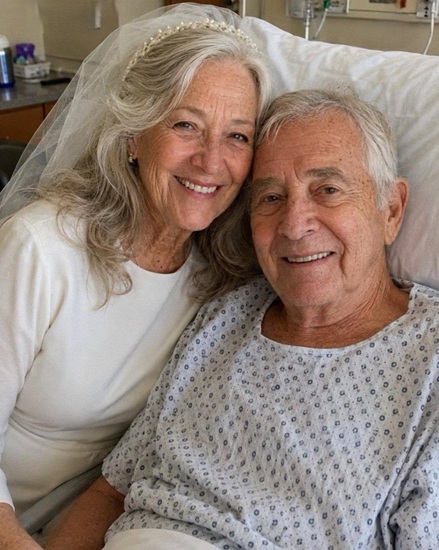
At 73, Nancy found herself returning to the small hometown she had left when she was still a teenager. She had expected retirement to bring financial stability, but her pension no longer stretched as far as she had planned. Rent, utilities and everyday expenses consumed more of her monthly income than expected. Rather than spend her savings simply trying to keep up, Nancy made a practical decision. She returned to part-time nursing at the local hospital, believing a few shifts each week would provide both additional income and a sense of purpose.
Coming home after more than five decades was strange. Nancy recognized street names but not always the buildings standing beside them. Stores she remembered had disappeared, neighborhoods had expanded and many childhood friends had moved away. She had never married or raised children, although she had experienced relationships during adulthood. None, however, had completely erased the memory of Thomas, the boy she had loved before leaving home at 17.
Nancy and Thomas had once believed they would remain together forever. Their plans changed when Nancy received an opportunity to continue her education in another city. Thomas wanted to stay behind and eventually work with his father’s business. Neither decision was unreasonable, but at 17 the distance between those futures seemed impossible to bridge. Their final conversation happened at a bus station while Nancy waited to leave.
Thomas asked her not to go.
He told her that she was breaking his heart and insisted they could build a life together if she remained. Nancy loved him, but she also knew that giving up her education could become a decision she regretted. She boarded the bus believing they would find some way to remain connected.
At first, they tried.
There were letters and occasional conversations.
Then life became busier.
Communication slowed, misunderstandings accumulated and eventually silence replaced the promises they had made at the station.
Fifty-six years passed without another meeting.
Nancy built a nursing career and learned how to live independently. Thomas remained somewhere in the background of her memories, connected to a younger version of herself rather than to her everyday life.
Then one morning at the hospital, everything changed.
Nancy picked up a patient’s chart and saw a familiar name.
Thomas.
She stared at it for several seconds.
The name was not especially rare, so she told herself it was probably a coincidence.
Then she entered the room.
The patient looked nothing like the 17-year-old boy preserved in Nancy’s memory. He was older, thin from illness and visibly exhausted.
But his eyes were unmistakable.
Thomas recognized her almost immediately.
A smile slowly appeared across his face.
For a moment, neither knew what to say.
There were 56 years between the last goodbye and this unexpected reunion.
They began carefully.
Nancy asked about his condition.
Thomas asked when she had returned.
Soon they were talking about high school, old friends and places around town that had vanished decades earlier.
Whenever Nancy’s work allowed, she spent a little more time with him.
The conversations gradually became more personal.
Thomas explained that he had remained in the area and spent much of his adult life working. Nancy told him about nursing and the cities where she had lived.
Eventually, they discovered something neither had expected.
Thomas had never married.
Neither had Nancy.
The revelation created a quiet pause between them.
Neither pretended that their separate lives had simply been waiting for this moment.
They had both lived full decades without each other.
Still, the emotional connection they remembered returned with surprising ease.
Thomas was seriously ill.
Within this fictional story, he had advanced cancer, and both understood that the reunion had arrived very late.
That knowledge made ordinary conversations feel more important.
One afternoon, Thomas asked about Nancy’s relatives.
She mentioned Raymond, a distant cousin who had recently become unusually attentive.
Raymond had begun calling several times each week.
His questions frequently involved Nancy’s pension, savings and apartment.
He wanted to know whether she had prepared a will and which bank she used.
Nancy considered the questions intrusive but had not viewed them as threatening.
Raymond described his interest as family responsibility.
He often reminded Nancy that he had helped their late Aunt Margaret manage her finances during the final years of her life.
Thomas became noticeably uncomfortable when Nancy mentioned Margaret.
He asked how much she knew about the circumstances surrounding her aunt’s estate.
Very little, Nancy admitted.
Margaret had once seemed financially comfortable.
Yet when she died, there had apparently been far less money than relatives expected.
Nancy had never investigated further.
Thomas did not immediately explain his concern.
His health was declining rapidly, and there were other things he wanted to discuss first.
One evening, he took Nancy’s hand.
He told her that leaving the bus station at 17 had never erased what he felt for her.
Time had changed him.
Life had moved forward.
But some part of the affection had remained.
Then Thomas asked Nancy to marry him.
She initially thought he was speaking from nostalgia.
Thomas insisted he understood exactly what marriage meant.
He knew they might have only weeks together.
He was not asking Nancy to pretend they could recover the decades they had lost.
He wanted whatever time remained to be honest.
Nancy thought about the question overnight.
The following morning, she said yes.
Three days later, they were married in Thomas’s hospital room.
There were no elaborate decorations or large gathering.
A nurse witnessed the ceremony, and Thomas’s attorney, Walter, attended.
For Nancy, the simplicity made the moment more meaningful.
They were not celebrating the beginning of a conventional lifetime together.
They were acknowledging a relationship that had somehow survived 56 years of separation.
After the ceremony, Walter discussed several legal documents with them.
In this fictional narrative, Thomas had arranged an estate plan that included a trust intended to support Nancy after his death.
Walter explained the documents before Nancy signed them.
The arrangements were designed so that professional legal oversight would be available if complicated financial questions later arose.
Raymond learned about the marriage almost immediately.
His reaction was unexpectedly hostile.
He called Nancy and accused Thomas of taking advantage of her.
Then he insisted she should seek an annulment.
Nancy refused.
She reminded Raymond that she was capable of making her own decisions.
His anger made Thomas’s earlier questions suddenly seem more important.
Thomas lived for approximately another month.
Nancy spent as much time beside him as she could.
They talked about the past without trying to rewrite it.
Nancy admitted that leaving town had given her the education and career she wanted.
Thomas admitted that remaining home had allowed him to build a life he valued.
Neither claimed that one choice had been completely right or completely wrong.
They had simply chosen different roads.
For a brief period at the end, those roads met again.
Thomas died peacefully with Nancy beside him.
The funeral brought another uncomfortable encounter with Raymond.
He emphasized that Nancy had few relatives remaining and suggested that she would eventually need someone to manage her affairs.
Then he mentioned Aunt Margaret.
This time, Nancy paid careful attention.
The morning after the funeral, Walter arrived carrying a wooden box.
Thomas had left instructions that it should not be delivered until after he was buried.
Walter sat with Nancy and reviewed the estate arrangements again.
The trust had been funded through Thomas’s estate and was intended to provide for Nancy.
More importantly, the structure meant that significant financial decisions could receive independent professional review rather than being made under pressure from another relative.
Then Walter opened the box.
Inside were documents connected with Thomas’s home.
There was also a collection of old envelopes tied together.
Nancy counted them.
Fifty-five.
Each envelope contained a letter Thomas had written during the years they were apart.
He had never mailed them.
Some described important events.
Others contained ordinary memories.
One mentioned hearing a song they had danced to as teenagers.
Another described walking past the bus station and wondering where Nancy was living.
The final envelope contained something different.
Thomas explained why Raymond had concerned him.
According to the fictional backstory, Aunt Margaret had been a longtime customer and friend of Thomas’s family business.
Years earlier, Thomas had noticed circumstances that made him worry about how Raymond was handling Margaret’s money.
He believed funds were disappearing.
Thomas tried to warn her.
Margaret refused to believe that someone in her own family could misuse her trust.
After she died, Thomas remained suspicious about what had happened.
He had no intention of making unsupported public accusations.
But he never forgot what he had observed.
When Nancy eventually returned to town, Thomas learned that Raymond had begun asking questions about her finances.
That information alarmed him.
The letter then explained something Nancy had not fully understood.
Thomas’s marriage proposal had been genuine.
He had wanted to marry her because he loved her.
But he also knew he was dying.
He worried that after his death, Raymond might try to persuade Nancy to sign documents or surrender financial control.
Thomas wanted safeguards in place before that could happen.
The trust was therefore not designed to control Nancy.
It was intended to preserve her independence.
That distinction mattered enormously.
Thomas had not transferred Nancy’s personal decision-making authority to himself.
Instead, he had arranged his own assets so that Nancy would receive support while having access to independent professional guidance.
The “trap” described in his final letter was meant for anyone who assumed Nancy would be easy to pressure.
Thomas expected Raymond’s behavior to reveal his intentions once money became involved.
Nancy was not entirely pleased with the plan.
She wished Thomas had told her everything while he was alive.
She wanted the opportunity to ask questions.
Protecting someone without fully informing them can still create problems, even when the intention is loving.
But she understood what Thomas had feared.
He knew he would not be there to help her personally.
So he had tried to create safeguards that would remain after him.
Several days later, Raymond arrived at Nancy’s home.
He demanded information about the estate.
When Nancy refused, he became angry.
Walter happened to be meeting with her that afternoon.
He calmly explained that Raymond had no automatic authority over Nancy simply because they were related.
Nancy was an adult capable of managing her affairs.
If she wanted financial assistance, she could choose qualified professionals.
If Raymond believed any estate document was invalid, appropriate legal procedures existed for challenging it.
He could not simply demand control.
Raymond eventually left.
For Nancy, that confrontation provided clarity.
She stopped discussing private financial matters with him.
Important documents were secured.
Any future paperwork involving significant assets would be reviewed independently before Nancy signed it.
She had spent decades making decisions for herself.
Turning 73 had not suddenly erased that ability.
The following spring, Nancy moved into Thomas’s home.
The house was filled with pieces of the life he had lived without her.
Books filled shelves she had never seen.
Photographs documented years she had missed.
Old furniture carried memories that belonged to Thomas alone.
Nancy did not try to erase those decades.
Instead, she slowly learned about them.
The letters helped.
She made one decision almost immediately.
She would not read all 55 at once.
Every Sunday morning, Nancy prepared coffee and opened a single envelope.
Some letters were funny.
Others were deeply emotional.
Several described ordinary days that would have meant nothing to anyone else.
To Nancy, they gradually filled the empty space between the teenagers at the bus station and the elderly couple reunited in a hospital room.
Thomas had continued living.
So had Nancy.
The letters proved that remembering someone did not mean life had stopped.
That became an important lesson.
Nancy refused to transform her story into one about waiting 56 years for love.
She had not waited.
She had worked.
She had traveled.
She had formed friendships and built an independent life.
Thomas had done the same.
Their reunion did not invalidate everything that came before it.
It simply gave them an unexpected final chapter.
Their marriage lasted only a short time.
Yet its length did not determine its meaning.
Nancy had been able to sit beside the person she first loved and finally speak about everything they had once left unfinished.
Thomas had been able to tell her that she still mattered.
And after he was gone, his estate planning gave Nancy additional security without requiring her to surrender control over her own future.
That point became more important than the inheritance itself.
Older adults do not automatically lose the right or ability to make decisions because relatives believe they know what is best.
Offers of assistance can be valuable.
Pressure is different.
Trust is different from control.
And family relationships do not create automatic ownership over another adult’s finances.
Nancy understood that more clearly after Raymond’s behavior.
She also understood something about Thomas.
His plan had been imperfect.
She wished he had trusted her with the complete truth from the beginning.
But the love behind it was genuine within this fictional story.
Thomas had spent his final weeks thinking not only about what he could leave Nancy, but about how she could remain independent after he was gone.
Money was only part of that legacy.
The letters mattered more.
Every Sunday, Nancy opened another one.
For a few minutes, Thomas was 24, or 37, or 51 again.
She met versions of him she had never known.
Then she folded the page carefully and returned it to the envelope.
Nancy could not recover the 56 years between their goodbye and reunion.
She no longer wished she could.
Those years had shaped both of them into the people who eventually met again.
Their story was not about correcting the past.
It was about recognizing what remained when the past unexpectedly returned.
Thomas had been Nancy’s first love.
Decades later, he became her husband.
Then, far sooner than either wanted, he became a memory again.
But this time Nancy did not have only the memory of a teenage goodbye.
She had a month of conversations.
She had a home filled with pieces of his life.
She had 55 unopened letters waiting for Sunday mornings.
And most importantly, she still had her independence.
Thomas could not decide what Nancy would do with the years remaining to her.
He had never wanted to.
His final arrangements simply helped make sure nobody else could easily decide for her either.
Nancy eventually came to understand that as the real meaning behind his last gift.
Their second chance had been brief.
The protection Thomas arranged would last longer.
And the love preserved inside those envelopes would continue revealing itself one Sunday at a time.
