
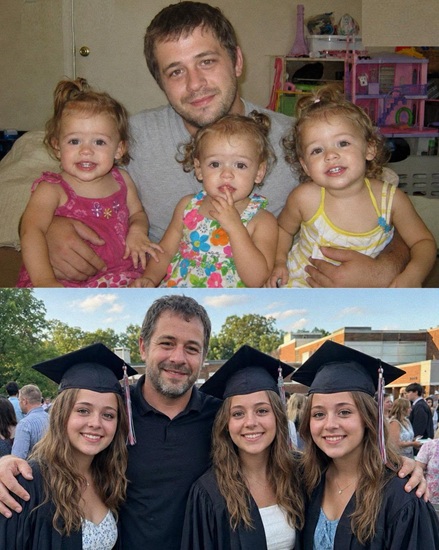
There were many nights when Noah wondered whether he had done enough. He questioned the choices he had made, the opportunities he had given up, and whether the three girls who depended on him had truly understood how much he loved them. Looking back years later, he could trace almost everything that mattered in his life to one ordinary October evening. Nothing about that night seemed important at first. He was simply returning home from another exhausting shift, carrying the smell of sawdust and motor oil with him.
By the time he reached his apartment door, however, his future had already changed. The porch light above the stairwell flickered weakly as Noah reached for his keys. He was tired enough that he nearly stumbled over the objects sitting directly in front of his door. There were three infant car seats lined against the wall, a diaper bag stuffed so full that one zipper could barely close, and a folded gas-station receipt placed on top. For several seconds, Noah simply stared. His mind recognized the babies before he was ready to accept what he was seeing.
He picked up the receipt first.
The handwriting belonged to his brother Daniel. The letters leaned sharply toward the right, just as they always had when Daniel wrote quickly. The message was short. Daniel apologized and said that he could not continue. There was no address, no explanation of where he was going, and no promise that he would come back. Noah read the note several times, but the words did not become easier to understand.
Daniel’s wife, Patricia, had died only eleven days earlier. The loss had devastated everyone, and Noah knew his brother was overwhelmed by grief. Still, he had never imagined Daniel would disappear and leave his three six-month-old daughters behind. The triplets were far too young to understand that their mother was gone or that their father had just driven away. They only knew that night had come and someone needed to pick them up.
Noah was twenty-seven years old, unmarried, and barely managing his own expenses. He lived in a small apartment above the hardware store where he worked. His checking account contained only a few hundred dollars. His furniture consisted mostly of secondhand pieces, including a futon that refused to open properly. His refrigerator was nearly empty, and his work schedule already left him exhausted.
Nothing about his life looked prepared for three babies.
Then one of the triplets made a soft hiccuping sound.
Noah finally looked down.
Two of the babies were sleeping. The smallest was awake and staring directly at him. Her eyes were gray and strangely familiar, reminding Noah of his mother. He knelt beside the car seats and whispered hello, even though he felt foolish doing it. The baby moved one hand through the air until her fingers wrapped around his index finger.
Her grip was surprisingly strong.
Noah did not move.
At that moment, the neighboring apartment door opened and Mrs. Hunter stepped outside wearing an old bathrobe and slippers. She had lived next door for years and had a habit of noticing everything that happened in the building. On most days, Noah considered that irritating. That night, he was grateful.
Mrs. Hunter immediately recognized the babies.
Patricia had visited with the triplets twice during the summer, proudly introducing them and explaining how to tell them apart. Mrs. Hunter remembered their names and even their different birth weights. She looked from the babies to Noah and then noticed the receipt in his hand.
“Where is Daniel?” she asked.
Noah handed her the note.
She read it silently.
Then she looked at him with an expression that made the situation feel even more real.
She told Noah that he could not possibly raise three infants by himself. He had no experience with babies, no savings, and no proper space for them. She reminded him that he did not even know how to prepare a bottle. Noah wanted to argue, but he could not. Every word she said was true.
Then the smallest baby tightened her hand around his finger.
Mrs. Hunter quietly told him her name was June.
Noah repeated it.
“June.”
Beside her slept Ava and Claire.
The three girls had already lost their mother. Now their father was gone too.
Mrs. Hunter suggested calling social services in the morning. She explained that there were families who were prepared to raise children and people with more resources than Noah had. Logically, he knew she was right. He opened his mouth to agree.
Instead, he looked down at June.
She did not know anything about bank accounts, work schedules, or legal responsibility. She only knew that someone was there.
Noah heard himself say, “I’ve got you.”
The words surprised him.
He said them again.
“I’ve got you.”
That night, Noah carried the babies into the apartment one at a time. By the time he made the third trip, something inside him had changed. Legally, he was still their uncle. Emotionally, he was already becoming something more.
The first night was chaos.
When one baby cried, the others woke up. Noah prepared bottles incorrectly, changed diapers too slowly, and spent most of the night asking Mrs. Hunter what he was supposed to do next. At three in the morning, he sat on the floor with June sleeping against his chest and wondered how any parent survived.
Morning brought even more problems.
There were calls to make, questions to answer, and arrangements Noah had never imagined handling. Loving the girls did not automatically solve the practical issues. There were medical appointments, childcare needs, legal responsibilities, and everyday expenses. Daniel remained their biological father, even though nobody knew where he had gone.
Days passed.
Then weeks.
Daniel did not return.
Noah slowly learned how to care for the girls.
He learned which bottle belonged to whom and which child slept best with music playing quietly. He discovered that Claire hated certain foods before she was old enough to explain why. Ava seemed happiest whenever someone talked to her. June calmed down whenever Noah walked slowly around the apartment with her resting against his shoulder.
Mrs. Hunter became an essential part of their lives.
She watched the girls when Noah desperately needed sleep. She corrected his mistakes without making him feel completely useless. Groceries occasionally appeared outside his door during weeks when money was especially tight. Mrs. Hunter always denied knowing anything about them.
As the triplets grew, Noah’s apartment transformed.
Toys appeared under furniture. Children’s clothes filled drawers that once held tools and work shirts. Three small beds eventually replaced the improvised sleeping arrangements Noah had created during infancy. The apartment was cramped, noisy, and frequently messy.
It was also home.
Noah worked constantly.
He accepted extra hours whenever the hardware store manager offered them. Some weeks included double shifts. Other periods required weekend jobs to cover unexpected expenses. Shoes seemed to become too small overnight. School supplies appeared on lists Noah never remembered receiving. There were doctor visits, winter coats, birthday presents, and endless grocery bills.
He became very good at stretching money.
He knew which supermarket reduced prices late in the evening. He knew when the hardware store would allow employees to take home damaged but usable furniture. He repaired almost everything instead of replacing it. Somehow, the bills got paid.
Parenting, however, involved far more than money.
Noah packed lunches every morning and somehow managed to buy the wrong bread repeatedly. He attended school meetings feeling convinced that someone would eventually realize he had no idea what he was doing. He helped with homework he barely understood and stayed awake late constructing science-project displays with cardboard and glue.
Hair became one of his greatest failures.
His attempts at braiding were so bad that Mrs. Hunter began fixing the girls’ hair on the porch before school.
Ava once looked at herself in the mirror and asked Noah whether he had created the braid during an earthquake.
He told her he was doing his best.
Mrs. Hunter laughed.
That became one of Noah’s most frequently repeated sentences.
“I’m doing my best.”
There were illnesses too.
Fevers frightened him more than he admitted. He sat beside beds with thermometers and worried about every number. He rushed to emergency rooms late at night when ordinary clinics were closed. He learned which medicines tasted terrible and which blankets the girls wanted when they were sick.
There were happier moments.
The triplets learned to ride bicycles in the empty parking lot behind the hardware store. Noah ran behind them until his lungs hurt, holding the seats until each girl shouted at him to let go. He attended school plays where he could barely hear their lines and clapped as if they had performed on Broadway.
Birthdays became especially important.
Noah never forgot the date Patricia had delivered the triplets.
Some years, he could afford a bakery cake. Other years, he made one himself and tried to hide the fact that it leaned slightly to one side. Friends and neighbors crowded into the apartment, and the girls opened inexpensive presents as though they were treasures.
On their first birthday, after everyone had gone home, Noah began a private tradition.
He sat at the kitchen table with an inexpensive notebook and wrote the girls a letter.
He admitted that he was scared.
He wrote that he did not know how to become the father they needed.
But he promised one thing.
He would stay.
He promised breakfast every morning even if it was burnt.
He promised they would never wake up wondering where he had gone.
Then Noah placed the notebook in the back of a kitchen drawer.
Every year, he added another entry.
He never told the girls.
As childhood turned into adolescence, life became more complicated.
June went through a phase of slamming doors so hard that Noah worried the hinges would eventually fall off. Claire once stopped speaking to him for weeks except when absolutely necessary. Ava told him at seventeen that he did not understand anything about her life.
Noah did not disagree.
He simply stayed.
When the girls experienced heartbreak, he discovered there was no easy repair. He could fix locks, broken shelves, and cabinet doors, but he could not repair emotional pain with tools. So he made grilled-cheese sandwiches and sat nearby while they cried.
Sometimes they wanted advice.
Sometimes they wanted silence.
Noah learned the difference.
There were sacrifices, although he rarely used that word out loud.
He missed a cousin’s wedding because Claire had the flu. He canceled a fishing trip that he had planned for years. He watched friends build lives that seemed simpler than his own.
And then there was Diana.
Noah loved her.
She remained patient with his complicated schedule for a long time. She understood that the girls came first, but understanding did not erase the difficulty.
One evening, Diana stood at his front door and asked whether there was room in Noah’s life for her.
She made it clear that she was not asking him to choose between her and the girls.
She only wanted to know whether there was enough space for another relationship.
Noah wanted to say yes.
Instead, he told her there was not enough room to give her the life she deserved.
Diana nodded quietly.
She left a sweater behind.
Noah never returned it.
Years passed.
Daniel appeared only occasionally from a distance.
A birthday card arrived without a return address. Later, there was a Christmas card mailed from another state. There was never a dependable pattern.
Then, when the triplets were twelve, Daniel called.
He said he wanted to reconnect.
He told Noah he had been thinking about becoming part of the girls’ lives again.
Noah listened until Daniel referred to himself as their father.
Then Noah asked him what being a father meant.
He told Daniel that if he truly wanted a relationship with the girls, he needed to show up in person. He needed to attend birthdays, listen to their anger, answer their questions, and accept that rebuilding trust would take time.
Daniel promised to think about it.
Noah told him thinking was not enough.
Daniel never came.
The cards eventually stopped.
Noah often wondered whether the girls noticed.
They never mentioned it.
He was afraid to ask.
Late at night, Noah sometimes sat alone at the kitchen table and counted things that could not be measured with money.
Had he done enough?
Had he been too tired too often?
Had he said the wrong things?
Did the girls know how deeply he loved them?
Or did they simply remember a man who was always working?
One fear remained underneath everything.
Perhaps they were still waiting for Daniel.
Perhaps Noah was simply the person who happened to be there.
He never blamed them for that possibility.
Daniel was their biological father.
Noah knew that mattered.
Still, the thought hurt.
The girls eventually graduated from high school and went to college.
Their education was financed through scholarships, part-time work, loans, and whatever Noah managed to save. College brought new worries. There were late-night calls, difficult classes, broken relationships, and unexpected expenses.
Then, almost without Noah noticing, twenty-two years had passed since the night on the porch.
The morning of their college graduation, Noah sat in his truck for nearly twenty minutes before entering the auditorium.
He was forty-nine now.
His beard had begun turning gray in uneven patches. One knee still hurt after a fall from a ladder two summers earlier. He carried an inexpensive camera that he barely knew how to operate.
Inside his wallet was Daniel’s original note.
Noah had kept it all those years.
The gas-station receipt was faded and soft along the folds.
He read it again.
Part of him wondered whether Daniel might appear that day.
Another part wondered whether the girls wished he would.
Noah put the note back into his wallet and finally entered the building.
The auditorium was crowded with families.
Flowers, cameras, balloons, and graduation programs filled the seats.
Noah found a place seven rows from the stage and rested the camera on his bad knee.
Ava’s name was called first.
She started crying before she had crossed half the stage and laughed while wiping her eyes with her sleeve.
Noah took several photographs.
Most were blurry.
Claire came next.
She spotted Noah almost immediately and waved both hands above her head, exactly the way she had waved from the school bus when she was eight.
Noah waved back.
Then came June.
She crossed the stage quietly, carrying herself with the same seriousness she had shown since childhood.
Noah photographed her holding the diploma.
He thought the ceremony was finished.
Then the dean returned to the microphone.
There was one more presentation.
Noah lowered the camera.
Ava, Claire, and June walked onto the stage together.
They were holding hands.
June stepped toward the microphone.
She told the audience that their father could not be there that day.
Noah’s stomach tightened.
His first thought was Daniel.
For one painful moment, Noah assumed they were going to speak about the man who had left them.
He told himself to remain quiet.
If they needed to acknowledge Daniel, Noah would allow it.
Then Ava removed a folded piece of paper from her graduation gown.
June said the three sisters had discovered a notebook in the kitchen drawer.
Noah froze.
He knew exactly which notebook she meant.
June began reading the entry from their first birthday.
It described a frightened young man who had no idea whether he was raising three babies correctly.
The writer admitted he did not know how to become a father.
Then he promised he would never leave.
Noah recognized every word.
He had written them himself.
June continued reading.
She read about burnt breakfasts and sleepless nights.
Ava took the microphone and read an entry about school shoes, scraped knees, and the fear of not having enough money.
Claire read another entry about how completely Noah loved them.
The auditorium blurred through his tears.
Then June looked directly at him.
She explained what she had meant when she said their father was not there.
Their biological father was absent.
Their dad was sitting in the seventh row.
Noah lowered his head.
For more than twenty years, he had feared that the girls viewed him only as the uncle who had stepped in when Daniel disappeared.
They had apparently decided otherwise long ago.
June walked down from the stage carrying a framed document.
She knelt beside Noah and handed it to him.
His hands shook so badly that he could barely read it.
The sisters explained that months earlier they had begun the legal process necessary to make their relationship official.
As adults, they wanted the paperwork to reflect what they already believed was true.
They wanted Noah legally recognized as their father.
Ava told him that Daniel was their biological father, but Noah was the person who had raised them.
Claire said the documents were simply making the official record match the life they had actually lived.
Noah cried openly.
He did not remember when the audience stood.
He barely remembered the applause.
He remembered only the three girls surrounding him.
June whispered that he had never been a replacement.
He was their dad.
Three weeks later, Noah stood in the apartment above the hardware store looking at two framed pieces of paper.
On the left was Daniel’s old gas-station receipt.
On the right were the adoption documents.
For years, Noah had described the life he gave the girls as sacrifice.
Looking at the two frames, he finally understood it differently.
He had certainly given things up.
But he had also received a life he never could have planned.
Three children had become his family.
They had chosen him just as surely as he had chosen them.
That evening, Noah sat on the couch and opened his phone.
He scrolled until he found a name he had not called in twelve years.
Diana.
His finger remained above the screen for several moments.
Then he pressed call.
The phone rang twice.
Diana answered.
There was silence when Noah said her name.
Then she laughed softly.
She told him she had often wondered whether he would eventually call.
Noah looked toward the two frames on the wall.
For the first time in years, he no longer felt that loving one person required abandoning another.
The girls were grown.
They had lives of their own.
And the question that had followed Noah through almost every sleepless night had finally been answered.
He had spent years wondering whether he had been enough.
The three women standing on that graduation stage had answered him more clearly than words ever could.
He had stayed.
He had shown up.
He had loved them consistently.
And for Ava, Claire, and June, that was what made him their father.

