
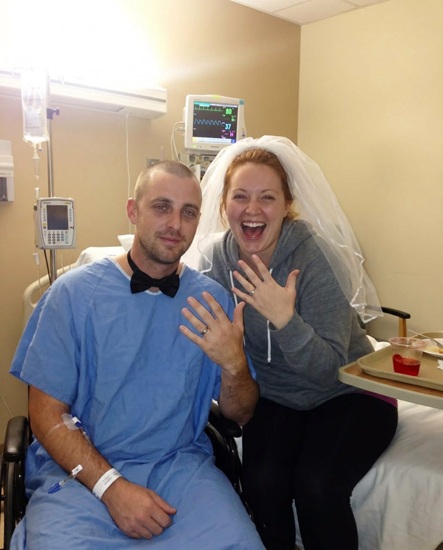
The steady rhythm of hospital monitors echoed through Room 407 as winter rain tapped softly against the windows overlooking the parking lot. The room was quiet except for the mechanical sounds of medical equipment and the occasional footsteps of nurses passing outside the door. Although hospitals are places where hope and heartbreak often exist side by side, I never imagined I would be standing in one wearing a white wedding dress.
My bouquet consisted of a handful of white flowers gathered by volunteers, and my veil had been borrowed only hours earlier. It was not the wedding I had imagined as a little girl, but I believed love mattered more than any grand celebration. Ben and I had known each other for almost our entire lives. We first met as children during the second grade, quickly becoming inseparable friends who spent countless afternoons riding bicycles, completing homework together, and dreaming about the future.
As we grew older, our friendship slowly became something deeper. Through school graduations, first jobs, family celebrations, and life’s inevitable disappointments, we remained by each other’s side. Everyone around us assumed that one day we would marry, and eventually we believed it ourselves.
When Ben proposed, neither of us hesitated. We began planning a joyful wedding surrounded by family and lifelong friends. We visited reception halls, sampled cakes, selected music, and imagined the life we hoped to build together. Every small detail seemed important because it represented the beginning of a future we had been planning for years. We talked about buying a small house, traveling whenever possible, and filling our home with books, photographs, and traditions that would become our own.
Then everything appeared to change. Only weeks before our wedding, Ben suddenly collapsed. Doctors ordered numerous examinations, and after several anxious days, we were told that his condition was extremely serious. The news shattered every plan we had made. Instead of discussing seating arrangements and honeymoon destinations, our conversations revolved around treatment schedules, medications, and uncertain tomorrows. Faced with what seemed like heartbreaking circumstances, we decided that postponing our marriage no longer felt right. If our time together truly was limited, we wanted to spend every possible day as husband and wife.
The hospital staff kindly agreed to help arrange a simple ceremony inside Ben’s room. A chaplain offered comforting words, nurses decorated the room with fresh flowers donated by volunteers, and a few close relatives attended quietly. Despite the sadness surrounding the occasion, everyone tried to create an atmosphere filled with warmth rather than despair. For a brief moment, the medical equipment faded into the background as we exchanged vows that reflected years of shared memories rather than uncertainty about the future.
When the ceremony ended, Ben smiled gently and thanked everyone who had helped make the day possible. Although he appeared exhausted, he seemed genuinely grateful that we had chosen love over fear. We spent the next hour talking quietly, remembering childhood adventures and laughing about awkward moments from our teenage years. The conversation reminded me of happier times before illness seemed to dominate every part of our lives.
Eventually, the medications made Ben drowsy, and he drifted into a light sleep. Hoping to give him time to rest, I stepped into the hallway with a paper cup of coffee from a vending machine. The corridor was almost empty, illuminated by soft evening lights that reflected off the polished floor. Families spoke quietly in nearby waiting areas, while nurses moved efficiently between patient rooms. I leaned against the wall, trying to absorb everything that had happened during the most emotional day of my life.
As I stood there, one of the nurses approached me. She appeared nervous, repeatedly glancing toward Ben’s room before speaking. Her expression suggested she wanted to say something important but was uncertain whether she should. After a long pause, she quietly advised me to pay close attention to details that I might otherwise overlook. She did not explain what she meant or accuse anyone of wrongdoing. Instead, she simply encouraged me to remain observant and to ask questions whenever something did not seem to make sense.
Her unexpected words stayed with me long after our conversation ended. At first, I dismissed them as a misunderstanding or perhaps a comment taken out of context. Yet the seriousness in her voice made it difficult to forget. Returning to Ben’s room, I found myself noticing small details that I previously would have ignored. Every conversation between doctors, every document placed on a table, and every unusual pause suddenly seemed more significant than before.
Later that evening, after visiting hours were nearly over, I sat beside Ben’s bed watching him sleep peacefully. The room was quiet again, and the events of the day replayed endlessly in my thoughts. I wanted to believe that everything was exactly as it appeared, yet a growing sense of uncertainty had begun to replace the confidence I had always felt. Without fully understanding why, I realized that the days ahead might reveal truths I had never expected to discover.
That evening, long after the hospital corridors had grown quiet, I found myself unable to ignore the nurse’s unusual advice. Her words echoed in my thoughts with every passing minute. Although she had not accused anyone directly, the concern in her expression suggested she believed something was wrong. I reminded myself that grief and exhaustion could easily distort perception, yet curiosity gradually replaced hesitation. Before leaving for the night, I took one final look around Room 407, searching for anything that might explain why she had spoken to me in such an urgent tone.
The room appeared ordinary. Medical equipment stood beside the bed, personal belongings rested neatly on a small cabinet, and flowers from the wedding ceremony brightened the windowsill. Nothing seemed unusual at first glance. Still, I carefully examined the room, paying attention to details I had overlooked throughout the day. I noticed a folder partially hidden beneath several magazines on the bedside table. It contained appointment reminders, handwritten notes, and personal correspondence, but nothing immediately suggested dishonesty or wrongdoing.
The following morning, I returned early and found Ben awake. He smiled warmly and thanked me for staying beside him throughout the previous day’s emotional events. We spent several hours talking about ordinary memories from childhood, favorite vacations, and future dreams we still hoped to pursue if circumstances allowed. Despite the seriousness of his illness, those conversations reminded me why I had loved him for so many years. They also made the nurse’s warning seem increasingly difficult to understand.
Later that afternoon, however, several conversations among hospital staff left me with additional questions. Different members of the medical team referred to appointments, consultations, and administrative matters that I did not fully understand. Rather than making assumptions, I politely asked whether someone could explain the overall treatment plan. The physician answered my questions professionally and encouraged me to continue asking whenever I needed clarification. Although the discussion eased some of my concerns, I realized how important clear communication is for families facing complex medical situations.
As the days passed, I began organizing Ben’s paperwork with his permission, hoping to help him manage insurance documents, appointment schedules, and correspondence. While sorting through the files, I discovered several financial letters that neither of us had previously discussed. They revealed that Ben had been facing significant financial difficulties for quite some time. The information came as a complete surprise because he had always tried to protect me from worrying about money. Instead of confronting him immediately, I chose to wait until we could have a calm and honest conversation.
When I finally asked about the letters, Ben admitted that he had hidden the seriousness of his financial situation because he felt ashamed. He explained that a series of poor investment decisions and unsuccessful business ventures had created debts that he struggled to repay. Rather than asking for help, he convinced himself that he could solve everything alone. The burden of keeping those problems secret had gradually affected many parts of his life, making open communication increasingly difficult.
Our conversation became emotional but remained respectful. We discussed how fear, embarrassment, and pride sometimes prevent people from asking for support when they need it most. Ben apologized for not trusting me with the truth sooner, while I acknowledged that difficult circumstances often lead people to make choices they later regret. Although his decisions had damaged trust between us, I realized that rebuilding honesty would require patience rather than anger alone.
During the following weeks, we focused less on the mistakes that had brought us to that moment and more on understanding how they had happened. Financial counselors, legal advisers, and family members helped us review the situation carefully. The process was neither quick nor easy, but every honest conversation replaced a small part of the uncertainty that secrecy had created. We learned that lasting relationships depend not only on love but also on openness, accountability, and a willingness to face uncomfortable realities together.
The experience also changed the way I viewed trust. I had once believed that trust meant never questioning the people closest to us. Over time, I came to understand that genuine trust includes honest conversations, transparency, and the courage to ask difficult questions when something feels wrong. Healthy relationships are strengthened by communication rather than weakened by it. Avoiding important conversations may postpone conflict, but it rarely solves the underlying problem.
Looking back, I also thought often about the nurse whose brief conversation encouraged me to pay closer attention. Whether her intention had been to warn me, encourage careful observation, or simply remind me to remain informed, her advice ultimately motivated me to seek clarity instead of relying on assumptions. That decision changed the course of my life by leading me toward honest conversations rather than unanswered questions.
Months later, as I walked past the hospital garden where our simple wedding photographs had been taken, I realized that life rarely follows the plans we carefully create. Unexpected events can challenge even the strongest relationships, but difficult moments also provide opportunities to choose honesty, compassion, and personal growth. Every experience, whether joyful or painful, becomes part of the story that shapes who we eventually become.
Although our future unfolded very differently from the one we imagined as children, the lessons remained valuable. Love without honesty cannot flourish for long, while honesty without compassion can become unnecessarily harsh. Lasting relationships require both. Looking back on everything that happened, I understood that the most important promise made on our wedding day was not simply the exchange of vows. It was the commitment to seek truth, face reality with courage, and treat one another with dignity regardless of how difficult the circumstances became.
As I left the hospital for the final time, the evening sunlight reflected across the windows of Room 407. I paused for a moment, grateful for the lessons hidden within one of the most challenging chapters of my life. Some memories would always carry sadness, but they also reminded me that resilience often begins with a single decision: choosing truth over fear and hope over uncertainty. That choice, more than any ceremony or celebration, became the beginning of a new chapter.

