
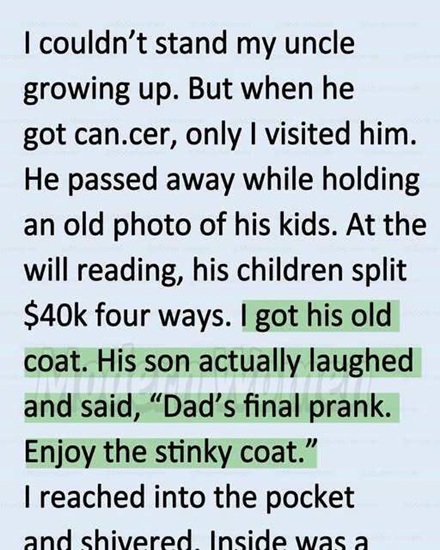
When I arrived at the lawyer’s office, I expected to leave exactly the way I had entered—with nothing. My late Uncle Richard had always been known as a difficult man. Family gatherings usually grew quiet when he entered the room, and few people ever described him as warm or approachable. Still, everyone knew he had spent decades investing in property and building considerable wealth. After his passing, many relatives seemed far more interested in discussing his estate than remembering the life he had lived.
The conference room buzzed with quiet conversations while everyone waited for the reading of the will to begin. Some relatives casually discussed vacation plans they hoped to make with their inheritance, while others speculated about houses, bank accounts, and investment properties. I sat quietly near the window, feeling strangely out of place. I hadn’t come expecting money. I was there simply because the attorney had informed every beneficiary that they should attend in person.
My relationship with Uncle Richard had never been especially close. We rarely agreed on anything, and our conversations often ended after only a few minutes. Yet shortly before his death, my mother encouraged me to visit him at the hospice center. She reminded me that kindness should never depend on someone’s personality or financial situation. Although I hesitated at first, I eventually spent an afternoon sitting beside his bed. We spoke very little, but before I left, he thanked me for coming. At the time, I believed those quiet words would be our final memory together.
The attorney eventually opened the envelope containing the will and began reading through each section. Several family members received modest financial gifts, while others inherited personal belongings or family keepsakes. There were smiles, disappointed expressions, and whispered reactions throughout the room. Then the attorney paused and looked directly toward me.
“My client wished for you to receive one personal possession.”
An assistant entered carrying an old canvas coat that looked as though it had been stored away for decades. The sleeves were worn, the fabric carried the scent of age, and one of the buttons had clearly been replaced years earlier. Laughter immediately spread across the room. A cousin jokingly suggested I had inherited the only item nobody else wanted. Another laughed that Uncle Richard had found one final opportunity to tease me. Embarrassed, I accepted the coat without responding.
Driving home, I couldn’t stop wondering whether everyone had been right. Perhaps the coat really had been nothing more than an old jacket with no value at all. I hung it near the front door and left it there for two days, unable to decide whether to donate it or throw it away. Every time I walked past it, I remembered my uncle’s final thank-you and wondered whether I had misunderstood its significance.
On the third evening, I decided to empty the pockets before taking it to a donation center. The outer pockets contained only a faded receipt and a worn handkerchief. As I checked the inside lining, however, my fingers brushed against an unusual seam. Hidden beneath the fabric was a carefully stitched compartment that would have been easy to overlook unless someone searched for it intentionally.
Inside rested a sealed envelope addressed to me.
My uncle’s handwriting was unmistakable.
The letter explained that throughout much of his later life he had struggled to know who genuinely cared about him and who cared only about the wealth he had accumulated. He admitted that his personality had often created distance between himself and others, but he also confessed that my quiet visit during his final days had meant more than he had been able to express at the time.
“You visited when there was nothing to gain,” he wrote. “That told me everything I needed to know.”
Alongside the letter was a small brass key attached to a numbered tag and paperwork identifying a private safety deposit box at a nearby bank. My curiosity quickly replaced the disappointment I had been carrying since leaving the lawyer’s office.
The following morning, I visited the bank listed in the documents. After confirming my identity and completing the necessary paperwork, an employee escorted me to a private room and placed a small deposit box on the table. I unlocked it with the brass key and slowly lifted the lid.
Inside were neatly organized legal documents relating to a commercial property that had been placed into a private trust. A second handwritten letter explained that my uncle had intentionally separated those assets from the rest of his estate years earlier. The coat had simply been the safest place to hide the key because he believed nobody else would bother claiming it.
He also wrote something that stayed with me long after I left the bank.
“People often look where value is obvious. Few people ever search where meaning is hidden.”
As the days passed, I thought less about the financial value of the inheritance and more about the lesson behind it. My uncle hadn’t left me the property because I was the closest relative or because I had asked for anything. According to his own words, he simply wanted to thank the one person who had chosen compassion over expectation during a difficult chapter of his life.
Months later, the old coat still hangs in my home. I no longer see worn fabric or faded buttons. Instead, I see a reminder that first impressions can be incomplete, that quiet moments sometimes carry the greatest significance, and that generosity can appear in unexpected forms. The inheritance changed my financial future, but the greater gift was understanding that simple acts of kindness often leave a deeper legacy than wealth itself. Sometimes the things that seem least valuable at first glance become the very objects that change the direction of our lives forever.

