
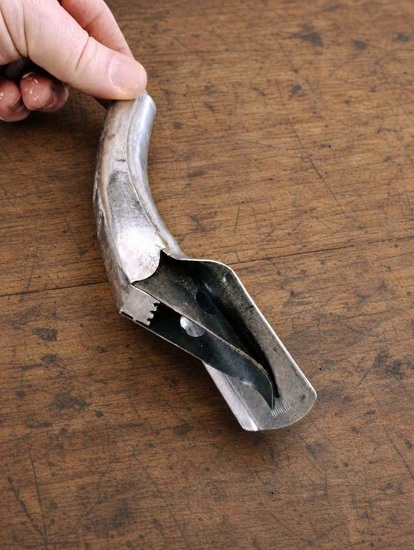
For many years, an unusual metal tool remained among a family’s inherited possessions without a clear explanation of what it had once been used for. It had belonged to the man’s father, but there was no instruction manual, packaging, label, or written description accompanying it. Its unusual construction made it appear more complicated than an ordinary household object, and several of its features seemed to suggest that it might have been connected to mechanical work. Whenever questions arose about it, the father reportedly offered little explanation.
As the years passed, an object that may once have been completely ordinary gradually became a small family mystery. This kind of mystery is surprisingly common with old tools because objects are usually designed to work within a larger system. A tool that looks perfectly logical beside the container or machine it was created for can become almost impossible to understand once that original equipment disappears. The shape remains, but the context that explained the shape is gone. Later generations are then left examining handles, cutting edges, openings, and channels without knowing what those features were intended to accomplish.
The problem is often not the complexity of the object itself, but the disappearance of the everyday routine surrounding it. The description of this particular object is consistent with a type of vintage automotive accessory commonly known as a self-piercing oil-can spout. Such tools were created for motor-oil containers that did not have the convenient screw caps and molded pouring necks found on modern plastic bottles. A reusable metal spout could puncture the sealed container and provide a path through which the oil could then be poured. In this way, a single device performed two closely related tasks. It opened the container and helped direct the liquid toward the engine or other equipment requiring lubrication.
Historical examples show why this arrangement was practical. Motor oil was once commonly sold in one-quart cans that had to be physically opened before their contents could be used. Instead of twisting off a cap, a mechanic or motorist needed to break through the top of the container. A sturdy reusable tool made that process faster and more controlled. After the oil had been poured, the device could be removed and used again on the next can. In an active garage or service station, that repeated usefulness made the tool an ordinary piece of equipment rather than an unusual invention.
The pointed or sharpened portion of such a device served an important purpose. It was designed to penetrate the relatively thin material sealing the oil container. The remaining structure then helped guide the liquid as it left the opening. Depending on the manufacturer and period, designs could vary considerably, so not every surviving oil-can opener looks exactly the same. Some examples were compact, while others incorporated longer pouring sections or different handle arrangements. Their appearance was determined primarily by the container they were intended to open.
Once that original container is removed from the picture, however, the design becomes much harder to understand. Someone accustomed exclusively to modern motor-oil bottles may see the sharp metal section and assume that it belongs to a cutting device. Another person may interpret the handle as part of a specialized mechanical adjustment tool. A channel intended for liquid may look like an unexplained structural feature. Placing the same device beside an old-style oil can suddenly makes those individual components much more logical.
Motor-oil packaging changed considerably during the twentieth century. Oil was sold through several types of containers, including metal cans and later composite cans that could combine paperboard bodies with metal ends. These packages served their purpose well, but they still needed to be punctured before the lubricant could be poured. The opener-and-spout design developed within that packaging environment. Its usefulness was therefore directly connected to a type of container that eventually disappeared from ordinary automotive retail.
This relationship between packaging and tools explains why the device later became obsolete. When manufacturers increasingly adopted plastic bottles, the container itself began performing functions that previously required separate equipment. A plastic motor-oil bottle could include a threaded opening, removable cap, molded handle, and narrow neck designed to assist pouring. Instead of finding a metal opener, piercing a container, and attaching a spout, the motorist could simply remove the cap and begin pouring.
Plastic bottles offered another practical advantage because they could generally be closed again. If a person did not use the entire contents immediately, the cap could be replaced. An opened metal or composite can was less convenient in this respect. The transition was therefore not simply cosmetic. Packaging changes altered how consumers handled, opened, poured, transported, and stored motor oil.
As those newer containers became standard, the old piercing tools gradually lost their everyday purpose. There was nothing fundamentally wrong with their design. They had simply been created to solve a problem that packaging manufacturers eventually eliminated. This is a recurring pattern in technological development. A useful accessory can disappear not because someone invents a better version of the accessory, but because another product is redesigned so that the accessory is no longer needed.
That is one reason old garages and workshops contain so many objects that younger people struggle to identify. Tools designed for obsolete containers, appliances, machines, fasteners, and maintenance routines can survive decades longer than the systems they supported. Metal is durable, and practical people often keep equipment even after they stop using it. A tool may move from an active workbench to a drawer, from the drawer to a storage box, and eventually from one generation of a family to another.
By the time the object reaches a younger owner, much of its history may already have disappeared. The new owner knows who possessed it but not necessarily why it was kept. Without photographs of it being used or someone available to demonstrate its function, imagination fills the missing information. A straightforward pouring tool can begin to look like part of an elaborate machine.
This difference in recognition has little to do with intelligence. People recognize objects largely through experience. Someone who regularly used canned motor oil could identify the appropriate opener because the shape was associated with a familiar physical action. A person born after those containers disappeared from ordinary use would never have formed that association. The same object can therefore be obvious to one generation and genuinely puzzling to another.
An experienced mechanic might recognize such a device very quickly for exactly that reason. Mechanics who worked during periods when canned motor oil remained common could have encountered similar spouts repeatedly. They would remember not only what the object looked like but also how it was positioned, how pressure was applied, and how the oil flowed afterward. That practical memory can make identification almost instantaneous.
The father’s reported reaction to questions about the object can also be understood in the context of this generational difference, although his exact thoughts should not be invented. He may simply have found it amusing that something once considered completely ordinary had become mysterious. Perhaps the tool reminded him of earlier vehicles, workplaces, or maintenance routines. Without a direct explanation from him, however, those possibilities remain interpretation rather than documented facts.
That distinction is important when retelling family stories. A person’s smile can suggest many things, but it cannot establish exactly what the person was thinking. A responsible account can describe the reaction without constructing an elaborate hidden meaning around it. Doing so allows the emotional quality of the story to remain while keeping speculation separate from verifiable information.
The physical construction of an unidentified tool can provide valuable clues when attempting to determine its purpose. A sharp or pointed edge can suggest that something was intended to be punctured. A hollow passage or channel may indicate that liquid or another material passed through it. A handle positioned for leverage can reveal how force was applied. Repeated wear around particular surfaces may show which sections regularly contacted another object.
Residue can sometimes provide another clue. An old tool used around automotive lubricants may retain dark or oily deposits in protected areas. However, residue by itself should not be treated as definitive proof of function. Workshops often contain many petroleum products, and tools can become contaminated even when they were originally designed for something else. Identification becomes stronger when several independent features point toward the same explanation.
Stamped markings can be even more informative. Older tools may contain manufacturer names, logos, patent numbers, model information, or partial lettering. These details can sometimes be compared with period catalogs, advertisements, patent documents, or museum collections. A matching patent illustration or catalog photograph provides much stronger evidence than a modern photograph of something that merely looks similar.
Measurements are useful as well. A tool designed to fit a standardized container should have dimensions corresponding to that container. Comparing width, curvature, piercing position, and handle placement with documented examples can help confirm or reject a proposed identification. This is why a clear photograph from several angles is especially useful when evaluating an unfamiliar antique tool.
Without such direct examination, absolute identification should be avoided. The description in this story fits historical self-piercing oil-can spouts, but different industrial and household tools can share similar features. Declaring that a specific inherited object definitely performed one function without seeing it would go beyond the available evidence. The safer conclusion is that the description strongly resembles a genuine class of vintage automotive tools whose historical function is well documented.
Understanding how those tools were used also requires understanding older service-station practices. Automotive maintenance was once closely connected with the experience of buying fuel. At full-service stations, attendants could perform tasks beyond simply filling the fuel tank. Checking oil levels was among the routine services associated with that era. When additional lubricant was needed, a fresh quart container could be opened and its contents added to the engine.
A reusable opening spout fit naturally into that workflow. The attendant did not need a complicated machine or a disposable device for every container. A durable metal tool could remain in the work area and be used repeatedly. Its strength and simplicity were advantages because it needed to survive many opening cycles.
Farm workshops and private garages could use similar equipment. Motor oil was needed not only for passenger cars but also for trucks, tractors, and various forms of machinery. Wherever sealed oil cans were stored, there was a practical need for a convenient way to open and empty them. The exact working environment varied, but the underlying packaging problem remained the same.
The device therefore belonged to a broader history of routine maintenance. It was not necessarily a rare professional instrument available only to specialists. Depending on the particular model, tools of this general type could be familiar equipment wherever canned lubricants were regularly used. That everyday status is precisely what makes surviving examples so interesting today.
Ordinary tools are often poorly documented within families because nobody expects them to become mysterious. People are more likely to record the history of jewelry, photographs, military medals, or expensive possessions than a small metal accessory kept near a workbench. When the owner dies or memories fade, the practical knowledge attached to an everyday tool can disappear surprisingly quickly.
The object itself then becomes the remaining evidence. Scratches show that it was handled. Worn edges reveal repeated contact. Old residue may hint at the environment in which it worked. A manufacturer’s mark can connect it to a period or company. Even without a written history, these details can help reconstruct the object’s former life.
This is one reason aggressive restoration should be approached cautiously. Making an old metal tool perfectly shiny may seem like an improvement, but heavy polishing can erase information. Stamped lettering can become less visible, original coatings can disappear, and characteristic surface wear can be removed. Patina may also help indicate age and storage history.
Basic preservation is often more useful than trying to make an antique appear new. Loose dirt can be removed carefully while preserving markings and stable surfaces. If old petroleum residue is present, sensible precautions should be taken because the exact composition may be unknown. The purpose of preservation is to keep the object stable and understandable rather than erase every sign that it was once used.
Recording family information can add considerably to an inherited tool’s significance. If the name of the previous owner is known, it can be written down. If the person worked as a mechanic, farmer, service-station employee, driver, or in another occupation involving machinery, that information can provide useful context. Even approximate dates and the location where the object was stored can help future generations.
This information is sometimes more meaningful than monetary value. Many ordinary vintage tools were manufactured in substantial quantities and may not command high collector prices. Their family history can nevertheless make them irreplaceable to the people who inherited them. A mass-produced object becomes unique when it is connected to a particular person’s life and work.
Market value and historical value should therefore not be confused. An item can be inexpensive while still providing an excellent illustration of how people once performed a routine task. A vintage oil-can spout can explain older packaging and maintenance practices more immediately than a written description alone. Looking at its cutting point and pouring channel makes the former process easier to visualize.
The history of motor-oil containers demonstrates how rapidly these routines can change. Once plastic bottles became widespread, opening oil became so simple that many consumers stopped thinking of it as a separate task. Removing a threaded cap requires no specialized equipment. The package itself now contains the solution.
That convenience can make older systems seem unnecessarily complicated when viewed from the present. It would be easy to ask why manufacturers did not simply use screw-top bottles from the beginning. But packaging technology depends on available materials, manufacturing processes, transportation needs, costs, and consumer expectations. Products evolve as those conditions change.
The old opener was therefore a sensible response to the technology of its period. Judging it by modern packaging standards misses the reason it existed. Its shape was not an arbitrary mechanical puzzle. It represented an efficient way to deal with a sealed container that millions of motorists and mechanics once encountered.
The same phenomenon appears throughout everyday history. A tool for rewinding magnetic tape, opening a particular food container, adjusting an obsolete appliance, or maintaining an older machine can become confusing when the related technology disappears. Future generations may experience the same uncertainty when encountering devices that are completely familiar today.
This is why identifying an old tool can feel surprisingly satisfying. Before identification, every feature raises another question. Afterward, those same features become answers. The sharp point exists because a can needed to be pierced. The channel exists because oil needed to flow somewhere. The handle exists because pressure and control were required.
Nothing about the device has physically changed, yet understanding changes the way it appears. An object that seemed overly complex suddenly looks remarkably economical. Each major component serves a recognizable purpose.
That transformation from mystery to explanation is one of the pleasures of studying historical objects. It demonstrates that material culture carries knowledge even when written instructions disappear. A tool preserves clues about the problem it was designed to solve.
Museums make use of the same principle when cataloging everyday artifacts. An object is not valuable only because of its appearance. Researchers want to know what it was called, who manufactured it, when it was produced, how it was used, and what other equipment surrounded it. Context transforms an isolated object into historical evidence.
Old advertisements and catalogs can be particularly helpful because they often show tools in use. A photograph of an unidentified metal object alone may provide few clues. An advertisement showing the same device attached to an oil can can resolve the mystery immediately. The missing relationship between tool and container becomes visible.
Patent drawings can provide another source of evidence. Inventors often had to explain not only the shape of a device but also the function of individual components. Those documents can reveal how a tool was supposed to move, where it contacted another object, and what problem the inventor intended to solve.
Historical photographs of service stations can add further context. A tool that seems strange on a modern kitchen table looks much more natural when placed among old fuel pumps, lubricant displays, cans, funnels, and workshop equipment. Environment helps restore meaning.
This is also where different generations can contribute different kinds of knowledge. An older relative may not know a manufacturer’s model number but may remember exactly how a tool was held. A younger family member may never have seen it used but can search digitized catalogs and museum databases.
Combining those perspectives can produce a much richer identification. One person supplies lived memory while another finds documentary confirmation. Instead of treating generational differences as a weakness, they can become complementary sources of information.
Family objects can encourage those conversations before knowledge disappears. Asking older relatives about tools, photographs, furniture, documents, and other possessions while they can still explain them preserves information that may otherwise be impossible to recover. A brief recorded explanation can become extremely valuable decades later.
The story of the mysterious metal tool illustrates what happens when that explanation is missing. The object survives, but its original meaning becomes uncertain. It remains connected to the father because he owned it, yet the practical part of that connection becomes harder to reconstruct.
Identification can restore at least part of what was lost. Knowing that an object resembles a vintage oil-can opening spout places it within a recognizable historical routine. The tool can once again be imagined alongside the container and vehicle for which equipment of this type was designed.
It also gives the father’s familiarity with the object a plausible context without inventing details about his personal history. If he encountered similar tools during the era when canned oil was common, there would have been nothing mysterious about the design to him. The younger generation’s confusion simply reflects how much packaging had changed.
Technological progress often works this way. New products make certain tasks easier, but they also cause the knowledge associated with older methods to fade. People gain convenience while losing familiarity with tools that were once necessary.
Neither generation is necessarily more capable because of this difference. Each understands the technology it regularly encounters. A modern driver may know how to navigate electronic vehicle systems that would be unfamiliar to someone from the 1950s, while the earlier motorist may instantly recognize mechanical accessories that puzzle today’s driver.
The inherited tool becomes a physical reminder of that changing knowledge. It connects two technological worlds without needing to be particularly valuable or rare. One generation sees a familiar accessory; another sees a puzzle.
Packaging is especially effective at producing these forgotten objects because it changes frequently. Manufacturers continually search for containers that are cheaper, lighter, stronger, safer, easier to transport, or more convenient for consumers. When packaging changes, accessories associated with the older design can quickly become unnecessary.
The move toward plastic motor-oil bottles is an excellent example. A screw cap eliminated the need to puncture a sealed top. A molded neck improved pouring. A replaceable cap allowed unused contents to be stored more conveniently. Several separate functions became part of one disposable package.
Once consumers became accustomed to that arrangement, the previous opening method faded from memory. Children growing up around plastic bottles might never see a traditional oil can being punctured. Within a relatively short period, recognition of the old opener could therefore decline dramatically.
That is how an everyday object can begin looking ancient long before it is truly ancient. Its unfamiliarity comes less from extreme age than from rapid technological change.
Collectors sometimes describe such objects as examples of obsolete technology, but “obsolete” does not mean useless from a historical perspective. The tool no longer needs to perform its original job to teach something about the past.
It can demonstrate how manufacturers packaged products, how mechanics worked, how consumers maintained vehicles, and how design responded to practical problems. Those lessons remain even when the original cans are gone.
An inherited example adds another dimension because it connects technological history with family memory. The tool is not simply representative of an

