
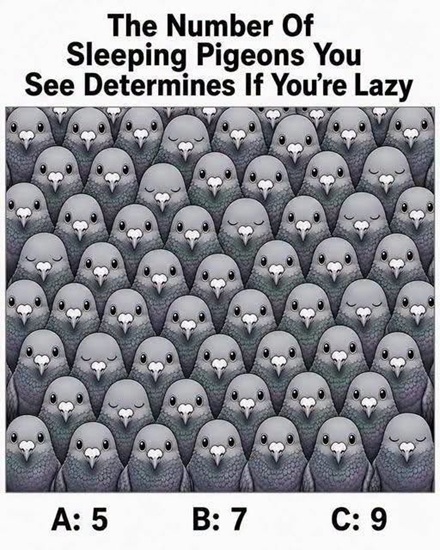
How Many Pigeons Did You See First? This Quick Visual Puzzle May Be Trickier Than It Looks
At first, the challenge seems straightforward. Look at the image. Count the pigeons.
Give your answer. But then someone beside you gives a different number. You look again.
And suddenly, what seemed obvious a few seconds earlier is not so obvious anymore.
That is the appeal of visual puzzles like this one.
They are simple enough to try quickly, but just uncertain enough to make people compare answers afterward.
Before going any further, however, there is one important thing to keep in mind.
This Is Not a Scientific Personality Test
Some online puzzles claim that the first thing you notice can reveal your personality, intelligence or hidden traits.
That should not be taken literally here.
This pigeon-counting challenge is not a psychological assessment.
It cannot diagnose a condition.
It cannot measure intelligence.
And it cannot reliably tell you what kind of person you are.
What it can do is give you a small demonstration of how differently people can look at the same image.
That alone is interesting.
Especially when the first answers do not match.
Look Once Before You Study the Picture
Try to resist the urge to count carefully at first.
Give the image one quick glance.
Then decide what number came to mind.
Five?
Seven?
Nine?
Remember that first answer.
Now return to the image and take more time.
Scan every part.
Look toward the corners.
Check the shapes that seemed less important during the first glance.
Did your number change?
If it did, there is nothing unusual about that.
Your first impression and your careful inspection are doing slightly different jobs.
And that is where the puzzle begins to get more interesting.
We Do Not Notice Everything at Once
Seeing may feel automatic, but attention is selective.
When you look at a scene quickly, some objects stand out more strongly than others.
Large shapes may attract attention first.
Central objects may be easier to notice than items near the edge.
Things with clearer contrast may stand out before less obvious details.
That means your initial count can depend on what your attention happened to prioritize.
Give yourself another few seconds and additional details may become visible.
The picture did not change.
Your attention did.
But there is another factor people often forget.
The Same Image Can Look Different on Different Screens
Someone viewing the puzzle on a large monitor may have an easier time noticing small details.
Someone on a phone may see the same image at a much smaller scale.
Brightness can affect visibility.
Contrast can affect visibility.
Image quality can affect visibility.
Viewing distance can matter too.
So when two people disagree about the number of pigeons, the difference may not tell you anything deep about either person’s personality.
They may simply be viewing the puzzle under different conditions.
Still, the first answers can be fun to compare.
If You Saw 5 Pigeons First
If your immediate answer was five, one simple possibility is that you noticed the most prominent birds first.
You may have taken in the overall scene before examining every small element.
People sometimes describe that as a “big-picture” style of looking.
But the puzzle cannot prove that this is how you approach every situation in life.
It only tells you what you noticed in this particular image at this particular moment.
Still, ask yourself something.
Did you answer quickly?
Did you focus mostly on the center?
Did you stop counting once the main shapes seemed clear?
If so, your second look may reveal more.
And for some people, it does.
What If You Saw 7?
Seven can appear when someone catches both the most obvious birds and several less noticeable ones.
Perhaps you scanned a little longer.
Perhaps certain details stood out to you immediately.
Or maybe the image was simply clearer on your screen.
It can be tempting to label seven as the “balanced” answer.
But there is no scientific evidence that seeing seven pigeons proves someone has a balanced personality.
The better question is how you arrived at seven.
Did you count systematically?
Or did the number seem obvious right away?
Take another look.
The answer may stay the same.
Or one more detail may suddenly appear.
If Your First Count Was 9
If you saw nine pigeons immediately, you may have noticed smaller details before deciding on your answer.
Maybe you scanned carefully from one part of the picture to another.
Maybe you took slightly longer before responding.
Or perhaps the hidden or less obvious birds were simply easier for you to see.
Calling this “detail-oriented” can be a fun description.
But again, it should not be treated as a personality diagnosis.
A careful count in one puzzle does not prove how someone behaves in work, relationships or everyday decisions.
Context changes attention.
And that is an important part of the exercise.
Try Changing Your Scanning Strategy
Here is another way to test yourself.
Start at the top-left corner.
Move slowly across the image.
Then go down and scan the next section.
Continue until you have examined the entire picture.
Count each pigeon only once.
Now compare that number with your first answer.
If the result is different, your eyesight did not suddenly improve.
Your method changed.
A deliberate search can reveal things that a quick glance misses.
That is one reason people often enjoy these puzzles more on the second attempt.
Why Different Answers Start Conversations
Visual puzzles are especially entertaining when people disagree.
One person confidently says five.
Another insists there are seven.
Someone else claims nine.
Then everyone returns to the image.
People start pointing things out.
One viewer realizes they overlooked a bird.
Another discovers they counted something twice.
A third notices an object near the edge that everyone else ignored.
The discussion becomes part of the puzzle.
And that may be more valuable than the answer itself.
Your Count Does Not Measure Intelligence
It is worth repeating this clearly.
Seeing more pigeons first does not automatically mean you are smarter.
Seeing fewer does not mean you are less observant.
The puzzle cannot measure IQ.
It cannot diagnose attention disorders.
It cannot reveal whether you are creative, logical, introverted or extroverted.
Claims like that would go far beyond what a casual image can establish.
The puzzle is better enjoyed for what it actually is.
A short test of observation under ordinary viewing conditions.
Nothing more.
But there is still a useful lesson hidden inside it.
First Impressions Can Feel More Complete Than They Really Are
Think about your original answer.
When you first gave the number, it probably felt right.
Maybe you were completely certain.
Then you looked again.
If your answer changed, that certainty suddenly became less reliable.
That is what makes the puzzle memorable.
The difference between the first and second look is often more interesting than whether you counted five, seven or nine.
A quick impression can be useful.
But it may leave out details.
A slower inspection can reveal information that was present the entire time.
And now the puzzle reaches its real point.
The Most Interesting Part Is Not the Number
Five, seven and nine give people something easy to compare.
But the number is not really the biggest takeaway.
The more interesting part is noticing how your perception changes when you give yourself more time.
On the first look, your attention may lock onto the most obvious shapes.
On the second, smaller details begin to emerge.
The image stays the same.
Your way of looking changes.
That is why this puzzle works so well as a simple observation exercise.
It does not need to reveal a hidden personality.
It does not need to predict anything about your future.
It only needs to make you look twice.
So remember your first number.
Count again slowly.
Then compare.
The real surprise may not be whether you saw five, seven or nine pigeons.
It may be realizing how much was in front of you before you ever noticed it.

