
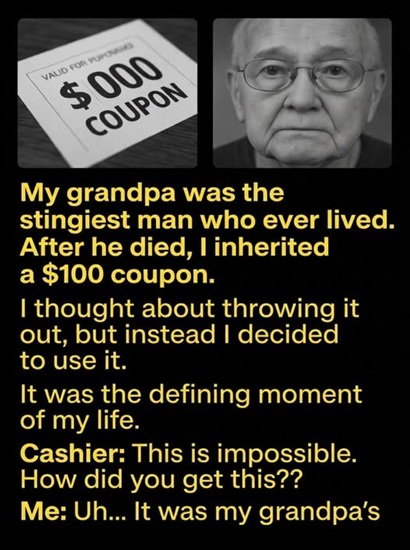
The story of the coupon I nearly threw away does not truly begin with the piece of paper itself, but with the kind of person my grandfather was. He was known in our family as someone who handled resources with care and attention. While some people may have simply described him as frugal, those who knew him more closely understood that his habits came from a deeper sense of respect for value and use. He rarely wasted anything and often kept items far longer than most people would consider necessary.
As children, we did not fully understand his way of living. We sometimes joked about the way he kept objects that appeared old or no longer useful. To us, it seemed unnecessary at the time, something that belonged to an earlier way of thinking. However, as we grew older, some of us began to realize that his actions were not random at all. They were part of a consistent mindset shaped by patience, discipline, and an appreciation for not wasting what still had purpose.
After his passing, going through his belongings became a quiet and emotional process. Among the items he left behind, I came across an old book filled with handwritten notes. Inside it, carefully placed between pages, was a faded coupon. At first glance, it looked completely ordinary. The paper was worn, slightly creased, and showed no sign of particular importance. My initial reaction was that it was something without real value, something that could easily be discarded.
For a moment, I genuinely considered throwing it away. It seemed like just another forgotten piece of paper that had lost its meaning over time. But something stopped me. Perhaps it was curiosity, or perhaps it was a sense of respect for the person who had kept it. I also realized that my grandfather rarely held on to things without a reason, even if that reason was not immediately clear to others. That thought made me pause and take a closer look instead of making a quick decision.
As I examined the coupon more carefully, I began to understand that its importance was not about its physical condition or monetary worth. Instead, it represented something deeper connected to the way my grandfather viewed life. It reflected a mindset where even small or ordinary items could carry meaning if they were preserved with intention. What once looked insignificant began to feel like a small window into his way of thinking.
This moment caused me to reflect on many assumptions I had made over the years. I had often viewed his habits through a modern perspective, where convenience and speed are highly valued. In such a mindset, keeping old or unused items can appear unnecessary. However, looking back with more maturity, I started to see his behavior differently. What once seemed like excess caution now appeared to be a form of careful stewardship over what he owned.
In today’s world, it is common to replace things quickly rather than repair or preserve them. Many people are encouraged to focus on what is new rather than what still has usefulness. Against this background, my grandfather’s habits stood out as something different. He seemed to follow a quieter principle, one that valued preservation, patience, and mindful use of resources rather than constant replacement.
This experience also made me think more deeply about patience. Patience is not simply about waiting for something to happen, but about understanding that value often develops over time. Many of my grandfather’s small habits reflected this idea. He would take care of belongings carefully, avoid unnecessary waste, and pay attention to details that others might ignore. Each action on its own seemed small, but together they formed a consistent way of living.
What I once failed to recognize was that meaning is often not immediately visible. From the outside, actions can look confusing or unnecessary, but they are usually shaped by personal experience and long-term understanding. This is especially true when looking at older generations, whose values were often formed in different circumstances and under different expectations than our own.
The coupon itself eventually became less important than what it helped me realize. It was not about financial value or practical use. Instead, it became a symbol of perspective. It reminded me that I had often judged actions too quickly without fully understanding their purpose. It also showed me that even the smallest objects can carry meaning when connected to memory and intention.
In many ways, this discovery felt like a quiet inheritance. It was not something physical or material, but rather a shift in how I viewed value, waste, and attention to detail. It encouraged me to be more thoughtful about how I interpret the actions of others, especially those who come from different generations or life experiences.
Looking back, the lesson was never truly about a coupon. It was about learning to slow down and reconsider what I thought I understood. It was about recognizing that wisdom is often hidden in simple habits and that meaning is not always obvious at first sight. Sometimes, it only becomes clear after time has passed and perspective has changed.
In the end, what remains is not the object itself, but the understanding it created. My grandfather’s careful way of living continues to influence how I think about value and responsibility. And that small, almost forgotten coupon became a reminder that even ordinary things can carry lessons that last far beyond their physical presence.

