
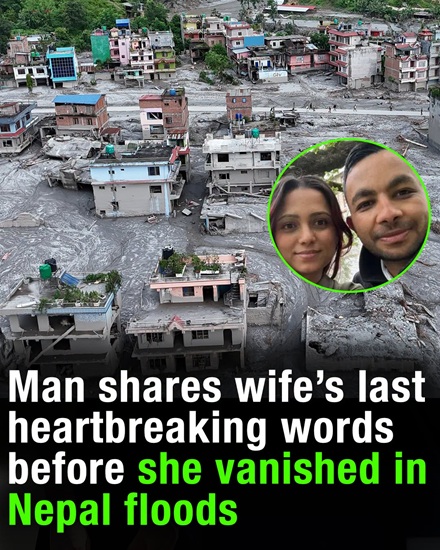
His Wife Said “I Love You” — Hours Later, a Devastating Flood Changed Everything
For Pramod Poudel, the morning began with an ordinary phone call.
His wife, Sumitra, was in Nepal.
Pramod was thousands of miles away in Britain.
The newly married couple spoke briefly, as they had done before.
Sumitra asked how he was.
Then she told him she loved him.
Neither of them could have known what the next few hours would bring.
Soon afterward, a catastrophic flood carrying water, mud, rock and ice tore through communities in the Himalayan border region.
When Pramod tried to reach his family again, there was no answer.
And Sumitra was not the only person missing.
Four Members of One Family
Pramod soon learned that his 25-year-old wife could not be located.
His mother was missing too.
So was his brother.
And his uncle.
The flood had devastated the village of Sole, where members of his family lived.
Communications were badly disrupted.
Roads and bridges had been destroyed.
Entire areas were difficult to reach.
From Britain, Pramod faced an unbearable problem.
He knew a disaster had struck his family’s community.
But he did not know what had happened to the people he loved.
Waiting from thousands of miles away was not an option he could accept.
He decided to return to Nepal.
The Disaster Came With Extraordinary Force
The August 26, 2026 disaster struck communities along the Nepal-China border and the river valleys below the Himalayas.
It was not an ordinary rise in river levels.
A massive movement of glacial material, rock and debris sent a destructive surge downstream.
The event was powerful enough to register on seismic monitoring equipment.
Early information initially caused confusion about whether an earthquake had occurred.
Later analysis connected the signal to a huge glacial collapse and debris movement.
What followed downstream was devastating.
Water mixed with mud, rock, ice and other debris.
The moving mass tore through infrastructure.
Bridges failed.
Roads were buried or washed away.
Buildings disappeared.
And communities suddenly became isolated.
For people in the path of the surge, there was very little time.
The Numbers Kept Rising
The first reports could not reveal the full scale of the catastrophe.
Many communities were inaccessible.
Communications had failed.
Thousands of people could not immediately be accounted for.
As search teams reached more locations, the toll increased.
By September 4, authorities were reporting more than 1,250 deaths in Nepal and more than 4,200 people still missing.
Thousands of people had also been displaced.
The destruction created two emergencies at once.
Rescuers needed to find survivors.
And survivors needed food, shelter, medical care, transportation and communication.
But for Pramod, everything came down to four names.
Sumitra.
His mother.
His brother.
His uncle.
“My Family Needs Me”
Pramod, 34, had grown up in Nepal before moving to Britain when he was young.
He later established his life in Uckfield, East Sussex, where he runs a Nepalese street-food business.
His family ties to Nepal remained strong.
When news of the flood arrived, those two parts of his life suddenly collided.
Pramod publicly explained that four members of his family were missing.
He described the situation as devastating.
Then he made his decision.
He would fly back.
His reason was simple.
His family needed him.
But arriving in Nepal would only be the beginning.
Getting Home Was Suddenly Extremely Difficult
The flood had damaged precisely the infrastructure people needed for rescue.
Roads were gone in places.
Bridges had collapsed.
Mud and debris blocked routes.
Electricity had failed in affected areas.
Phone connections were unreliable or unavailable.
Even knowing where someone was did not mean rescuers could immediately reach them.
Pramod faced the same obstacles.
After flying to Nepal, he began traveling toward the region where he had grown up.
Some parts of the journey could not be completed normally by road.
He had to continue toward the devastated area under extremely difficult conditions.
The closer he came, the clearer the scale of the destruction became.
And what he eventually saw was difficult to recognize.
The Village He Remembered Had Changed
Sole had been devastated.
Pramod said that most of the village had been swept away.
Homes that had once stood there were gone.
Routes connecting communities had disappeared.
Mud and debris covered areas where people had lived.
This was not simply damage to a few buildings.
The physical landscape had been transformed.
For someone returning to the place where he grew up, the destruction carried another kind of weight.
Every missing structure could hold a memory.
Every vanished path had once led somewhere familiar.
But Pramod had not traveled thousands of miles simply to look at what had been lost.
He was searching for people.
And there was still no confirmed answer.
His Father Was There — The Others Were Not
Reports following Pramod’s return to Nepal indicated that he was reunited with his father.
That brought one piece of certainty.
But four other members of the family remained missing.
Sumitra had not been found.
Neither had Pramod’s mother, brother or uncle.
As the days passed, the possibility of finding them alive became increasingly uncertain.
Yet the disaster had already produced surprising rescues.
Some people survived in places that initially seemed impossible.
And those stories made giving up even harder.
Survivors Were Found Days Later
The flood struck hydropower facilities as well as residential communities.
Some workers became trapped underground or inside tunnels.
Search teams continued looking for them long after the initial surge had passed.
In one extraordinary case, a worker was rescued after surviving for nine days.
Other survivors were also located after extended periods.
Each successful rescue mattered far beyond the individual involved.
For families waiting for news, it demonstrated that survival was still possible.
That possibility can sustain hope.
But hope becomes increasingly painful when days continue passing without news.
Pramod knew both realities.
People could survive.
But thousands were still missing.
The Last Phone Call Became Impossible to Forget
Before the disaster, Pramod’s conversation with Sumitra would have seemed completely ordinary.
They were a married couple living temporarily apart.
He had returned to Britain for work.
She remained in Nepal.
They expected to speak again.
During their final known conversation, Sumitra asked Pramod how he was doing.
She told him she loved him.
Then they ended the call.
There was no dramatic farewell.
No warning.
No reason to think those words would later carry such enormous weight.
Hours afterward, Sumitra disappeared during the disaster.
Pramod would replay that conversation in a completely different world.
They Had Only Recently Married
The timing added another layer to the tragedy.
Pramod and Sumitra were newlyweds.
Their marriage was supposed to mark the beginning of a shared future.
Work had temporarily separated them geographically.
That separation was not supposed to last.
Pramod was building his life and working in Britain.
Sumitra remained close to his family in Nepal.
Then, within hours, the future they expected became uncertain.
A routine phone call became their last confirmed contact.
That is one of the cruelest features of sudden disasters.
People rarely know which ordinary moment will become the one they remember forever.
Rescue Teams Faced a Landscape Working Against Them
The Himalayan environment made the response exceptionally difficult.
Mountain roads often follow narrow valleys.
Communities may depend on a limited number of bridges.
When a major flood destroys those connections, alternative routes can be extremely difficult.
Heavy debris creates another problem.
Mud can make roads impassable.
Large boulders can block access.
Damaged slopes may remain unstable.
Helicopters can help, but weather, terrain and available landing areas can restrict operations.
Search teams therefore had to work through enormous logistical obstacles.
For families waiting for news, every delay felt much longer.
The Flood Also Hit Major Infrastructure
Hydropower facilities along the affected river systems suffered serious damage.
Workers were caught in the disaster.
Some became trapped.
Others were listed as missing.
Rescuers searched tunnels because those underground spaces created both danger and hope.
A tunnel could become inaccessible after debris blocked its entrance.
But it could also protect someone from the full force of the flood outside.
That possibility proved important when survivors were later rescued.
Elsewhere, however, entire structures had simply disappeared.
The search zone was enormous.
And the number of missing people was overwhelming.
One School Escaped With Minutes to Spare
Amid the destruction, there were also remarkable stories of survival.
At one school, a warning allowed hundreds of students and staff to move to safer ground before floodwaters arrived.
The school itself was later devastated.
The people escaped.
The episode demonstrated how important even a short warning can be during a fast-moving flood.
Minutes matter.
Information matters.
A decision made immediately can matter.
Many other communities did not receive enough time.
For some, the flood arrived with terrifying speed.
Families Began Searching Everywhere
Hospitals became places of hope and fear.
So did shelters.
Identification centers.
Survivor lists.
Families checked every available source of information.
Some traveled toward damaged communities themselves.
Others waited for phone networks to return.
Some missing people eventually made contact.
They had survived but had been unable to communicate.
Each reunion brought relief.
But it also highlighted the thousands of families who were still waiting.
Pramod remained among them.
The Search Slowly Changed
Immediately after a disaster, every effort focuses on finding survivors.
Teams listen for signs of life.
They search damaged buildings.
They enter tunnels.
They follow reports from witnesses.
But eventually another task becomes unavoidable.
Recovering and identifying those who did not survive.
The enormous number of victims placed additional pressure on Nepal’s emergency services.
Identification became a major challenge.
Families needed certainty before they could begin mourning.
DNA samples and other identifying information became increasingly important.
The process was slow.
For someone waiting for a missing relative, every unidentified victim created another possibility they did not want to consider.
Not Knowing Can Become Its Own Form of Grief
When a death is confirmed, grief begins around a terrible certainty.
When someone is missing, certainty never arrives.
A family can move between hope and fear repeatedly.
A phone ringing can suddenly seem important.
A rumor about survivors can create hope.
A new list can cause panic.
Every unidentified person could be the one they are searching for.
Every rescue can renew hope.
Every passing day can weaken it.
Pramod was living inside that uncertainty.
And four members of his family were at the center of it.
The Disaster Was Bigger Than Any One Family
By early September, Nepal was facing destruction on a national scale.
More than a thousand people had been reported dead.
Thousands remained missing.
Homes and businesses had been destroyed.
Critical infrastructure needed repair.
The estimated financial losses reached billions of dollars.
But numbers can become difficult to comprehend.
Four missing relatives are easier to imagine.
One newlywed wife.
One mother.
One brother.
One uncle.
One man crossing thousands of miles to search for them.
Pramod’s experience does not represent every family’s story.
But it shows what a disaster statistic means at the human level.
Every number has a name behind it.
The Scientific Questions Matter Too
Researchers and authorities have continued examining what triggered the disaster.
The event was associated with a major glacial and debris collapse in the Himalayan region.
Large volumes of ice, rock and sediment moved rapidly downhill and entered river systems.
In steep mountain terrain, that material can gain enormous destructive force.
Boulders become part of the flow.
Mud becomes dense.
Bridges designed for ordinary river conditions face extraordinary pressure.
Buildings near waterways can have little protection.
Understanding exactly how the event developed will matter for future risk assessment.
Because the danger in the Himalayas extends beyond one flood.
A Changing Mountain Environment Creates New Challenges
The Hindu Kush Himalayan region contains enormous quantities of snow and ice.
Scientists have documented major changes to glaciers across the region as the climate warms.
Those changes can affect glacial lakes, slopes and water systems.
However, scientists must study individual disasters carefully before assigning specific causes.
Not every flood has one simple explanation.
What is clear is that mountain communities can face serious risks from glacial hazards and extreme flows.
Better monitoring and warning systems can save lives.
The school evacuation demonstrated exactly why.
A few minutes can be priceless.
The Physical Recovery Will Be Long
Once the search operations end, another enormous task begins.
Roads must be rebuilt.
Bridges must be replaced.
Electricity needs restoration.
Homes need reconstruction.
Water supplies need protection.
Schools and businesses need to reopen.
Displaced families need somewhere to live.
Nepalese officials estimated billions of dollars in losses.
Those numbers describe infrastructure.
They cannot measure personal loss.
A rebuilt house cannot replace a missing family member.
A new bridge cannot erase the memory of what happened.
That recovery follows a different timeline.
For Pramod, Everything Still Returns to One Conversation
The statistics are enormous.
The science is complicated.
The reconstruction will take years.
But Pramod’s story keeps returning to something much smaller.
A phone call.
His wife was on the other end.
She asked how he was.
She told him she loved him.
They expected another conversation.
Then the flood came.
That is why those words became so important afterward.
They were never intended to be a farewell.
One Story Among Thousands
Pramod traveled from Britain to Nepal because waiting at a distance had become unbearable.
He wanted answers.
He wanted to reach the place where his family had been.
He wanted to search.
But the disaster had destroyed much of what connected him to that place.
His wife Sumitra, his mother, his brother and his uncle remained missing in the latest detailed reports about his search.
Their fate was feared to be tragic, but without confirmation, the uncertainty remained.
And that distinction matters.
Missing is not the same as confirmed dead.
Reporting should preserve that difference.
So should memory.
For Pramod, the final confirmed moment with Sumitra remains that early-morning call.
Nothing about it sounded historic.
Nothing about it sounded final.
It was simply a husband and wife talking across thousands of miles.
Then she said she loved him.
Hours later, the world they expected to return to had changed.

