
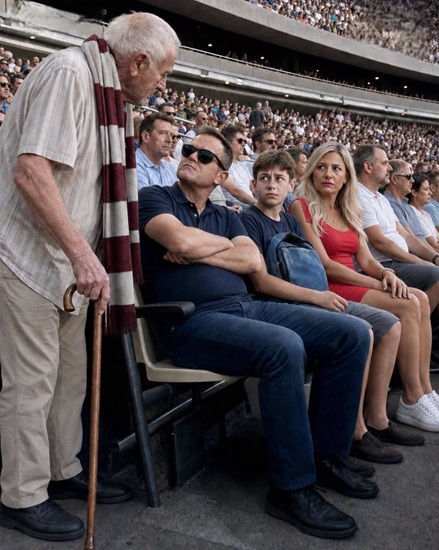
Football had been part of my grandfather Jeremy’s life for longer than I could remember. At ninety-two, he could still describe matches from decades earlier with surprising detail, including goals, players and afternoons spent in the stands with my grandmother June. She had died twelve years earlier, but Grandpa continued wearing the faded blue scarf she had bought him when they were young. To everyone else it was simply an old piece of fabric. To him, it represented a lifetime of memories.
As Grandpa grew older, attending matches became increasingly difficult. Walking long distances exhausted him, stairs were challenging, and he relied heavily on his cane. Still, whenever our team appeared on television, he became the enthusiastic supporter I remembered from childhood. When he mentioned that he wished he could attend one major match at the stadium again, I decided that we should stop talking about it and make it happen. I saved enough money to purchase two premium accessible seats.
When I showed Grandpa the tickets, he initially thought I was joking.
Then he became emotional.
He carefully removed an old photograph from his wallet. It showed June when she was nineteen, smiling at the camera with the same blue scarf around her shoulders.
“She’ll come with us,” he said.
On match day, the stadium was already filled with noise when we arrived. Supporters streamed through the entrances wearing team colors while songs echoed through the concourses. I guided Grandpa slowly toward our section, making sure he had enough time to rest whenever he needed it.
When we finally reached our seats, he looked across the field and smiled.
For several minutes, he didn’t speak.
Then he took June’s photograph from his wallet and held it toward the pitch.
“We made it,” he whispered.
That moment alone made every dollar I had spent worthwhile.
Unfortunately, the peaceful beginning did not last.
Shortly before kickoff, another family arrived.
A well-dressed man looked at our seats and insisted that we were sitting where his family belonged.
I immediately checked our tickets.
The numbers matched perfectly.
I showed them to him and explained that I had specifically purchased accessible seating because my grandfather could not comfortably manage ordinary stadium stairs.
The man barely looked at the tickets.
Instead, he continued insisting that we move.
I asked him to call a steward so the situation could be resolved properly.
Then he looked at Grandpa.
His next comment stunned me.
He suggested that at Grandpa’s age, the match probably wouldn’t matter much because he might not even remember it afterward.
Grandpa heard him.
The excitement disappeared from his face.
I was furious.
Before I could respond, Grandpa touched my arm.
“Leave it,” he whispered.
“No.”
“It’s only a seat.”
But we both knew it wasn’t.
The seat represented the match he had dreamed about attending.
More importantly, nobody deserved to be dismissed simply because of their age.
Grandpa nevertheless reached for his cane and began preparing to move.
That was when another voice interrupted us.
“Dad, that’s enough.”
The man’s teenage son stepped forward.
In this fictional story, his name was Brandon.
His father told him not to interfere, but Brandon remained where he was.
He looked at Grandpa, then at his father.
“You know those aren’t our seats.”
The man became visibly irritated.
Brandon opened his backpack.
Inside was an old captain’s armband.
He explained that it had belonged to his grandfather, who had spent much of his life supporting the same team.
His grandfather had eventually given the armband to Brandon’s father as a reminder that leadership was about responsibility rather than status.
Brandon held it in his hands.
Then he looked directly at his father.
“Grandpa would be ashamed of this.”
The words were quiet.
That somehow made them more powerful.
His father stared at him.
Brandon walked toward Jeremy and held out the armband.
“I don’t think Dad should have this right now.”
Grandpa shook his head.
“Son, that’s a family keepsake.”
“I know.”
“Then keep it.”
Brandon hesitated.
“I want you to hold it until he remembers what it means.”
Before the disagreement could continue, a stadium steward arrived.
I showed him our tickets.
The other family showed theirs.
Within moments, the issue was resolved.
The premium accessible seats were ours.
The steward politely instructed the other family to move to their assigned places.
There was no need for an argument.
The tickets settled everything.
But people nearby had already noticed what happened.
One supporter offered Grandpa a match program.
Another handed him binoculars.
A woman nearby shifted her belongings so Grandpa had additional room for his cane.
Suddenly, instead of feeling unwanted, Grandpa found himself surrounded by strangers making sure he was comfortable.
Brandon remained nearby for several minutes.
Before leaving for his own seat, he shook Grandpa’s hand.
“Enjoy the match.”
Grandpa smiled.
“You too.”
The first half was exciting, but the score remained tied.
At halftime, Brandon’s father returned.
This time he came alone.
He looked uncomfortable.
“I owe you an apology,” he said.
Grandpa waited.
The man admitted that he had behaved badly.
Then he turned toward Brandon, who had followed him back.
“Can I have Grandpa’s armband?”
Brandon looked at him.
“Do you understand why I took it?”
His father nodded.
“I think so.”
Grandpa stepped between them.
He handed the armband back to Brandon instead.
“You decide when he’s ready.”
For the first time that afternoon, the father smiled slightly.
“Fair enough.”
The second half began.
With only minutes remaining, our team scored.
The stadium exploded.
Grandpa instinctively tried to stand, and I grabbed his arm to steady him.
He was laughing and crying simultaneously.
Then he pulled June’s photograph from his pocket and held it against his chest.
“That one was for you,” he whispered.
The final whistle came soon afterward.
Our team had won.
As supporters began leaving, Brandon returned to say goodbye.
Grandpa looked at the captain’s armband around the teenager’s wrist.
“You know what that means?” he asked.
“Leadership?”
Grandpa nodded.
“But leadership isn’t about having authority.”
Brandon listened carefully.
“It’s about what you do when you could take something for yourself but decide to make room for someone else instead.”
Brandon glanced toward his father.
The man was standing several feet away.
This time, there was no arrogance in his expression.
Grandpa reached out and shook his hand.
The man apologized once more.
Grandpa accepted it.
That surprised me.
Later, I asked why.
“Because people can behave badly and still learn something,” he said.
We slowly made our way toward the exit.
Near the end of the row, Grandpa noticed an empty paper cup on the ground.
He stopped and picked it up.
“Seriously?” I laughed. “You’re ninety-two. Let somebody else do that.”
Grandpa dropped it into a nearby bin.
Then he looked at me.
“You always leave your place a little better than you found it.”
On the drive home, he talked endlessly about the match.
He remembered the winning goal.
He remembered Brandon.
He remembered the armband.
And, despite what the stranger had predicted, he remembered exactly where we had been sitting.
But the most important part of the day had nothing to do with football.
It was about dignity.
Getting older does not make someone’s experiences meaningless.
A memory does not lose its value simply because it might someday fade.
And respect should never depend on how young, wealthy, strong or influential someone appears.
Grandpa had waited years to attend that match.
In the end, he received much more than the view I had paid for.
He saw a teenager challenge someone he loved because he knew that person was behaving unfairly.
He saw a stranger admit he had been wrong.
And he reminded all of us that character is not measured by whether we make mistakes.
Sometimes it is measured by what we do after someone has the courage to point them out.
That evening, Grandpa placed June’s photograph beside his old blue scarf.
Then he smiled.
“Best match I’ve ever seen.”
I laughed.
“Because we won?”
He shook his head.
“No. Because that boy understood what the game was really about.”
And long after the stadium lights went dark, that was the part of the day neither of us wanted to forget.

