
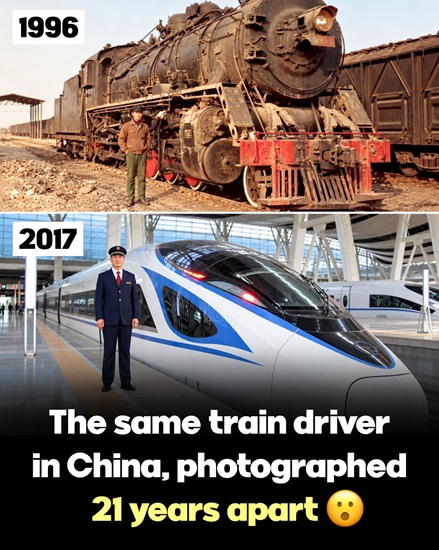
When Han Junjia began working on China’s railways in 1992, his working world was filled with coal, steam, noise and intense heat.
He was only 19 years old. The steam locomotives he first encountered typically traveled at around 50 to 60 kilometers per hour, or roughly 31 to 37 mph.
They represented technology that had powered railways for generations.
Han could not have known just how dramatically his profession was about to change.
Decades later, he would be sitting inside a completely different machine.
A Fuxing high-speed train capable of commercial operation at 350 kilometers per hour — approximately 217 mph.
The distance between those two locomotives was far greater than speed alone.
It represented decades of technological change.
And Han experienced much of it from the driver’s cab.
His railway story began with steam
Han joined the railway in Zhangjiakou in 1992.
Like many railway workers of that era, he entered a demanding profession in which physical endurance remained an important part of the job.
Steam locomotives were powerful machines, but they offered little of the comfort associated with modern trains.
Working conditions could be exhausting.
The enormous boiler generated intense heat.
Coal and dust were part of everyday life.
During warmer months, conditions inside the locomotive could become extremely uncomfortable.
But winter presented the opposite problem.
Crew members still needed to observe the railway line and signals, meaning cold outside air could enter the working environment even as tremendous heat came from the boiler.
Operating those locomotives also required constant attention.
Modern digital systems were still far in the future.
Drivers and other crew members depended heavily on training, observation and experience.
For the young Han, however, working on the railway fulfilled a long-standing ambition.
And before he had much time to become comfortable with one type of locomotive, the technology began moving forward.
Diesel brought the first major change
By the mid-1990s, China’s railway system was increasingly moving beyond steam.
In 1996, Han transitioned to diesel locomotive operations.
The difference was immediately noticeable.
There was no longer the same environment of coal, ash and steam.
The cab provided a different working experience, and monitoring equipment offered drivers assistance that earlier generations had not enjoyed.
But diesel locomotives introduced challenges of their own.
Noise could be intense.
Communication between crew members sometimes required raised voices.
Even so, the technological improvement was obvious.
Speed was increasing too.
Passenger trains pulled by diesel locomotives Han operated could travel at around 120 kilometers per hour.
Only a few years into his career, Han was already operating trains traveling roughly twice as fast as the steam locomotives associated with his early railway experience.
Yet this was only the beginning.
China’s railways were about to accelerate much more dramatically.
Another generation of locomotives arrived
Between 1997 and 2007, China’s conventional railway network underwent a series of major speed increases.
Infrastructure was upgraded.
Rolling stock improved.
Journey times began falling.
And railway employees had to continually adapt.
Han was among them.
Rather than spending his entire career operating the same equipment, he continued studying and qualifying for newer types of locomotives.
Electric traction represented another important step.
For drivers, the improvements were not limited to performance.
The workplace itself was becoming more comfortable.
Modernized cabs offered equipment and climate control that would have seemed remarkably advanced compared with the steam locomotives Han knew at the beginning of his career.
But something even more significant was happening elsewhere in China’s railway system.
High-speed rail was arriving.
And Han wanted to be part of it.
A new challenge
China’s high-speed railway development accelerated rapidly in the late 2000s.
The Beijing-Tianjin intercity railway opened in 2008 and became an important milestone in the country’s high-speed rail era.
Soon, opportunities appeared for experienced railway workers to train on the new generation of high-speed equipment.
Han decided to pursue one of them.
It was not necessarily the easiest choice.
By that stage, he had accumulated years of railway experience and had moved into technical work.
Returning to frontline driving and qualifying for high-speed operations meant intensive training and another demanding learning process.
It also meant more time away from ordinary family life.
Han nevertheless chose to continue.
In 2010, he began training for high-speed EMU operations connected with China’s rapidly expanding high-speed railway system.
The railwayman who had learned his profession around steam locomotives now had to master a radically different type of train.
And the technological leap was enormous.
From mechanical power to digital control
Inside a high-speed train cab, Han encountered a working environment that would have been almost unimaginable when he started.
Coal was gone.
So was the steam.
The loud diesel environment had also been left behind.
In their place were sophisticated electronics, displays, monitoring equipment and advanced train-control systems.
The physical effort involved in operating a locomotive had changed.
But responsibility had not disappeared.
If anything, traveling at much higher speeds required intense concentration and strict adherence to operating procedures.
Han continued learning.
Then another milestone arrived.
China introduced a new generation of high-speed train.
The Fuxing.
The 350 km/h milestone
Fuxing high-speed trains were developed for commercial operation at speeds of up to 350 kilometers per hour on suitable routes.
In September 2017, Fuxing trains began commercial operation at 350 km/h on the Beijing-Shanghai high-speed railway.
Han became one of the drivers entrusted with operating them.
The contrast with 1992 was extraordinary.
At the beginning of his career, Han had worked around steam locomotives typically traveling at approximately 50 to 60 km/h.
Now he could operate a passenger train at 350 km/h.
That is about 217 mph.
In roughly a quarter of a century, the maximum operating speed of the trains associated with his career had increased by around six times.
But there was another way to measure his journey.
It involved the licenses he collected along the way.
Each license represented another era
Every transition to new railway equipment required training and qualification.
Han repeatedly returned to studying.
By 2018, published accounts of his career reported that he had obtained eight locomotive-driving licenses.
Those qualifications covered multiple generations of railway technology.
Steam.
Diesel.
Electric.
High-speed EMUs.
Hexie trains.
Fuxing trains.
Later reporting indicated that his qualifications continued expanding, with accounts in 2024 describing him as having obtained nine driving licenses and operated dozens of different locomotive and train types during his career.
Viewed together, those licenses tell their own story.
They are almost like pages in a technological history book.
Except Han did not read that history.
He drove through it.
Progress came with personal costs
Railway careers can involve irregular schedules, long journeys and significant periods away from home.
Han’s experience was no exception.
Training for newer equipment demanded additional time and concentration.
He has spoken about the sacrifices his railway career required and the tension between professional responsibilities and family life.
Those sacrifices were real.
But improvements in railway technology eventually changed time itself for workers and passengers.
Routes that once required many hours could be completed much faster.
Cities effectively became closer together.
For passengers, that meant shorter journeys.
For railway workers, faster services could also change how long certain assignments kept them away.
The progress Han watched therefore was not simply about breaking speed records.
It affected everyday life.
And while his own career continued, the network beneath those trains was expanding at remarkable speed.
China’s high-speed network kept growing
China’s first major high-speed railway projects were only the beginning.
Over the following years, new lines spread across the country.
Cities previously separated by long rail journeys became connected by high-speed services.
The scale eventually became enormous.
By the end of 2025, China’s operational high-speed railway network had reached approximately 50,400 kilometers, according to figures reported by the country’s national railway operator.
Its overall operational railway network had reached approximately 165,000 kilometers.
China consequently operates the world’s largest high-speed railway network.
For Han, those numbers represent something more personal than statistics.
His working life spans much of the period in which that transformation occurred.
One career, several railway generations
Consider what Han experienced.
He entered the profession when steam locomotives were still part of railway operations.
Then came diesel.
Then increasingly sophisticated electric locomotives.
Then high-speed EMUs.
And eventually, the Fuxing generation.
With each transition, the equipment changed.
The driver’s cab changed.
The required skills changed.
The speeds changed dramatically.
Han changed with them.
That adaptability became one of the defining features of his career.
Instead of becoming an expert in one disappearing technology, he repeatedly trained for what came next.
And what came next kept getting faster.
More than a story about speed
It would be easy to describe Han Junjia’s career simply by comparing two numbers.
Around 50 to 60 km/h at the beginning.
Up to 350 km/h decades later.
Those figures are striking.
But they leave out the most interesting part.
Behind every increase in speed were years of infrastructure construction, technological development, training and changes in railway operations.
Drivers had to learn new systems.
Maintenance teams had to understand new machines.
Railway infrastructure had to support higher speeds.
And safety procedures had to evolve alongside the technology.
Han’s story provides a human perspective on that much larger transformation.
He was not an observer standing beside the tracks.
He was inside the cab.
The view from the driver’s seat
More than three decades separate the teenage railway worker of 1992 from the veteran high-speed driver Han eventually became.
The two working environments could hardly look more different.
One involved coal, steam and mechanical controls.
The other involved electronics, digital displays and trains capable of covering enormous distances in a fraction of the time.
Yet something remained constant.
Han continued driving trains.
His career became a bridge between two railway eras that can now seem generations apart.
That may be why his story is so striking.
Technological progress is often explained through statistics.
Kilometers of track.
Maximum speeds.
Travel times.
Numbers of passengers.
Han’s career offers another measurement.
One person’s working life.
He started in a railway world where steam locomotives still mattered.
He eventually reached a driver’s cab moving at approximately 217 mph.
And along the way, he repeatedly learned how to operate whatever came next.
The trains became cleaner.
The cabins became more advanced.
The network became larger.
And the journeys became dramatically faster.
Han Junjia witnessed all of it.
But “witnessed” may not quite be the right word.
Because for much of that transformation, his hands were on the controls.

