
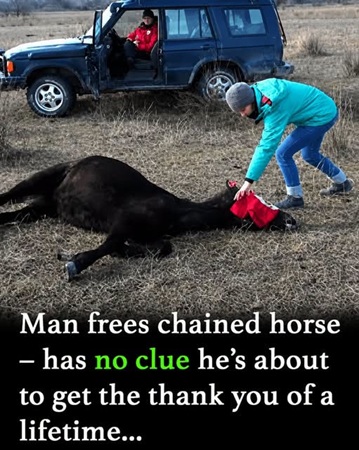
A memorable encounter involving veterinarian Dr. Ovidiu Roșu and free-roaming horses in Romania’s Danube Delta gained attention because of a brief but striking interaction. During fieldwork, Roșu encountered a mare whose legs had been restrained, a welfare problem that veterinary teams had previously documented among some horses in the region. These restraints were not part of the official horse-management program. According to the available information, chains had sometimes been used informally by people trying to keep individual horses from wandering too far.
For the animals, however, such restraints could interfere with normal movement and leave visible marks on their legs. Veterinary teams working in the area removed them when they encountered affected horses and when it could be done safely. Approaching a nervous free-roaming horse requires considerable care. Unlike a domestic horse that is routinely handled, an animal living largely on its own may react unpredictably when people come close. A frightened horse can suddenly move, kick, struggle, or injure itself if it feels trapped.
That makes calm veterinary handling particularly important when an animal is already restricted by a chain. Roșu had extensive experience working with the Danube Delta horses, so the scene represented more than a chance encounter with one mare. He had participated in veterinary and population-management work involving these horses for years, making careful handling an essential part of his field responsibilities. After the mare was freed from the restraint, another horse moved closer to the veterinarian.
The animal approached calmly and made gentle physical contact with him, creating the moment that many viewers remembered most clearly. Some people interpreted the horse’s behavior as a deliberate expression of gratitude. That interpretation is understandable, but it cannot be confirmed scientifically from the footage alone. No one can determine exactly what the horse was thinking or why it chose to approach at that specific moment. The most accurate description is simply that the horse voluntarily came closer and made calm contact with Roșu after he had helped the restrained mare.
The scene did not need a dramatic explanation to be meaningful. The calm interaction between a free-roaming horse and a veterinarian was unusual enough on its own. Many people who watched the footage responded to the apparent gentleness of the encounter, especially because it came immediately after another horse had been helped. The video offered a simple visual moment that could be understood without knowing anything about population management, veterinary medicine, or conservation policy. At the same time, the few seconds captured on camera were connected to a much larger story involving the history of horses in the Danube Delta and the challenge of protecting both the animals and the environment around them.
The Horses of the Danube Delta Have a Long and Complicated History
The horses associated with the Letea area have roots stretching far back into the region’s history. Historical accounts cited by FOUR PAWS connect horses in the area with events dating back roughly 700 years, when Tatars traveling through the region brought horses with them. Some of those animals were reportedly left behind, and later generations adapted to life in the delta. The modern population, however, was also strongly influenced by much more recent social and agricultural changes. After the fall of Romania’s communist system in 1989, collective farming structures changed significantly, and many horses that had previously been used for agricultural work were no longer kept in the same way.
Some of those former working horses were released or left to survive more independently in the Danube Delta. The environment provided large areas where horses could move, feed, and reproduce with relatively little direct human management. Over time, the free-roaming population increased. Although the animals are often described casually as wild horses, terms such as free-roaming, feral, or semi-feral can be more precise because their history includes domesticated animals that later lived independently. Their story therefore combines natural adaptation with a long history of human influence.
As horse numbers increased during the 1990s and 2000s, concerns also grew about the effects of large grazing populations on sensitive habitats. One of the areas receiving particular attention was Letea Forest, a protected ecosystem within the Danube Delta. Large herbivores require significant amounts of vegetation, and growing horse populations can place pressure on young trees, shrubs, and other plants. Repeated grazing and browsing may prevent some vegetation from regenerating normally. That created an increasingly difficult conservation question: how could the horses remain part of the landscape without allowing their numbers to grow beyond what the protected habitat could support?
The problem was complicated because both sides of the issue mattered. The horses had become a familiar and important part of the Danube Delta landscape. At the same time, Letea Forest had its own ecological importance and required protection from excessive grazing pressure. Simply allowing population growth to continue indefinitely was not necessarily a neutral choice. Over time, habitat degradation could create problems not only for plants and other wildlife but eventually for the horses themselves. Sustainable management therefore required consideration of both animal welfare and ecosystem protection.
The Situation Became Particularly Serious in 2011
By 2011, concerns surrounding the horse population had become severe. Plans to remove horses from the area created major controversy, especially when animals were rounded up for transport toward slaughter. Animal-welfare organizations became involved because large-scale lethal removal raised serious ethical concerns. FOUR PAWS intervened during this period and later developed a longer-term strategy intended to reduce population growth without repeatedly killing large numbers of horses.
The challenge was finding an approach that addressed the ecological pressure while allowing existing animals to remain alive. A rapid population reduction through culling can produce immediate numerical results, but it also raises significant welfare concerns. Doing nothing, however, could allow the population to continue expanding and place increasing pressure on a protected ecosystem. A third approach was therefore needed if managers wanted to protect both the horses and the forest.
FOUR PAWS proposed a non-lethal population-management program based on immunocontraception. Instead of removing large numbers of adult horses, veterinarians would reduce the number of foals being born over time. Female horses were treated with a contraceptive vaccine that temporarily reduced fertility. The intention was to slow population growth gradually while allowing existing horses to continue living in the landscape.
This approach required patience because contraception does not immediately reduce the number of adult animals already present. Horses can live for many years, meaning that population change occurs gradually as fewer foals enter the population. Teams therefore needed to continue monitoring horse numbers over multiple seasons. Some mares also required follow-up treatment or booster doses, making the program a repeated field effort rather than a single campaign. Non-lethal management may appear simpler than culling, but in practice it demands ongoing veterinary work, funding, and careful recordkeeping.
Dr. Ovidiu Roșu Was Involved in the Wider Management Program
The veterinarian seen helping the restrained mare was already deeply involved with the Danube Delta horse project. Roșu did not simply encounter a chained horse by coincidence and then disappear from the wider story. He participated in the long-term veterinary work associated with the horse population and contributed academically to research connected with fertility control and veterinary management. The source material notes that his doctoral work examined the contraceptive approach used in the project.
His role included work that was far less visible than the moment captured in the viral footage. Population management required veterinarians to locate animals, safely approach or immobilize them, assess health, identify individual horses, and administer treatment when appropriate. Each horse had to be considered separately, especially because some mares required future booster treatments. That made identification important. Field teams needed to know which horses had already received contraception and which remained untreated.
Health examinations could be performed at the same time. When mares were safely immobilized, veterinarians could assess their general condition, examine their teeth to help estimate age, collect blood samples, and look for injuries or other welfare concerns. Horses could also be marked or tagged so teams could recognize them during future monitoring. This transformed the project into a combination of reproductive management, health surveillance, and long-term research.
The work required cooperation between veterinarians, animal-welfare specialists, researchers, and Romanian authorities. A free-roaming horse population cannot be managed responsibly by one person working alone. Veterinary procedures require trained professionals, while long-term conservation decisions require institutional support and reliable data. The project therefore depended on partnerships capable of continuing over multiple years rather than a series of isolated rescues.
Population Control Was Intended to Protect Both Horses and Habitat
The contraception strategy represented an attempt to balance responsibilities that might otherwise appear to conflict. Protecting horses from unnecessary killing was one goal. Protecting Letea Forest from excessive grazing was another. When a large population of animals relies on a sensitive environment, those concerns cannot simply be separated. The welfare of the animals depends partly on the health of the habitat supporting them.
Allowing horse numbers to increase indefinitely could eventually create shortages of food and additional pressure on vegetation. At the same time, removing large numbers of animals through lethal methods would create an entirely different welfare problem. The fertility-control program was designed as a middle path. Existing horses could remain in the environment, while the number of future births would gradually be reduced.
The slower pace of contraception also meant that managers had to remain committed for years. Unlike a one-time removal program, fertility control depends on continued monitoring. Horse numbers can change, treated mares may require additional doses, and environmental conditions may also vary. Managers therefore need repeated population estimates and veterinary follow-up to understand whether the strategy remains effective.
This kind of management illustrates why conservation is rarely about choosing a single side. The question was not simply whether the horses mattered or whether the forest mattered. Both had legitimate claims to protection. The challenge was finding a method that reduced ecological pressure without treating the animals themselves as disposable. That principle became one of the most important parts of the long-running Danube Delta project.
The Restrained Mare Highlighted Another Animal-Welfare Issue
Population growth was not the only welfare challenge encountered during fieldwork. Veterinary teams also found some horses with chains or restraints around their legs. These were not part of the official contraception program. According to the project material, they had been used informally by some people in an effort to limit how far horses could move.
Restricting a horse’s legs in this way can create obvious problems. A horse needs normal movement for grazing, social behavior, and travel across its environment. A chain can rub against the skin, restrict the animal’s stride, and potentially contribute to injury. If the horse becomes frightened while restrained, it may also struggle and make the situation worse. That is why removing such restraints became an immediate welfare concern when veterinarians encountered affected animals.
The mare seen in the widely shared footage showed signs that the restraint had affected her legs. Helping her therefore required more than simply cutting or removing a chain as quickly as possible. Roșu needed to work calmly around an animal that could react suddenly. Veterinary handling had to reduce the risk of the horse hurting herself or the people nearby. The quiet nature of the rescue is part of what made the footage effective. It showed that careful handling can be just as important as the final act of removing the restraint.
Once the mare was free, the appearance of the second horse gave the footage an unexpectedly emotional conclusion. The approaching animal did not flee immediately or display obvious aggression. Instead, it moved toward the veterinarian and touched him. That contact lasted only briefly, but it transformed a piece of veterinary field footage into something that people could connect with emotionally.
Calling the Contact a “Thank-You” Goes Beyond What Can Be Proven
Many viewers understandably described the second horse as thanking Roșu. Human beings naturally interpret animal behavior using familiar emotional concepts, especially when an action occurs immediately after an important event. A gentle approach after a rescue can look remarkably similar to affection or gratitude when viewed through a human perspective.
However, animal behavior should be described carefully. The footage cannot tell us precisely what the horse understood about the mare’s restraint, whether it recognized Roșu’s actions as assistance, or whether it approached for another reason entirely. It may have been curious. It may have been responding socially to another horse and a calm human nearby. It may simply have felt safe enough to investigate. None of those possibilities can be confirmed from a brief video.
The safest and most accurate description remains the observable one. The horse voluntarily approached the veterinarian and made calm physical contact with him after he had been helping the restrained mare. That behavior was unusual and memorable enough without adding a definite human-style explanation.
This distinction matters because emotional animal stories can easily become exaggerated online. Saying that viewers interpreted a gesture as gratitude is different from claiming that gratitude was scientifically established. The first accurately describes the public reaction. The second claims knowledge about the animal’s thoughts that the footage cannot provide. A truthful version of the story remains powerful without crossing that line.
The Viral Video Helped People See the Individual Animal Behind the Statistics
Large conservation programs are often explained using population numbers. Researchers discuss hundreds or thousands of animals, changes in birth rates, habitat pressure, and long-term trends. These numbers are essential for management, but they can make the individual animal disappear from the conversation. The video of Roșu and the mare provided a very different perspective.
Instead of seeing a population estimate, viewers saw one horse whose movement had been restricted. They watched a veterinarian work beside her and then saw another animal approach. That individual story made a complicated issue easier to understand emotionally. The mare represented one of the real animals behind years of management plans, scientific research, and population surveys.
At the same time, one rescue cannot explain the entire conservation problem. Protecting individual horses from harmful restraints is important, but managers must also consider what happens when the total population becomes too large for the available environment. A viral rescue shows one side of animal welfare. Population management addresses another. Responsible conservation has to consider both.
The footage therefore became useful not because it provided a complete answer but because it encouraged people to notice a project that usually took place far from public view. Veterinary teams conduct examinations, identify animals, collect information, and repeat treatments without attracting widespread attention. A short video can suddenly make years of work visible to people who might never otherwise hear about it.
Long-Term Welfare Requires More Than Individual Rescues
Removing one set of chains can immediately improve one horse’s situation. But preventing repeated welfare problems requires a wider system. Veterinary teams need to monitor animals, identify injuries, coordinate with authorities, and understand why harmful practices are occurring. A single intervention may help one individual but cannot guarantee that every horse in the region will remain free from similar problems.
The same principle applies to population growth. One vaccination cannot change an entire population. A fertility-control program must continue across many animals and breeding seasons before major changes become visible. Horses need to be identified, treatments recorded, and population trends monitored. The work is slow compared with the immediate satisfaction of a rescue, but it addresses problems that cannot be solved in a single day.
This helps explain why the Danube Delta program became a long-running effort rather than a temporary campaign. FOUR PAWS remained involved with equine welfare in Romania for years, working toward a system that could eventually continue under Romanian management. A sustainable program cannot depend permanently on outside teams traveling in whenever a problem appears. Local institutions need the capacity to continue veterinary and population-management work over time.
By 2025, the project had entered a new stage, with responsibility for equine welfare programs transferred to Romanian authorities. That did not mean the underlying issues had disappeared. Horse numbers can rise again, environmental conditions can change, and individual animals can still require care. The transfer represented a continuation of long-term management rather than proof that no further work would ever be necessary.
The Letea Horses Are Part of Both Natural and Human History
The presence of these horses cannot be understood only through wildlife biology. Their population was shaped by centuries of interaction between people, animals, agriculture, and the landscape. Historical movements brought horses into the region, while the later collapse of collective farming contributed to more animals living independently. Generations of free-roaming horses then became part of the visual identity of the Danube Delta.
That history is one reason management decisions can become emotionally difficult. People may see the horses as symbols of freedom or as part of the cultural landscape. Conservation managers, however, must also consider their ecological effects. A protected forest cannot regenerate normally if grazing pressure becomes excessive. The horses therefore exist at the intersection of history, culture, animal welfare, and environmental science.
The most responsible approach is not to pretend that one of those concerns does not exist. Romanticizing unlimited horse numbers can overlook habitat damage. Focusing only on environmental pressure can overlook the welfare of individual animals. The contraception program attempted to recognize both realities at once. It accepted the continued presence of horses while trying to moderate future population growth.
That balance is what makes the project significant beyond Romania. It illustrates the kinds of choices conservation managers face whenever free-ranging animal populations interact with protected habitats. Different locations may require different solutions, and no single method should automatically be treated as appropriate everywhere. The Romanian experience simply provides one documented example of an attempt to combine welfare with ecological responsibility.
Dr. Roșu’s Work Connected Individual Care With Population Management
The viral encounter is easy to remember because it involved one veterinarian and one visibly restrained horse. Yet Roșu’s professional work connected that individual moment with much broader responsibilities. His involvement in reproductive management, field veterinary care, and research meant that he worked at both the individual and population levels.
Helping one horse requires attention to its immediate condition. Managing hundreds of horses requires data, planning, and repeated intervention. These tasks may look very different, but both depend on veterinary expertise. An individual animal must be handled safely, while the population must be managed using methods capable of producing sustainable results over time.
The source material also notes that veterinary field visits created opportunities to discover welfare problems that might otherwise have remained unnoticed. During population-management work, teams could identify injuries, restraints, or poor physical condition. That meant contraception and direct veterinary care could happen as part of the same broader field program.
The restrained mare therefore represented both an individual case and an example of why repeated veterinary presence mattered. Without teams working regularly among the horses, some problems might remain unnoticed for much longer. Population monitoring created opportunities to provide direct care, while direct care gave veterinarians a better understanding of the conditions individual horses were experiencing.
Conservation Work Is Usually Much Less Dramatic Than the Viral Moment
Most days of conservation fieldwork do not produce unforgettable footage. Teams travel, observe animals, record identification information, collect samples, perform examinations, and update population records. Researchers later analyze that information and authorities use it to guide management decisions. These activities can be scientifically important while appearing ordinary to an outside viewer.
The viral encounter was different because it compressed a larger story into a few easily understood seconds. A veterinarian helped a restrained horse. Another horse came closer. There was a quiet touch. Then the interaction ended. That simplicity made the video memorable in a way that population tables and veterinary reports rarely are.
Animal behavior can also surprise observers. People might expect a free-roaming horse to immediately flee from humans. In some situations, that certainly happens. Horses may also become defensive when frightened. Yet animals do not react identically in every circumstance. The calm approach seen in the footage is one example of behavior that did not match the dramatic response some viewers might have expected.
Again, there is no need to assign a specific human emotion to the horse. The simple fact that it remained calm and voluntarily approached is enough to make the moment unusual. Sometimes careful description is more powerful than exaggeration because it allows viewers to appreciate what actually happened.
Protecting Horses Requires Attention to More Than What Happens on Camera
Horse welfare includes freedom from avoidable pain and injury, access to food, appropriate veterinary care, and the ability to move normally. Removing a harmful restraint can address one immediate problem. Maintaining a sustainable population can help address longer-term pressures involving food, habitat, and animal health.
Those responsibilities require more than public attention. They need trained veterinarians, researchers, authorities, long-term funding, and consistent monitoring. Popular videos may increase awareness, but sustainable welfare depends on systems that continue even after public interest moves elsewhere.
This is why the Danube Delta project lasted for years. Controlling reproduction required repeated treatment. Monitoring required repeated counts. Individual animals required veterinary assessment. Cooperation with Romanian institutions was necessary if management was going to continue over the long term.
The work therefore illustrates an important difference between awareness and conservation. Awareness can happen almost instantly when a video reaches a large audience. Conservation takes years and often involves decisions that receive little public attention. The emotional moment may introduce people to the issue, but long-term results depend on what happens after the camera is gone.
The Second Horse’s Approach Became a Symbol of the Wider Story
For many viewers, the image that remained was not the vaccination program, the population data, or the history of Letea Forest. It was the second horse moving toward Roșu and touching him. Human memory often responds more strongly to a single recognizable image than to complex information.
That does not diminish the scientific work behind the project. Instead, the footage gave that work a human-scale representation. Years of population management could suddenly be connected with one veterinarian, one mare, and one brief moment of calm contact. The encounter helped turn an abstract conservation issue into something people could immediately see and understand.
Whether the approaching horse was showing curiosity, social interest, comfort, or something else cannot be known with certainty. The available evidence does not allow anyone to translate the behavior into a definite emotional message. What is documented is the action itself: the horse approached voluntarily and made gentle contact with the veterinarian.
That observation remains moving without being presented as proof of a human-like thank-you. Accurate storytelling does not require removing emotion. It simply means distinguishing between what was visibly recorded and what viewers interpreted from it.
A Few Seconds of Footage Represented Years of Work
Freeing the mare took a comparatively short period of time. Managing the wider horse population required years. Those two scales are very different, but they were connected through the same overall concern: finding ways to reduce suffering while protecting a sensitive environment.
The contraception program acknowledged that the horses had become part of the landscape while recognizing that their population could not grow without limits. Instead of treating existing animals simply as a problem to eliminate, the project attempted to slow reproduction and reduce pressure gradually.
The mare’s restraint represented a more immediate problem. A horse restricted by chains needed direct intervention, not a long-term population model. Veterinary teams had to be able to respond to both kinds of issues. This combination of immediate care and long-term planning is one of the clearest lessons from the project.
The famous video happened to capture those two worlds meeting. The veterinarian involved in population-level work was also helping one individual animal. Another horse then stepped closer and created a moment people around the world could understand without needing any technical background.
The Danube Delta Horses Remain a Story About Beauty and Responsibility
The horses are visually striking and have become closely associated with the landscape in which they live. Yet their presence also carries responsibilities. A free-ranging population still requires careful observation when its numbers affect protected habitats or when individual animals experience welfare problems.
Likewise, the forest cannot be protected responsibly by ignoring the welfare of the animals living around it. Sustainable management requires decisions that recognize ecological limits while avoiding unnecessary suffering. This was the balance the long-term contraception strategy attempted to achieve.
The challenge was never simply choosing between horses and forest. Both matter. The difficult work lies in finding management methods that respect animal welfare while preserving the environment supporting the wider ecosystem.
That wider context is what gives the quiet encounter involving Dr. Ovidiu Roșu lasting significance. A veterinarian freed a restrained mare. Another horse approached calmly afterward. People interpreted the moment in different ways, but the precise reason for the horse’s behavior remains unknown.
What can be said confidently is that the encounter drew attention to a much larger and well-documented effort involving veterinary care, fertility control, scientific monitoring, and habitat protection. The few seconds that became memorable online represented only a small part of work that had continued for years.
In the end, the strongest version of the story does not need to claim that the horse intentionally said thank you. The observable event is meaningful enough. A free-roaming horse came close to a veterinarian after he had been helping another horse and made gentle physical contact with him. Behind that simple interaction stood a complicated history of horses, people, conservation, and long-term responsibility in Romania’s Danube Delta.

