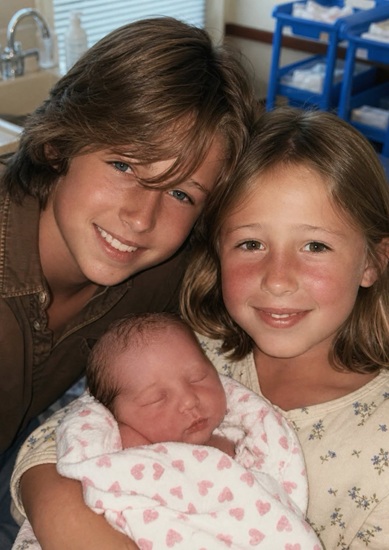
In the spring of 2014, a story from North London attracted enormous attention across Britain.
At the center of it were three children.
One was a newborn baby girl.
The other two were her parents.
The mother was only 12 years old when she gave birth.
The baby’s father was 13.
Those ages were enough to turn an already serious family situation into national news.
Headlines quickly focused on one question.
Were they Britain’s youngest parents?
But the extraordinary ages were only the beginning of the story.
Behind the headlines was a 12-year-old girl who had suddenly become responsible for a newborn while still needing care, education and protection herself.
Beside her was a 13-year-old boy facing a similar contradiction.
He had become a father.
Yet he was still a child too.
Contemporary reports said the girl had become pregnant when she was 11.
She was reported to have been attending primary school when the pregnancy began.
By the time her daughter was born in April 2014, she was 12 years and three months old.
The father was reportedly 13.
The identities of the two young parents were protected.
That privacy mattered.
At those ages, neither child could reasonably have anticipated the scale of attention that would follow the birth.
But once the story became public, curiosity spread rapidly.
People wanted photographs.
They wanted names.
They wanted to know how the relationship had started.
They wanted to know what the families thought.
Some people wanted to predict whether the young couple would stay together.
Others treated the case almost like a record-breaking curiosity.
Yet the most important issues were happening away from the cameras.
A baby needed a safe and stable environment.
A very young mother needed medical care and support.
A very young father needed guidance.
And both teenagers needed adults capable of helping them navigate responsibilities far beyond what most children their age experience.
That was where the real challenge began.
Becoming a parent does not instantly turn a child into an adult.
A 12-year-old does not suddenly gain financial independence because she has given birth.
A 13-year-old does not suddenly finish emotional development because he becomes a father.
Parenthood may create serious responsibilities.
It does not erase childhood.
That distinction is especially important in a case involving such young parents.
The young mother still needed an education.
She still needed healthcare.
She still needed guidance from adults.
She still needed protection from exploitation, unnecessary publicity and harassment.
The young father had many of the same needs.
He was still expected to continue growing, learning and attending school.
He could not realistically be expected to support a household financially in the way an independent adult might.
That meant the adults around them would inevitably play a major role.
Contemporary reporting suggested that their families intended to provide support.
The girl’s father publicly indicated that his family would stand behind her.
That support could make an enormous difference.
There were practical questions almost immediately.
Who would care for the baby while the young mother attended school?
Who would accompany her to appointments?
How could both young parents continue their education?
How would the baby’s daily needs be met?
Those were not questions that could be answered by a dramatic headline.
They required long-term planning.
And there was another issue that demanded careful attention.
Pregnancy at such a young age can carry additional health concerns.
Adolescent pregnancies are associated with higher risks of several maternal complications compared with pregnancies among women in their twenties.
Babies born to adolescent mothers also face increased risks of problems including premature birth and low birth weight.
That does not mean complications are inevitable.
It means proper medical care becomes especially important.
For a very young pregnant person, regular prenatal care allows professionals to monitor both mother and baby.
Nutrition can be assessed.
The baby’s development can be followed.
Potential complications can be identified.
Delivery can be planned more safely.
Healthcare professionals also need to communicate information in a way a young patient can genuinely understand.
A 12-year-old may technically be a mother after giving birth.
She is still a young adolescent.
Medical explanations, emotional support and decision-making therefore need to reflect that reality.
Privacy is equally important.
National interest in a story does not remove a child’s right to dignity.
That became particularly significant once the North London case was reported across the country.
The parents’ ages were unusual enough to guarantee attention.
But attention can quickly become intrusion.
And for children, the consequences of that exposure can last much longer than the news cycle.
A headline disappears from the front page.
A search result can remain for years.
That is why identifying details about children in situations like this deserve careful protection.
The baby deserves that protection as well.
She did not choose the circumstances surrounding her birth.
As she grows older, she should not automatically be reduced to a headline about how young her parents once were.
There was also a safeguarding question that could not responsibly be ignored.
In England and Wales, the age of consent is 16.
The law gives even stronger protection to children under 13.
A child below that age cannot legally consent to sexual activity.
But that legal fact does not mean online commenters can determine individual criminal responsibility from a headline.
The circumstances of relationships involving children can be complex.
Age differences matter.
Possible coercion matters.
Exploitation matters.
The children’s vulnerability matters.
Safeguarding professionals must examine those circumstances carefully.
That work belongs with trained authorities.
It does not belong with strangers attempting to determine guilt from photographs or social-media posts.
This is where the story begins to look very different from the sensational version.
The headline was about two extremely young parents.
The real situation was about protecting children.
Three of them.
The newborn needed dependable care.
The young mother needed support while recovering from childbirth and adjusting to motherhood.
The young father needed help understanding his responsibilities without being expected to function as a fully independent adult.
Both parents needed the chance to continue learning.
Education was especially important.
Becoming a parent at 12 or 13 can make attending school dramatically more complicated.
There are appointments.
There is childcare.
There are sleepless nights.
There may be embarrassment or bullying.
There may be pressure from classmates or unwanted attention from strangers.
Without support, leaving education can begin to seem like the easiest option.
But leaving school extremely early can create difficulties that last much longer than the immediate crisis.
Education can affect employment opportunities.
It can influence financial independence.
It can shape the young parents’ ability to provide stability for themselves and their child later in life.
That is why helping young parents remain connected to education can be so important.
Flexible arrangements may help.
Childcare can help.
Tutoring can help when lessons are missed.
Supportive teachers can help protect students from bullying or humiliation.
And family members can make it possible for a young parent to attend school while still participating in the baby’s care.
None of these measures removes parental responsibility.
They make that responsibility more realistic for someone who is still growing up.
Mental and emotional health matter too.
Adolescence can already be an intense period.
Young people are developing their identity.
They are learning how to manage relationships.
They are gaining independence gradually.
They are also still learning how to respond to stress.
Parenthood adds another level entirely.
A newborn needs care throughout the day and night.
Sleep becomes unpredictable.
Relationships can become strained.
Financial worries may appear even when extended family members are helping.
Then imagine dealing with all of that while strangers across the country are discussing your life.
The attention that surrounded the North London case could not have made the situation easier.
Public shame rarely solves practical problems.
It cannot change a diaper.
It cannot attend a medical appointment.
It cannot provide childcare while a teenager takes an exam.
It cannot create a stable home.
Support can.
That does not mean the seriousness of the situation should be minimized.
Children becoming parents raises profound concerns.
Medical care is necessary.
Safeguarding is necessary.
Education is necessary.
Responsible adult involvement is necessary.
But seriousness and compassion are not opposites.
Both can exist at the same time.
The young parents could be held accountable for caring for their baby while still receiving the protection appropriate to their own ages.
There is another part of the story that deserves similar caution.
Years after sensational cases become public, websites often use a familiar promise.
“See what they look like now.”
It is an effective way to attract curiosity.
But appearance is almost meaningless when evaluating what happened afterward.
A recent photograph cannot show whether someone completed school.
It cannot reveal whether the baby had a stable childhood.
It cannot explain whether the parents stayed together.
It cannot show how much help grandparents provided.
It cannot measure emotional recovery.
And it cannot tell us whether the people involved even want their childhood experience placed back into public circulation.
Without reliable and appropriately sourced updates, those details should not be invented.
The verified beginning of the story is remarkable enough.
A 12-year-old girl in North London gave birth in April 2014.
The baby’s father was 13.
Reports at the time described their families as supportive.
The young mother was expected to need significant help if she was to continue her education while caring for her daughter.
Those basic facts already raise important questions about how society responds when children become parents.
They also point toward a broader issue.
Preventing extremely early pregnancies cannot depend on embarrassment or silence.
Young people need age-appropriate information about their bodies.
They need to understand healthy relationships.
They need to understand consent.
As they become old enough for appropriate reproductive-health education, they need accurate information rather than rumors.
Most importantly, children need trusted adults they can approach when something feels wrong.
A child who fears punishment may hide a serious problem.
A child who feels safe asking questions has a better chance of receiving help early.
The same applies to possible coercion or abuse.
Children need to understand that they can tell a trusted adult.
Schools, healthcare professionals, parents and safeguarding services can all play different roles.
None can replace the others completely.
And none of those responsibilities should be transformed into entertainment.
That may be the most significant lesson hidden beneath the original headlines.
The extraordinary ages attracted public attention.
But age alone was not the challenge that would determine what happened next.
The real challenge was what came afterward.
Could the young mother continue her education?
Could the young father do the same?
Would their families provide enough practical help?
Would the baby grow up in a stable environment?
Would the young parents have access to medical and emotional support?
Could their privacy be protected while they grew from children into adults?
Those questions mattered far more than how they looked in photographs.
And most of them could not be answered immediately.
They required years.
That is the delayed reality behind stories like this.
A birth can become a headline in a single day.
Building a stable life takes much longer.
The public may remember the shocking ages.
The families have to deal with everything that follows.
There are nights without enough sleep.
There are school schedules.
There are childcare arrangements.
There are medical appointments.
There are difficult decisions.
There are ordinary days when nobody outside the family is paying attention anymore.
That is where the true outcome is shaped.
Not in the photograph that first made the story famous.
Not in an online comment section.
And not in a sensational “before and after” comparison years later.
The meaningful outcome is whether the people involved were able to build safe and stable lives.
For the baby, that means growing up with consistent care.
For the young mother, it means having the opportunity to continue developing as both a parent and a person.
For the young father, it means learning to take responsibility without being denied the education and guidance he still needs.
For their families, it means providing support without completely taking control away from the young parents.
That balance is difficult.
But it is far more constructive than public humiliation.
The North London case was extraordinary because of the ages involved.
Yet the most useful response is not endless curiosity about the children who made headlines.
It is understanding what very young families actually need.
Medical care.
Safeguarding.
Education.
Stable housing.
Responsible adults.
Emotional support.
Privacy.
And time.
Those things do not produce sensational headlines.
They produce better chances for the future.
That is why the final meaning of the story is very different from the first impression.
At first, the astonishing fact is that a 12-year-old became a mother and a 13-year-old became a father.
That is what makes people stop reading and look twice.
But by the end, the more important fact becomes clear.
Two children had entered parenthood while they were still in need of parenting themselves.
And from that moment onward, the responsibility did not belong only to them.
It also belonged to the adults and institutions around them to protect the baby, safeguard both young parents and help them continue growing into adulthood.
The ages created the headline.
What happened after the headline was always the part that mattered more.
