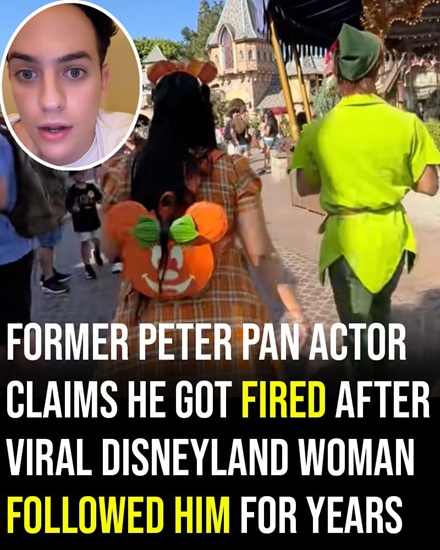
A series of Disneyland videos featuring longtime Disney fan Toni Kulusich has developed into a much larger social-media conversation about fandom, character performers and personal boundaries. Toni has documented encounters with different performers portraying Peter Pan over a period of years, sharing conversations, photographs and other moments from her park visits. After older and newer clips began circulating together on TikTok and other platforms, millions of viewers encountered the videos outside their original context.
The resulting debate has produced sharply different interpretations of what those interactions actually represent. For Toni, the Peter Pan encounters are part of a longstanding interest in Disney and its theme parks. Videos associated with her account include footage dating back to when she was younger, meaning viewers can effectively watch years of visits condensed into a comparatively short period of scrolling. In some clips she talks with Peter Pan, while others show photographs, gifts or longer character interactions. Importantly, the person portraying Peter Pan has changed over time, so the footage does not document a decade-long relationship with one individual employee.
That distinction has sometimes disappeared as the story has spread. Viral compilations can create a misleading sense of frequency because events separated by months or years may appear one after another on a screen. A viewer watching several clips consecutively might naturally assume the encounters happened almost continuously. Toni has disputed that impression, saying publicly that Peter Pan was present during only seven of her previous 30 Disneyland visits.
That does not settle every question raised by the videos.
Some viewers consider the interactions harmless expressions of enthusiasm for a fictional character. Others have argued that certain encounters appear unusually intense or prolonged and have questioned how the employees involved felt about them.
The discussion becomes complicated because character performers are working.
A visitor sees Peter Pan, a familiar fictional character whose personality is intentionally maintained throughout the interaction. Behind that performance, however, is an employee completing a professional assignment.
Disney character entertainment depends heavily on maintaining that illusion.
Performers generally interact with guests while behaving consistently with the characters they portray. That can create memorable experiences, especially for visitors who enjoy returning to meet favorite characters.
But professional performance and personal friendship are not the same thing.
That difference has become one of the central themes of the controversy surrounding Toni’s videos.
The story gained another layer after a TikTok user identified as Ryan said he had previously worked as a Peter Pan performer at Walt Disney World.
Ryan described the challenges he associated with maintaining character during repeated guest interactions. He also claimed that he had encountered Toni and alleged that he eventually lost his Disney job after breaking character during an interaction.
That claim needs careful wording.
It is Ryan’s publicly stated account.
Without independent confirmation from Disney or other reliable documentation, it should not be reported as an established fact that Disney terminated him specifically because of an encounter with Toni.
His comments nevertheless provide one perspective on character work.
A performer may be expected to remain playful and responsive even when an interaction feels repetitive or uncomfortable. That professional expectation can create circumstances in which viewers have difficulty determining where the character ends and the employee’s personal reaction begins.
Another former Peter Pan performer, Dylan Gadeke, has also discussed experiences connected with Toni.
His comments add important context because his perspective has been more complicated than some of the viral headlines suggest.
Gadeke acknowledged that certain interactions could feel awkward.
At the same time, he reportedly distinguished Toni’s behavior from another situation he personally regarded as genuine stalking.
That separate experience allegedly involved someone obtaining information about his private identity, waiting near an employee parking area and following members of his family inside Disneyland.
The distinction is significant.
Returning to a theme park to interact with Peter Pan is fundamentally different from attempting to pursue the private individual who portrays Peter Pan outside the character environment.
This does not mean every interaction inside the park is automatically appropriate.
Employees can still have boundaries while performing.
Guests should remain attentive when a performer or another cast member attempts to end an interaction, redirect the conversation or create distance.
But serious labels require evidence.
Online commenters have frequently described Toni using words such as “obsessed” or “stalker.”
Those terms represent interpretations from social-media users, not established findings about her behavior.
Using them as factual descriptions would go beyond what publicly available information demonstrates.
Toni has defended herself against those accusations.
She has explained that Disney is a major personal interest and that the viral presentation of her visits does not accurately represent how frequently she encounters Peter Pan.
Her content also includes a much longer timeline than many people first encountering the controversy may realize.
That timeline matters because social media changes how repeated experiences appear.
Imagine seeing seven encounters spread over many separate visits.
Then imagine watching those same encounters edited into a one-minute compilation.
The underlying events have not changed.
The viewer’s perception of their frequency has.
That is one reason context is essential before making conclusions about another person’s conduct.
Another complication involves body language.
Thousands of commenters have analyzed individual Peter Pan performers frame by frame, arguing that a facial expression or movement proves discomfort.
Such interpretations may sometimes be correct.
But they are not reliable evidence of someone’s internal state.
Peter Pan himself is typically portrayed as mischievous, energetic and sometimes teasing.
A performer’s exaggerated expression may therefore be part of the character.
Alternatively, an employee may genuinely feel uncomfortable while continuing to perform professionally.
Outside viewers cannot know which explanation applies simply by examining a few seconds of footage.
The safest approach is to avoid claiming certainty about another person’s private emotions without direct evidence.
That principle protects performers as much as guests.
Character employees should not have strangers attempting to identify them, searching for private information or contacting their families because a video has gone viral.
The person portraying Peter Pan is performing a public-facing job.
Their private identity remains separate.
The same principle applies to Toni.
Posting videos publicly makes those videos open to criticism and discussion.
It does not automatically make every aspect of her private life appropriate for investigation or harassment.
Recent attention surrounding the controversy has reportedly included personal attacks and attempts to expose information beyond the original videos.
That behavior does not create a healthier discussion about boundaries.
It simply creates another boundary problem.
The controversy has also become connected to the broader internet argument surrounding so-called “Disney adults.”
The phrase is commonly used for adults who maintain a strong interest in Disney films, characters, merchandise or theme parks.
Sometimes it is used descriptively.
Other times it is intended as an insult.
Toni’s videos have increasingly been pulled into that debate.
Some commenters argue that adults should not interact enthusiastically with Disney characters.
Others respond that Disney parks openly serve adult visitors and that enjoying fictional characters is not limited to children.
Neither position fully addresses the more important issue.
Being an adult Disney fan is not, by itself, evidence of inappropriate behavior.
Likewise, being a paying guest does not provide unlimited access to an employee’s attention.
The relevant question is how people behave.
Respectful enthusiasm and respect for personal boundaries can exist simultaneously.
A guest can enjoy meeting a character without assuming that the performer owes them unlimited time or personal familiarity.
Similarly, an employee can provide a warm character interaction without that professional friendliness being interpreted as a private relationship.
This distinction is common throughout entertainment.
Actors can appreciate fans without knowing them personally.
Musicians can interact warmly during meet-and-greets without establishing friendships.
Theme-park performers can create memorable experiences without surrendering their individual boundaries.
Social media makes those distinctions more difficult.
Recordings preserve interactions that previously would have lasted only a few minutes.
Audiences can replay them repeatedly, analyze every expression and construct narratives involving people they have never met.
Once a story becomes viral, those narratives can become more influential than the original events.
Toni’s situation demonstrates that effect particularly clearly.
Years of footage have been reorganized by social-media algorithms into a single ongoing controversy.
People encountering one viral clip may have no knowledge of when it was recorded, which performer appears in it or how frequently Toni actually visited that particular character.
They may then encounter commentary describing the situation in dramatic terms.
Those descriptions influence how the next video is interpreted.
Soon, assumptions begin reinforcing other assumptions.
This does not mean criticism should be prohibited.
Public content can reasonably generate discussion.
People can watch Toni’s videos and conclude that they personally would maintain different boundaries with character performers.
Former employees can also describe their own experiences and explain what public-facing character work feels like.
But criticism becomes less reliable when speculation is presented as fact.
For example, Ryan’s claim about being fired can be accurately described as something he has said.
It should not become “Disney fired an employee because of Toni” unless independent evidence confirms that version.
Likewise, a viewer can say a particular interaction appears uncomfortable.
That is different from stating that the performer definitely felt threatened.
Language matters.
The controversy also illustrates why direct testimony from people involved is more valuable than interpretations from strangers.
Gadeke’s comments, for example, provide context because he actually performed the character.
His distinction between uncomfortable encounters and behavior he personally considered stalking demonstrates that different situations can exist on a spectrum rather than fitting one dramatic label.
Toni’s own account deserves inclusion for the same reason.
She disputes the characterization that she continuously searches for Peter Pan and has provided information about how often those encounters occurred during her recent visits.
Readers do not have to agree with her interpretation.
But responsible reporting should acknowledge it.
Disney’s policies and any official assessment would provide another important piece of evidence.
Without an official finding that Toni violated park rules, it would be inappropriate to imply that such a determination has already been made.
Absence of such confirmation does not prove that every interaction was ideal.
It simply defines the limits of what can currently be stated as fact.
That is especially important when real people become viral subjects.
Labels can follow someone long after the original social-media trend disappears.
A dramatic accusation may be repeated thousands of times even when it began as one person’s interpretation of a short video.
Responsible discussion should therefore separate documented behavior from speculation.
The same standard should be applied consistently.
Toni deserves not to have unverified accusations presented as established facts.
Character performers deserve not to have their private identities or feelings invented by online observers.
Ryan’s account deserves accurate attribution rather than being transformed into an independently confirmed employment record.
And viewers deserve enough context to form their own conclusions.
Seen that way, the Peter Pan controversy becomes less sensational but considerably more interesting.
It raises genuine questions about how theme-park entertainment works in an era when nearly every interaction can become permanent online content.
Character performers are expected to create the feeling that guests are meeting fictional personalities.
Returning visitors may naturally remember previous interactions and hope for similar experiences.
But the employee behind the character may change.
Even when the same employee returns, professional interaction should not automatically be interpreted as personal access.
Clear boundaries protect everyone.
Guests benefit from knowing what kinds of interaction are appropriate.
Performers benefit from workplace procedures that allow them to step away or request assistance when necessary.
Theme parks benefit when memorable experiences can happen without employees feeling that the character role eliminates their personal autonomy.
Online audiences have responsibilities too.
Watching a viral clip does not make someone a witness to everything surrounding it.
A viewer may see only seconds from an interaction that occurred years earlier.
Important context may exist outside the frame.
Recognizing those limitations does not require ignoring uncomfortable behavior.
It simply means evaluating what can actually be established.
The current debate therefore should not be reduced to whether Toni is a “good” or “bad” Disney fan.
Nor does it need to become a referendum on every adult who enjoys Disney.
The more meaningful discussion concerns the boundaries between fandom, performance and personal identity.
A visitor can love Peter Pan.
A performer can enjoy portraying Peter Pan.
Both can participate in a memorable interaction.
And the person inside the costume or character presentation still remains an employee with a private life beyond the park.
That principle is straightforward even when individual videos are not.
For now, Toni continues to be associated with the Peter Pan videos that brought widespread attention to her account.
Former performers have shared different perspectives, and social-media users continue debating what they see in the footage.
The available information supports discussion.
It does not support treating every viral accusation as proven.
Perhaps that is the most useful lesson from the controversy.
Online videos can show what happened in front of a camera.
They cannot automatically reveal someone’s motives, private emotions or complete history.
Those require context.
When that context is missing, the responsible response is not to fill the gaps with the most dramatic explanation.
It is to distinguish what is documented, what someone involved has claimed and what remains interpretation.
Doing so leaves room for a reasonable conclusion that does not require attacking either side: enthusiastic fans should respect the boundaries of public-facing workers, performers deserve support when interactions become uncomfortable, and viral audiences should avoid turning speculation about real people into established fact.
The magic of meeting a fictional character depends on everyone understanding something that social media can easily blur.
Peter Pan may remain in character.
The employee portraying him is still a real person.
And the guest standing beside him is one too.
