
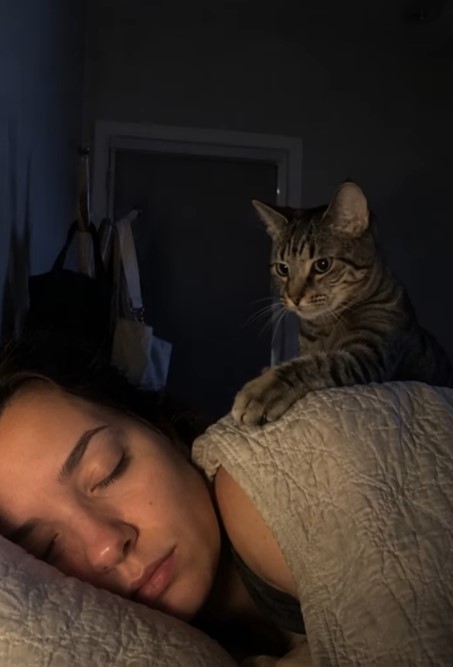
The Cat Forced Her Owner Out of the Bedroom Every Night Until a Veterinarian Suggested a Hidden Medical Cause Behind the Behavior A Strange Nightly Pattern Begins. Anna never expected that living with her cat would slowly turn into a confusing and exhausting routine that disrupted her sleep and raised concerns about what was happening inside her home every night.
At first, her gray cat Luna was gentle, affectionate, and predictable. During the day, she behaved normally, showing no signs of illness, stress, or unusual behavioral issues that might cause concern. However, everything changed at night. At almost the same time every evening, Luna would wake Anna repeatedly, interrupting her sleep with behavior that gradually became more persistent and difficult to ignore.
Initially, the cat would lightly tap Anna’s face with her paw, as if trying to gently wake her before returning to sleep, a behavior that seemed harmless and easy to dismiss at first. When that did not work, Luna’s behavior escalated. She began scratching the blanket, nudging more firmly, and occasionally biting lightly, always targeting Anna during deep sleep cycles throughout the night.
Despite changing routines, feeding times, and sleeping arrangements, nothing seemed to stop the pattern. The behavior continued consistently, leaving Anna increasingly tired and concerned about the cause behind it. Eventually, Anna discovered a strange pattern. The only way Luna would calm down was if she physically left the bedroom and moved to sleep somewhere else, usually the living room couch.
Once Anna left the room, Luna would immediately stop the disruptive behavior, settle calmly on the bed, and sleep peacefully until morning as if nothing unusual had occurred at all. This cycle repeated for weeks, gradually leaving Anna physically exhausted and emotionally confused about whether the issue was behavioral, environmental, or something more serious involving her cat’s health.
Seeking Professional Help. After nearly three months of broken sleep, Anna decided she could no longer ignore the situation and scheduled a veterinary appointment to understand Luna’s unusual nighttime behavior more clearly. When she contacted the clinic, her voice reflected exhaustion and concern. She explained that her cat was preventing her from sleeping and that the situation was becoming increasingly difficult to manage.
Veterinarians are often familiar with nighttime cat behavior, including restlessness, attention-seeking, or environmental stress responses. However, Anna’s description felt more consistent and unusual than typical cases. She did not sound angry or frustrated, but genuinely worried, as if she suspected something deeper might be affecting either her cat or her own health during sleep. When Anna arrived at the clinic, she appeared tired but composed.
She carefully carried Luna in a pet carrier, showing concern and affection despite the ongoing nighttime difficulties they were experiencing. “This is Luna,” Anna said. “She is normally very calm, but at night she behaves like she is trying to force me out of the bedroom repeatedly.” Inside the carrier, Luna remained calm and observant. There were no immediate signs of aggression, illness, or neurological issues that would clearly explain the repeated nighttime behavior.
The veterinarian conducted a full examination, checking heart rate, breathing, weight, and general health. All results appeared normal, with no clear medical explanation for the behavior at that stage. However, during observation, the veterinarian noticed something subtle. Luna consistently watched Anna closely, following her movements with focused attention throughout the entire appointment. A Different Perspective Emerges
The veterinarian then shifted focus and asked Anna questions about her own health, sleep quality, and physical sensations during the night, exploring whether another factor might be involved. Anna explained that she often woke up feeling anxious, with a racing heartbeat, dry mouth, and occasional shortness of breath, which made her sleep feel irregular and interrupted. She had previously assumed stress or insomnia was the cause and had even been prescribed mild medication, but the symptoms continued without significant improvement over time.
Anna also mentioned feedback from a neighbor, who had noticed irregular breathing sounds during the night, including moments where her breathing seemed to pause before suddenly returning. This detail raised concern for the veterinarian, suggesting that the issue might not be purely behavioral, but potentially connected to an underlying sleep or respiratory condition affecting Anna herself. The veterinarian explained that animals can sometimes detect subtle physical changes in humans, including breathing irregularities, heart rhythm changes, or distress signals during unconscious sleep states.
“It is possible,” the veterinarian said, “that Luna is reacting to changes in your condition during sleep rather than behaving aggressively or unpredictably without reason.” Anna was surprised and asked whether her cat could actually be responding to a medical issue rather than simply causing disruption or acting out during the night.
The veterinarian recommended further medical evaluation, including blood tests, heart monitoring, and a sleep study to better understand what might be happening during her nighttime episodes. Medical Findings Provide Answers. A week later, Anna underwent full medical testing and returned for follow-up discussions, where doctors shared results that helped explain many of her previously confusing symptoms.
The tests revealed elevated blood sugar levels and signs that required further medical attention, indicating that her body was experiencing physical stress that needed proper management and treatment. Additional evaluations suggested possible cardiovascular concerns, which required monitoring and further specialist consultation to ensure long-term health and safety moving forward. Most importantly, a sleep study confirmed interrupted breathing episodes during the night, indicating a condition that affected her oxygen levels and overall sleep quality significantly.
Suddenly, Luna’s behavior made more sense. Each time the cat woke her, it may have coincided with moments when Anna’s breathing or body functions were becoming unstable. When Anna sat up or moved to another room, her breathing improved slightly, which could explain why Luna consistently stopped the behavior once she left the bedroom. A New Understanding and Changed Relationship
After beginning treatment, Anna gradually noticed improvements in her health. Medical guidance, monitoring, and lifestyle adjustments helped stabilize her condition over time. As her condition improved, Luna’s behavior changed as well. The nighttime disturbances stopped completely, and the cat no longer needed to wake or move her out of bed.
Instead, Luna began sleeping peacefully beside Anna, remaining calm throughout the night and showing no further signs of disruptive behavior or stress-related activity. What once seemed like problematic behavior was now viewed differently, possibly reflecting an instinctive response to changes in Anna’s physical condition during sleep.
Anna later reflected on the experience, realizing she had initially misunderstood her cat’s actions and assumed behavioral issues rather than considering possible health-related causes. She also acknowledged that without Luna’s repeated nighttime interruptions, she might not have discovered her medical condition as early as she did, potentially delaying treatment. Today, Anna and Luna continue to live together with a stronger understanding and calmer routine, built on trust, care, and improved awareness of each other’s needs and signals.

