
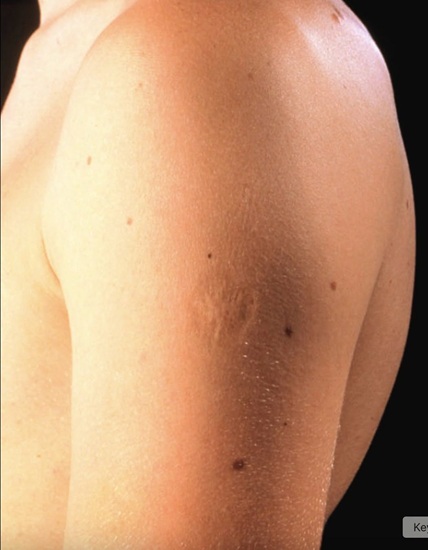
Have you ever noticed a small, round scar high on the arm of a parent, grandparent, or another older adult and wondered where it came from? The mark can look unusual, sometimes appearing as a shallow circular depression with uneven or pitted skin around it. For many people who received routine vaccinations decades ago, one possible explanation is the smallpox vaccine. The scar is especially associated with older generations who were vaccinated before smallpox was eradicated worldwide.
However, appearance alone cannot confirm the cause of any individual scar, since other vaccines, injuries, and skin conditions can produce similar marks. For people who actually received the smallpox vaccine, the scar can serve as a physical reminder of a period when smallpox remained a serious public-health concern. Younger generations are less likely to have this particular vaccination scar because routine smallpox vaccination ended in many countries after the disease was eliminated locally and eventually eradicated globally.
The timing varied from country to country, so age alone cannot determine whether someone received the vaccine. Personal vaccination history and medical records, when available, provide more reliable information.
What Was Smallpox?
Smallpox was a highly contagious infectious disease caused by the variola virus. For centuries, it caused devastating outbreaks in populations around the world. People infected with the disease commonly developed fever and other symptoms before a distinctive rash appeared. The rash progressed through several stages and produced lesions that could spread across large areas of the body.
The disease could be extremely dangerous. The more common and severe form, known as variola major, killed approximately three out of every ten people who became infected. Survivors could experience lasting consequences, including prominent pitted scars. In some cases, smallpox could also lead to serious complications affecting different parts of the body.
Before eradication, the possibility of a smallpox outbreak was therefore taken very seriously. Communities could experience enormous loss when the virus began spreading, particularly before widespread vaccination became available. Preventing transmission became one of the major challenges of infectious-disease control.
A Vaccine That Worked Differently From Many Modern Injections
The traditional smallpox vaccination technique differed noticeably from the way many vaccines are administered today. Rather than simply placing a conventional injection into a muscle, vaccinators commonly introduced smallpox vaccine into superficial layers of the skin. During the global eradication era, this was often done with a specialized instrument called a bifurcated needle.
A bifurcated needle has two small prongs at its tip. A small amount of vaccine could be held between those prongs and delivered through multiple rapid punctures in the skin. This technique helped vaccinators administer the vaccine efficiently during large immunization campaigns.
Importantly, the vaccine did not contain the variola virus that causes smallpox. It used vaccinia virus, which belongs to the same broader family of viruses but is distinct from variola. This distinction is important when explaining how smallpox vaccination worked.
Why Did Vaccination Leave a Scar?
The recognizable scar developed because smallpox vaccination intentionally produced a localized reaction at the vaccination site. After successful vaccination, the skin did not simply return to normal immediately. Instead, the area changed through several stages while the body’s immune system responded.
A raised area typically developed first. Over time, the vaccination site could become a fluid-filled blister and then progress into a pustule. Eventually, a scab formed over the area. The process took place over a period of weeks rather than disappearing after a day or two.
When the scab eventually separated and the skin healed, a permanent scar could remain. That is why the resulting mark can look much more noticeable than the tiny temporary spot associated with many routine injections today. Decades later, the scar may still be visible.
Why Is the Scar Often High on the Arm?
Many people who received the vaccine have the scar on the upper arm. This was a convenient location for administering the vaccine and allowed the area to remain reasonably protected by clothing while healing.
The resulting mark can vary considerably between individuals. Some people have an obvious circular depression, while others have a smaller or less distinctive scar. Skin characteristics and individual healing responses can influence the final appearance.
Not every round scar on an upper arm should automatically be identified as evidence of smallpox vaccination. BCG vaccination against tuberculosis, for example, can also produce a permanent scar and remains widely used in many parts of the world. Injuries, infections, and medical procedures can create similar marks as well.
Smallpox Had Devastating Consequences
The reason such widespread vaccination campaigns became necessary was the severity of smallpox itself. The disease had affected humanity for thousands of years and caused enormous numbers of deaths before eradication.
People who survived were not always able to return to life without lasting effects. Smallpox lesions could leave extensive pitted scars, particularly on the face. These permanent changes meant that even survivors could carry visible evidence of the disease for the remainder of their lives.
Because humans were the natural hosts of variola virus and an effective vaccine existed, health authorities eventually recognized that complete eradication might be possible. Achieving that goal, however, required an international effort on a scale rarely attempted before.
The Long History of Smallpox Vaccination
The history of vaccination against smallpox is closely associated with English physician Edward Jenner. In 1796, Jenner conducted work showing that exposure to cowpox could provide protection against smallpox. His experiments became a landmark in the development of vaccination.
Jenner did not immediately eliminate smallpox, of course. The disease continued circulating for generations. Vaccination techniques and vaccine production improved over time, while different governments introduced programs designed to protect their populations.
By the twentieth century, vaccination had dramatically changed the fight against smallpox, but the disease still remained endemic in parts of the world. Eliminating it completely required finding and interrupting every remaining chain of transmission.
A Global Campaign Begins
The World Health Organization intensified its global smallpox eradication program in 1967. The campaign did not rely solely on vaccinating as many people as possible. Health workers also needed to identify cases rapidly, investigate outbreaks, find people who had been exposed, and prevent the virus from spreading further.
Surveillance became an essential part of the strategy. When health workers discovered a case, teams could focus vaccination and containment efforts around the affected community. This approach helped break chains of transmission.
The work was extraordinarily challenging. Vaccination teams traveled to remote areas, dealt with transportation difficulties, worked across different cultures and languages, and attempted to locate cases in regions with limited medical infrastructure.
The Importance of the Bifurcated Needle
The bifurcated needle became an important practical tool during the eradication campaign. Its simple design allowed a small amount of vaccine to be delivered efficiently through multiple punctures.
The technique could be taught relatively quickly to trained vaccination workers, which was especially useful when enormous numbers of people needed protection. The needle also required only a small quantity of vaccine for each vaccination.
The characteristic reaction at the vaccination site provided another useful feature. A successful vaccination generally produced an identifiable skin response, allowing health workers to evaluate whether the expected reaction had occurred.
For recipients, that reaction sometimes resulted in the permanent circular scar that can still be seen decades later. What appears today to be a small mark on someone’s arm can therefore be connected to one of the largest disease-eradication campaigns ever undertaken.
Smallpox Disappeared at Different Times in Different Countries
It is important to distinguish between eliminating smallpox within an individual country and eradicating the disease worldwide. These events did not happen simultaneously.
In the United States, the last naturally occurring case of smallpox was recorded in 1949. Routine smallpox vaccination for the general American population ended in 1972 because the risk of encountering the disease had become extremely low.
Smallpox nevertheless continued circulating elsewhere in the world. International eradication efforts therefore remained necessary long after naturally occurring cases had disappeared from the United States and several other countries.
This distinction is particularly important because some online accounts incorrectly state that smallpox was eradicated globally during the 1950s or early 1970s. The actual worldwide milestone came later.
The Last Naturally Occurring Case
By the 1970s, the global campaign had dramatically reduced the number of places where smallpox remained. Each remaining outbreak became increasingly important because health workers were getting closer to completely interrupting natural transmission.
The last known naturally occurring case of smallpox occurred in Somalia in 1977. The patient was Ali Maow Maalin, who recovered from the infection. His case became a historic milestone because no subsequent naturally occurring chain of smallpox transmission has been identified.
The end of natural transmission did not immediately result in an official declaration of eradication. International health authorities needed to verify that the virus was no longer circulating undetected anywhere in the world.
A laboratory-associated smallpox incident also occurred in Birmingham, England, in 1978. For this reason, discussions of smallpox history should distinguish between the final naturally occurring case and later infections connected with laboratory exposure.
Global Eradication Was Declared in 1980
After extensive surveillance and verification, an international commission concluded that smallpox had been eradicated. On May 8, 1980, the World Health Assembly formally endorsed the declaration of global eradication.
This achievement was unprecedented. Smallpox became the first human infectious disease to be eradicated worldwide through deliberate public-health action.
Eradication meant that naturally circulating variola virus was no longer passing from person to person anywhere in the world. As a result, routine vaccination of the general population was no longer necessary.
The accomplishment demonstrated what vaccination, international cooperation, careful surveillance, and rapid outbreak response could achieve when combined effectively.
Why Routine Smallpox Vaccination Ended
Vaccination programs are based on balancing expected benefits against potential risks. When smallpox was circulating, the danger posed by the disease made vaccination enormously valuable.
Once natural transmission had been eliminated, that calculation changed. Smallpox vaccination can cause adverse reactions, and there was no longer a routine risk of encountering naturally circulating smallpox.
Countries therefore stopped routine vaccination at different points as circumstances changed. The United States ended routine vaccination in 1972, while global eradication was formally declared eight years later.
This is one reason younger people generally do not have the characteristic smallpox vaccination scar. Most people born after eradication were never routinely vaccinated against the disease.
Could a Similar Scar Come From Another Vaccine?
Yes. This is an important detail because identifying a vaccine solely from a photograph or visual inspection can be unreliable.
BCG, a vaccine primarily used against tuberculosis, can also produce a small permanent scar. BCG vaccination policies differ considerably between countries, and it has been routinely administered to infants or children in many regions.
Consequently, two people of similar ages from different countries could have similar-looking scars for entirely different reasons. One may have received smallpox vaccination, while another may have a BCG scar.
The location, appearance, person’s age, country where they grew up, and known vaccination history can provide useful context. Medical or vaccination records offer stronger evidence whenever they are available.
The Scar Is a Result of Healing
There is nothing mysterious about why an authentic smallpox vaccination scar can remain for decades. The vaccine produced a deliberate local skin reaction, and the body then repaired the affected tissue.
Whenever deeper layers of skin are involved in an inflammatory or injury process, healing can sometimes produce scar tissue rather than perfectly recreating the skin’s previous appearance. The vaccination site’s characteristic progression made permanent scarring relatively common.
The shape may remain recognizable many decades later even as the surrounding skin changes naturally with age. Some scars become less obvious, while others remain clearly visible.
A Tiny Mark With an Extraordinary History
What makes the smallpox vaccination scar particularly fascinating is not simply its appearance but what it can represent. Behind that small circle of scar tissue lies the history of a disease that once caused devastating outbreaks throughout the world.
Generations lived during a period when smallpox remained a genuine threat. Doctors, scientists, nurses, public-health workers, and vaccination teams spent decades trying to prevent infections and eventually eliminate transmission entirely.
Millions of people participated simply by receiving vaccination. Their individual protection contributed to a much larger effort that gradually deprived the virus of opportunities to spread.
The scars left on some recipients became unintended physical reminders of that campaign.
An Important Difference Between a Scar and a “Vaccine Passport”
It can be tempting to describe the scar informally as an early “vaccine passport,” but that comparison should not be interpreted literally. A scar was not equivalent to today’s official vaccination documentation, and visual inspection alone could not provide a complete or universally reliable vaccination history.
What the scar could provide was visible evidence consistent with a characteristic vaccination reaction. During the smallpox era, health workers sometimes examined vaccination sites or scars as part of determining vaccination status, but documentation and public-health procedures varied across countries and periods.
Today, an old scar should be viewed primarily as a possible clue to someone’s medical history rather than definitive proof on its own.
Why These Scars Are Becoming Less Common
As generations born after the end of routine smallpox vaccination grow older, encountering a genuine smallpox vaccination scar naturally becomes less common.
Someone can now reach middle age without ever having lived during a period when routine smallpox vaccination was part of ordinary childhood healthcare in their country. For younger generations, the disease itself may exist primarily in history books.
That generational difference can explain why a child might notice a parent’s or grandparent’s scar and become curious about it. Something completely ordinary to one generation can appear mysterious to another.
The Larger Lesson Behind the Mark
The story of smallpox vaccination is ultimately much larger than a scar on someone’s shoulder. It is a story about centuries of disease followed by scientific progress and extraordinary international cooperation.
Smallpox eradication required more than discovering a vaccine. It depended on producing and transporting vaccines, training workers, identifying cases, investigating outbreaks, locating contacts, vaccinating communities, and verifying that transmission had truly stopped.
The final result was something humanity had never previously accomplished with a human infectious disease: deliberate global eradication.
Today, smallpox no longer circulates naturally anywhere in the world. The characteristic scars still visible on some older adults therefore belong to a very different period in medical history.
If you notice such a mark on a family member, it can be worth asking about their vaccination history rather than assuming its origin. Depending on their age and where they grew up, the answer might involve smallpox vaccination, BCG vaccination, or something entirely different.
But when the mark really is an old smallpox vaccination scar, that small indentation represents an extraordinary chapter of history. It is a physical reminder of the time when smallpox threatened communities around the world—and of the vaccination, surveillance, and international cooperation that eventually helped bring naturally occurring smallpox to an end.

