

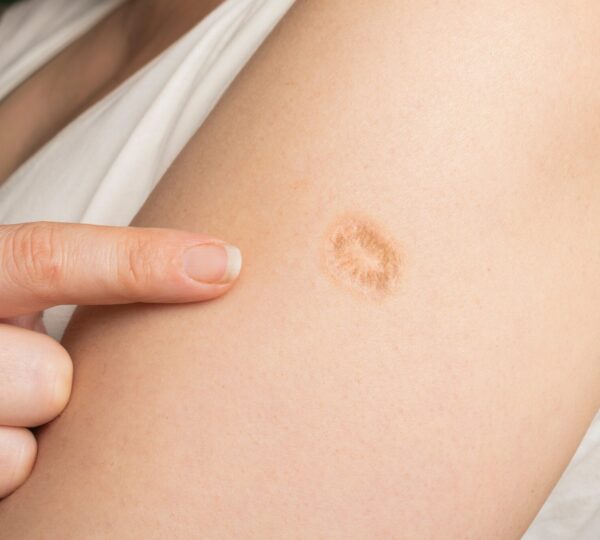
For many people, an unusual scar on the upper arm can become a source of curiosity. It may be small and circular, with a slightly indented or textured appearance that makes it look different from the mark left by an ordinary cut. Younger family members sometimes notice these scars on their parents or grandparents and wonder where they came from. In many cases, particularly among people born when routine smallpox vaccination was still common, the explanation may be connected to that vaccine.
The small mark can therefore represent much more than an old childhood memory. It can be a visible connection to one of the most important public-health achievements in history. Smallpox was once one of the world’s most feared infectious diseases. It was caused by the variola virus and spread mainly through close contact between people, although contaminated materials could also play a role in transmission. Infected individuals typically developed symptoms that included fever, severe fatigue, and a characteristic rash.
The rash progressed into lesions that eventually formed scabs before healing. Those who survived could be left with permanent pitted scars, particularly on the face and other areas of the body. Some survivors also experienced serious complications, including vision problems. The danger posed by smallpox was considerable. According to historical information from the World Health Organization, the more severe and common form of the disease, known as variola major, had an overall fatality rate of around 30 percent.
The disease existed for thousands of years and repeatedly caused devastating outbreaks in communities around the world. During the 20th century alone, smallpox was responsible for hundreds of millions of deaths. These enormous consequences explain why preventing the disease became such an important objective for scientists, physicians, governments, and public-health organizations. The origins of smallpox vaccination stretch back more than two centuries.
English physician Edward Jenner became one of the central figures in this history after observing that exposure to cowpox appeared to provide protection against smallpox. In 1796, Jenner carried out the experiment for which he later became famous, helping establish an early scientific foundation for vaccination. Medical knowledge and vaccine technology changed significantly during the following generations, but Jenner’s work represented a major milestone. It demonstrated that protection against a deadly infectious disease could be deliberately produced rather than simply left to chance.
Smallpox vaccination eventually became widespread in many countries. For people growing up during periods when the disease remained a threat, receiving the vaccine could be a routine part of childhood healthcare. Vaccination policies were not identical everywhere, and different countries changed their programs at different times. This means that a person’s age alone cannot prove whether they received the vaccine. Nevertheless, millions of people were vaccinated using methods that frequently produced a recognizable scar, which explains why similar marks can still be seen on the arms of many older adults today.
The distinctive scar was partly a consequence of how the traditional vaccine was administered. Smallpox vaccination differed from many injections familiar to people today. During the eradication era, health workers commonly used a specialized instrument called a bifurcated needle. The tiny needle had two prongs at its tip and could hold a small amount of vaccine between them. Instead of delivering a single conventional injection deep into the arm, the vaccinator made a series of rapid punctures in a small area of the skin.
This technique offered practical advantages during enormous vaccination campaigns. The bifurcated needle was simple, relatively inexpensive, and required only a small quantity of vaccine for each person. These characteristics were especially valuable when health workers needed to vaccinate large populations, sometimes in areas with limited medical infrastructure. The needle could also be sterilized and used efficiently by properly trained personnel. Together with improved vaccine production and storage methods, it became an important tool during the international campaign against smallpox.
After vaccination, the treated area normally underwent a noticeable reaction rather than immediately disappearing like the mark from many ordinary injections. The vaccine contained vaccinia virus, a virus related to the variola virus that causes smallpox. Importantly, the traditional vaccine did not give recipients smallpox itself. Instead, exposure to vaccinia stimulated an immune response capable of protecting people against smallpox. The local reaction around the vaccination site was part of the body’s response to this process.
Over the following days, the vaccination site could pass through several stages. A small raised area developed and later became a fluid-filled lesion. Eventually, the area formed a scab as the skin began healing. Once that scab naturally separated, a small permanent scar could remain behind. Because numerous punctures had been made within a concentrated area, the finished mark could have a textured, circular, or indented appearance. This is the familiar scar that many people continue to carry decades after receiving the vaccine.
Historically, healthcare workers also observed the vaccination site to determine whether the expected reaction had occurred. A characteristic reaction was sometimes described as a successful vaccine “take.” This gave medical workers useful information about how the vaccination had progressed. The resulting scar was therefore not deliberately created as an identification mark; it was a consequence of vaccination and healing. Although someone might informally compare the scar to visible evidence of having been vaccinated, describing it literally as an early “vaccine passport” would oversimplify its medical purpose.
Not every circular upper-arm scar should be identified as a smallpox vaccination scar. This distinction is particularly important because another vaccine, BCG, can also leave a noticeable scar. BCG vaccination is used to help protect against tuberculosis and has been widely administered in many parts of the world. Depending on a person’s country of origin, age, and vaccination history, a scar that appears to be from smallpox vaccination could have another explanation. Injuries, infections, and medical procedures can also leave similar marks.
For that reason, appearance alone cannot provide absolute confirmation of what caused a particular person’s scar. Historical circumstances can provide clues, but personal vaccination records or medical history offer stronger evidence. Someone who received a vaccine during childhood decades ago may understandably have little or no memory of the event. Family members might remember it, or old medical documentation may provide additional information. When there is a genuine medical concern about an unexplained scar, a qualified healthcare professional is more appropriate than attempting to diagnose its origin from an online photograph.
The history behind genuine smallpox vaccination scars becomes especially meaningful when viewed alongside the global fight against the disease. By the 20th century, scientists already possessed an effective method of prevention, but eliminating smallpox everywhere remained an enormous challenge. Vaccinating people across different continents required reliable supplies, trained health workers, transportation, surveillance systems, and international cooperation. Remote communities had to be reached, suspected cases had to be identified, and outbreaks had to be contained before the virus could continue spreading.
The World Health Organization intensified the global smallpox eradication program in 1967. Vaccination was central to the campaign, but success depended on more than simply trying to vaccinate every person on Earth. Health workers increasingly used surveillance to locate outbreaks and identify people who might have been exposed. Vaccination could then be concentrated around confirmed cases and their contacts. This approach helped create barriers around outbreaks and interrupt chains of transmission.
Such work could be extremely demanding. Health teams sometimes traveled into difficult or remote environments while searching for possible cases. When a suspected infection was identified, investigators needed to determine who had been in contact with that person and whether additional transmission had occurred. Accurate reporting became essential because even a small unnoticed outbreak could allow the virus to survive. International coordination also mattered because infectious diseases do not respect national borders.
Technological improvements strengthened the campaign as well. Freeze-dried smallpox vaccine was better suited to challenging environments because it could retain effectiveness under conditions where earlier vaccine preparations were more difficult to use. The bifurcated needle reduced the amount of vaccine needed for each vaccination and simplified administration. These practical innovations might appear modest compared with dramatic scientific discoveries, yet they made an enormous difference when applied across populations numbering in the millions.
Gradually, the geographic territory in which smallpox continued circulating became smaller. Transmission was eliminated from region after region as vaccination and containment programs succeeded. The last known naturally occurring case of variola major was recorded in Bangladesh in 1975. The final naturally occurring case of smallpox, involving the milder variola minor form, was identified in Somalia in 1977. The patient, Ali Maow Maalin, survived and later became associated with public-health work in Somalia.
Ending the final known chain of natural transmission did not immediately lead authorities to declare victory. Investigators needed strong evidence that hidden cases were not continuing somewhere else. Extensive surveillance and international verification followed. Experts reviewed available information and searched for signs that smallpox remained in circulation. Only after this careful process was the world prepared to conclude that naturally occurring transmission had genuinely been interrupted.
In 1980, the World Health Assembly officially declared smallpox eradicated. This represented an extraordinary achievement: a disease that had affected humanity for thousands of years was no longer circulating naturally anywhere in the world. Smallpox became the first human infectious disease to be eradicated through a deliberate global campaign. The accomplishment demonstrated what vaccination, surveillance, scientific research, international cooperation, and sustained public-health work could achieve when directed toward a common objective.
It is important to use the word “eradicated” rather than saying that the virus simply became “extinct.” Naturally occurring smallpox transmission has ended, but highly controlled laboratory stocks of variola virus have historically remained under strict international oversight. Health authorities also maintain preparedness measures because the consequences of any future smallpox emergency could be severe. Vaccine reserves and response plans therefore continue to exist even though routine vaccination of the general public is no longer necessary.
The disappearance of naturally circulating smallpox also changed the balance between the benefits and risks of routine vaccination. Smallpox vaccines were extremely valuable when people faced the possibility of exposure to a deadly disease, but the traditional vaccine could itself cause adverse reactions in some recipients. Once the natural disease had been eliminated, routinely vaccinating everyone was no longer justified in the same way. Countries therefore discontinued routine programs as the threat disappeared and global eradication approached.
In the United States, routine smallpox vaccination recommendations for children ended in 1971. This historical detail is sometimes simplified into the claim that routine vaccination ended everywhere in 1972, but the actual transition depended on policy, location, and population. Other countries followed their own timelines. Consequently, whether an older adult received the vaccine depends partly on where and when that person grew up. The scar is common among certain generations, but it should never be assumed that every person from those generations has one.
This history creates a striking difference between generations. A parent or grandparent may carry a permanent vaccination scar while their children and grandchildren have no comparable mark. Someone younger might initially assume that the scar came from an accident because they have never encountered that vaccination procedure themselves. Learning its possible origin can therefore reveal how dramatically medicine has changed within a single lifetime.
A person who received the vaccine as a young child might not remember the procedure at all. Yet the physical mark can remain visible for decades. In that sense, the scar becomes a quiet historical record written into the skin. It reflects a period when smallpox was still taken seriously enough that governments maintained routine vaccination programs to protect populations from possible outbreaks.
The contrast with earlier generations is even more dramatic when the consequences of smallpox itself are considered. Before eradication, people did not merely worry about a temporary fever or rash. Severe smallpox could kill, and survivors sometimes carried extensive facial and body scars for the remainder of their lives. Some experienced blindness and other complications. Families and communities could be deeply affected when outbreaks occurred.
Vaccination changed that history by preventing infection and reducing opportunities for the virus to move from person to person. However, the eventual eradication of smallpox cannot be credited to one individual, one country, or one technological invention. It was the result of contributions from countless scientists, doctors, nurses, vaccinators, epidemiologists, laboratory workers, local health personnel, governments, international organizations, and participating communities. Each part of the system contributed to the final result.
The small bifurcated needle provides an especially interesting example of how simple tools can support enormous achievements. It was not visually impressive and did not involve complicated machinery. Yet it helped health workers administer vaccine efficiently while using relatively small amounts of material. When multiplied across millions of vaccinations, those advantages became extremely important. A tiny instrument could therefore play a meaningful role in a campaign with worldwide consequences.
For families today, discovering the story behind an old vaccination scar can also encourage conversations between generations. A younger person may notice the mark on a parent’s arm and ask about it for the first time. That simple question can lead to memories of childhood vaccinations, doctors’ offices, school health programs, or life during an era when diseases now rarely discussed were still familiar concerns.
Those conversations are also reminders that medical history is not always distant. The worldwide eradication of smallpox was officially recognized only in 1980. Millions of people alive today were born before that happened. Many personally experienced routine smallpox vaccination and still carry its visible evidence. Something that younger generations encounter mainly through books and historical photographs was part of ordinary healthcare during their parents’ or grandparents’ lives.
At the same time, historical curiosity should remain separate from individual medical diagnosis. A photograph of an upper-arm scar cannot reliably establish someone’s vaccination history. BCG scars can resemble smallpox vaccine scars, and natural differences in healing can make scars look different from one person to another. Even two people who received the same type of vaccine might not develop identical marks.
What can be said with confidence is that traditional smallpox vaccination frequently produced a characteristic permanent scar. The mark resulted from the vaccination technique, the local reaction to vaccinia virus, and the body’s natural healing process. It was not a sign that someone had contracted smallpox. Instead, for genuine smallpox vaccination scars, it reflected an effort to protect the recipient against the disease.
The distinction between vaccinia and variola is particularly important. Variola virus causes smallpox, whereas the traditional vaccine used vaccinia virus to stimulate protective immunity. Confusing these two viruses can lead to the mistaken idea that vaccination involved intentionally infecting people with smallpox itself. That is not an accurate description of the vaccination process.
Understanding these details makes the scar considerably more interesting than it might initially appear. A small indentation on someone’s upper arm can connect personal history with the development of vaccination, advances in epidemiology, worldwide disease surveillance, and one of medicine’s greatest international campaigns. It demonstrates how something physically tiny can represent a historical achievement of enormous scale.
Smallpox once caused suffering across continents and throughout centuries of human history. Today, naturally occurring cases no longer exist because transmission was successfully interrupted worldwide. That outcome was not inevitable. It required sustained effort over many years and careful work even after the number of cases had fallen dramatically.
For those who genuinely carry a smallpox vaccination scar, the mark therefore has an unusual historical significance. It may have started as a routine childhood medical procedure that the recipient barely remembers. Decades later, however, it remains visible after the disease it was designed to prevent has disappeared from natural circulation.
So when a distinctive circular scar appears on the upper arm of an older relative, smallpox vaccination may be one possible explanation, particularly if that person’s age and vaccination history correspond with the period when the vaccine was routinely administered. It should not automatically be identified without supporting information, because several other causes are possible. Still, asking about it can uncover a fascinating piece of family and medical history.
Behind many genuine smallpox vaccination scars is ultimately a story of prevention rather than disease. The marks are remnants of an era when humanity was still fighting a virus that had caused devastating epidemics for generations. Through vaccination, surveillance, containment, scientific innovation, and international cooperation, that fight eventually succeeded.
Today, the scar can appear modest enough to overlook completely. Yet for those whose marks truly came from smallpox vaccination, it represents a direct physical connection to a remarkable period in medical history. Smallpox was once a worldwide threat, but its natural transmission was ultimately stopped, and the World Health Assembly declared the disease eradicated in 1980. A tiny mark left on the arm decades ago can therefore carry a surprisingly large story — one about medicine, history, cooperation, and the global effort that finally brought one of humanity’s oldest infectious enemies under control.

