
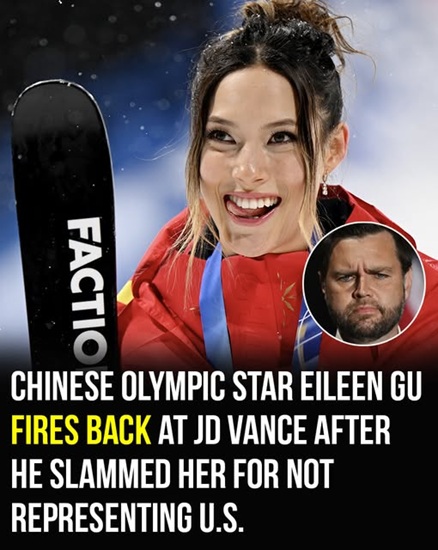
Discussions about politics and sports have once again surfaced during the Winter Olympic season, this time involving comments made by JD Vance and responses from freestyle skiing star Eileen Gu.
As with many high-profile Olympic moments, athletic achievement has shared the spotlight with broader conversations about national identity, representation, and the role of political expression in international competition.
It is important to clarify several factual points at the outset. The 2026 Winter Olympics in Italy, officially known as 2026 Winter Olympics, are scheduled to take place in Milan and Cortina d’Ampezzo.
As of now, those Games have not yet occurred, meaning medal counts and performance outcomes remain unknown.
Therefore, any claims about record-breaking medal totals or specific results from 2026 are speculative and not confirmed.
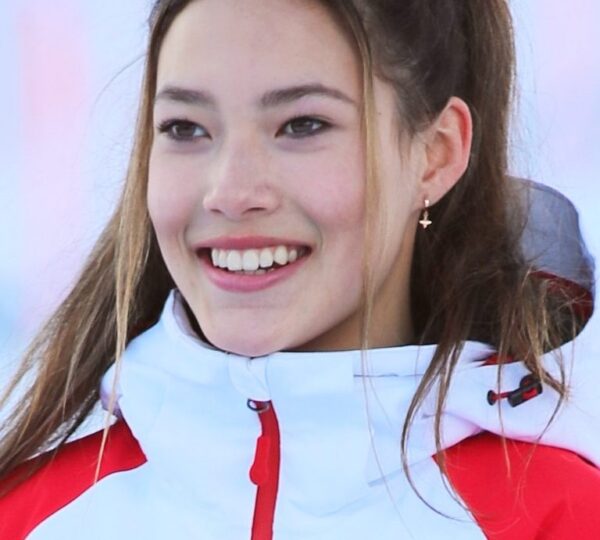
However, conversations surrounding Eileen Gu’s nationality, Olympic representation, and political commentary stem largely from events that unfolded during and after the 2022 Winter Olympics in Beijing.
Eileen Gu, born in San Francisco in 2003, has become one of the most prominent figures in freestyle skiing. She first gained global attention when she chose in 2019 to represent China in international competition rather than the United States.
Her decision immediately generated headlines because she had grown up in California, trained in the U.S., and was widely regarded as an emerging American talent.
Gu’s athletic achievements are substantial. At the 2022 Beijing Winter Olympics, she won two gold medals and one silver medal for China, competing in big air, halfpipe, and slopestyle events.
Those victories elevated her status internationally and made her one of the most decorated freestyle skiers of her generation. Her success also intensified scrutiny around her decision to compete for China rather than Team USA.
Questions about athlete nationality are not new in Olympic history. Under International Olympic Committee (IOC) rules, athletes who hold dual nationality may represent either country, provided they meet eligibility criteria and adhere to federation guidelines.
The IOC states that a person who is a national of two or more countries may compete for one of them, subject to waiting periods or administrative requirements if switching representation.
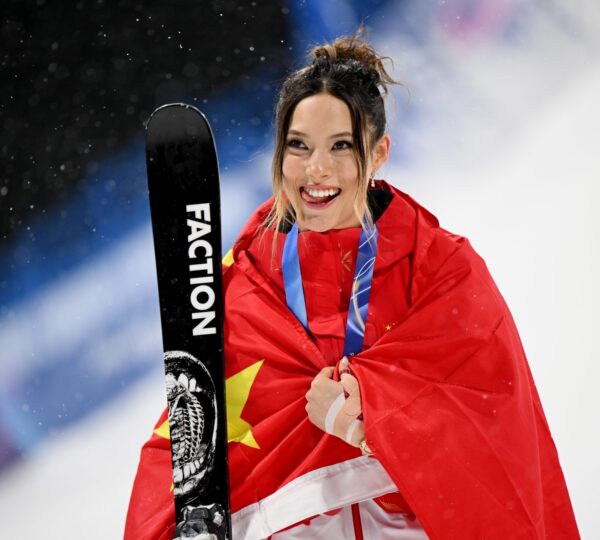
China, however, does not officially recognize dual citizenship, which has led to ongoing public speculation about Gu’s precise citizenship status.
Gu herself has not publicly provided detailed clarification on the matter, and Olympic regulations focus primarily on eligibility rather than public disclosure of passport details.
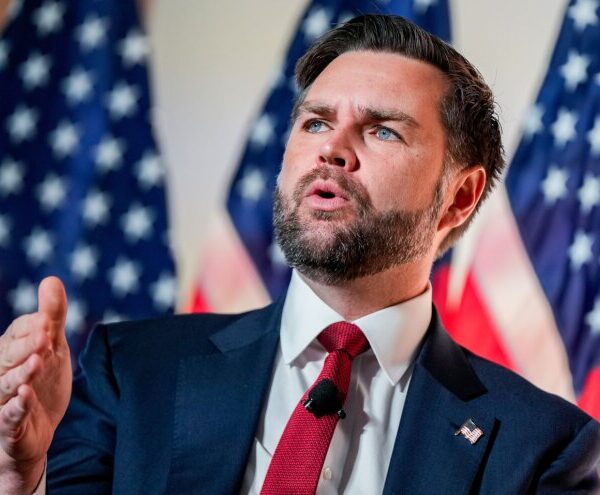
The political dimension of Gu’s choice resurfaced after comments attributed to Vice President JD Vance regarding American athletes expressing political opinions during Olympic competition.
Vance has voiced criticism of athletes who use major sporting platforms to comment on U.S. policy or governance, arguing that the Olympics should center on competition rather than political messaging.
In remarks reported by media outlets, he suggested that athletes who enter political discussions should expect public response and debate.
In addition, Vance questioned whether athletes who were raised and educated in the United States should represent another country in the Olympic Games.
He expressed the view that individuals who have benefited from American institutions might be expected to compete under the U.S. flag.
While he did not propose policy changes to Olympic eligibility rules, his comments added fuel to an already ongoing debate about patriotism and representation.
Gu responded publicly to such commentary. When asked whether she felt targeted in American political discussions, she acknowledged that criticism often focuses disproportionately on her decision to represent China.
She suggested that public reaction sometimes reflects broader geopolitical tensions rather than purely athletic considerations.
In interviews, she has emphasized that many athletes worldwide compete for countries different from their birthplace, and that such choices are common in international sport.
Gu has consistently framed her decision in personal rather than political terms. She has stated that her primary motivation is to inspire young girls and expand opportunities in freestyle skiing, particularly in China, where winter sports participation has grown significantly in recent years.
In interviews, she has said she identifies as both American and Chinese, reflecting her multicultural upbringing.
Born to a Chinese mother, Yan Gu, and an American father, Eileen Gu was raised primarily by her mother in San Francisco.
Her mother, who studied chemistry and biochemistry, had previously participated in speed skating while attending Peking University.
Gu began skiing at a young age, often training in Lake Tahoe. By her early teens, she was already competing at high levels in freestyle skiing competitions.
Her rapid ascent in the sport was marked by podium finishes at World Cup events and X Games competitions before her Olympic debut.
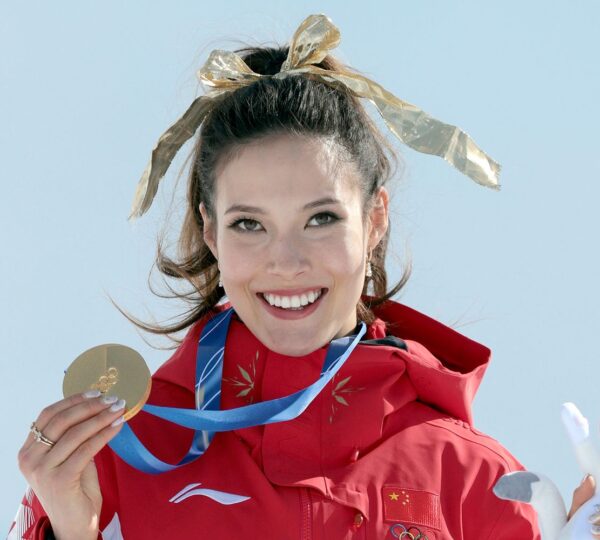
By choosing to represent China, she became part of a broader effort to grow winter sports participation there, especially ahead of the Beijing Olympics. Her victories in 2022 made her one of the most recognizable faces of those Games.
The broader issue raised by Vance’s comments touches on the long-standing intersection between sports and politics. Historically, the Olympics have been both a sporting event and a stage for symbolic representation.
From Cold War-era rivalries to modern debates about athlete activism, the Games have often reflected geopolitical realities.
Some argue that athletes should focus solely on competition and avoid political commentary. Others contend that athletes, as public figures and citizens, have the right to express their views on issues that matter to them.
This debate has intensified in recent years as social media provides athletes with direct platforms to communicate with global audiences.
Gu’s response to political criticism has often been measured. In one interview, she offered a brief and pointed reaction, expressing appreciation rather than anger at being mentioned in political discussions.
She also made clear that she does not see herself as engaged in political confrontation. Instead, she describes her focus as athletic excellence and youth inspiration.
Her remarks about unity reflect the Olympic Charter’s broader mission of promoting friendship and mutual understanding through sport.
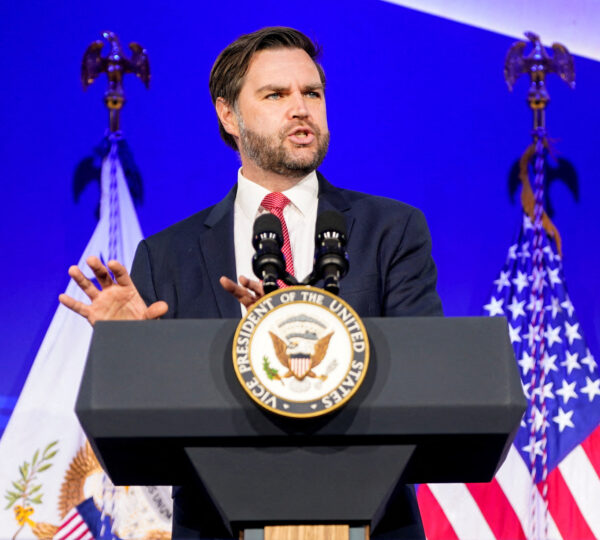
The complexity of Gu’s situation lies in the broader context of U.S.-China relations. Diplomatic tensions, trade disputes, and differing political systems have influenced public perception.
As a high-profile athlete competing for China despite her American upbringing, Gu has become a symbolic figure in these discussions. However, she has repeatedly stated that her personal identity is multifaceted and not defined by political divisions.
It is also important to note that many athletes across various sports represent countries other than their birthplace.
Globalization, migration, and family heritage contribute to diverse national affiliations in international competition.
Olympic eligibility rules accommodate such circumstances, recognizing that nationality can be complex in a globalized world.
From a strictly factual standpoint, Gu remains one of the most accomplished freestyle skiers competing today. Her medals at the 2022 Beijing Games are confirmed achievements.
Future competitions, including the 2026 Winter Olympics, remain forthcoming, and no official results are yet available for those Games.
The broader conversation about political commentary during the Olympics is unlikely to fade. Public officials may continue to voice opinions about athlete activism, and athletes may continue to speak about issues they consider important.
The balance between sports and politics remains an evolving discussion shaped by public sentiment and media coverage.
In reflecting on Gu’s career, it is clear that her athletic accomplishments stand independently of political debates. She has demonstrated exceptional technical skill in halfpipe, slopestyle, and big air events.
Her training discipline and competitive success have positioned her as a leading figure in freestyle skiing.
Ultimately, discussions about nationality, representation, and political speech at the Olympics highlight the global nature of modern sport.
Athletes operate on an international stage where personal identity, heritage, and public perception intersect. While political commentary may generate headlines, the foundation of Olympic competition remains athletic performance.
As future Winter Games approach, attention will likely return to the slopes and halfpipes where athletes compete for medals.
Whether representing the United States, China, or any other nation, competitors bring personal stories and diverse backgrounds to the Olympic stage.
In Eileen Gu’s case, her journey reflects both athletic excellence and the complexities of identity in a connected world.
Her own words perhaps summarize her perspective best: she has stated that she feels both American and Chinese and that her mission is to inspire the next generation.
In the end, her performances on snow continue to define her career more than political debate.
