
The 2026 FIFA World Cup concluded with one of the most memorable finals in recent tournament history, as Spain defeated Argentina 1–0 after extra time to claim its second men’s World Cup title. The victory marked the end of a month-long competition that attracted hundreds of millions of viewers around the world and culminated in a trophy presentation attended by players, coaches, international dignitaries, and FIFA officials. Alongside the sporting achievement, several moments from the post-match ceremony generated significant discussion across television broadcasts, news outlets, and social media platforms.
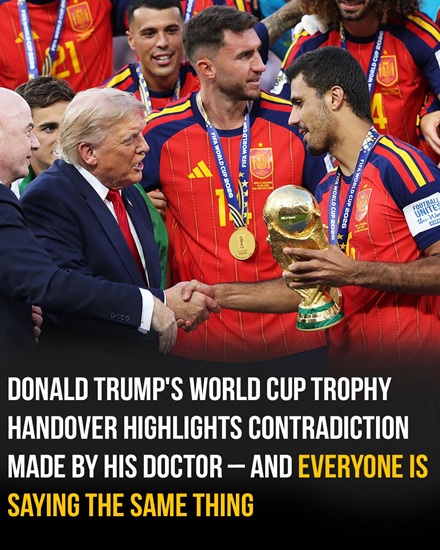
As host nation president, Donald Trump attended the final in East Rutherford, New Jersey, and participated in the official trophy presentation alongside FIFA President Gianni Infantino and other invited leaders. During the ceremony, Spain’s players received their medals before captain Rodri accepted the FIFA World Cup Trophy on behalf of the newly crowned champions. Images and video from the presentation were broadcast live worldwide and were later shared extensively across news organizations and official social media accounts.
One of the moments that attracted the greatest public attention occurred as the trophy presentation concluded. Television footage showed Trump remaining on the stage with the Spanish players for several moments after handing over the trophy. FIFA President Gianni Infantino then appeared to gesture for him to move toward the side of the podium before the team lifted the trophy together. The sequence quickly spread online, where it became the subject of numerous discussions and differing interpretations among viewers. Reuters also reported that Trump remained on the podium before being invited to the side as Rodri prepared to lift the trophy.
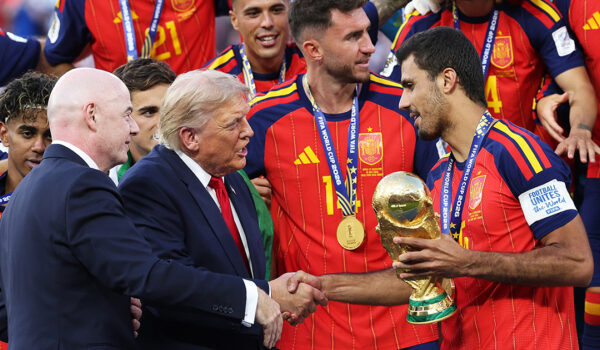
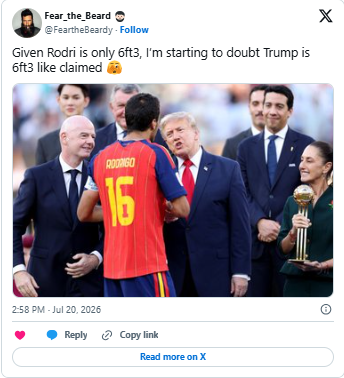
Another topic that emerged online involved comparisons between Trump’s height and that of Spain captain Rodri. Various social media users posted screenshots from the ceremony and commented that Rodri appeared taller during their handshake and while standing nearby. These posts generated thousands of reactions and prompted renewed discussion about publicly listed heights for well-known figures. However, the online conversation largely relied on visual comparisons taken from photographs and broadcast footage rather than independently verified measurements.
Officially available information lists Rodri at approximately 1.90 meters, or 6 feet 3 inches, on football reference profiles. Donald Trump’s most recent White House medical report also lists his height as 6 feet 3 inches. Because both publicly available figures are the same, some observers questioned why they appeared different in certain photographs. At the same time, specialists in photography and broadcasting have long noted that perspective, camera angle, footwear, posture, distance from the camera, and body positioning can all influence how height appears on screen. A single photograph or video frame therefore cannot reliably determine a person’s actual height.
This distinction became important as discussions spread across social media. Some posts suggested that the images proved one of the published height measurements was inaccurate, while others pointed out that visual perception alone is not sufficient evidence to reach that conclusion. News organizations covering the ceremony generally focused on reporting the reactions themselves rather than presenting the online speculation as established fact. In many cases, the story became less about physical measurements and more about how quickly brief moments from major public events can generate widespread online debate.
The trophy ceremony itself represented an important conclusion to Spain’s successful tournament. After Ferran Torres scored the decisive goal in extra time, Spanish players celebrated with supporters before receiving their medals and lifting football’s most prestigious international trophy. Captain Rodri, who had already established himself as one of the leading midfielders in world football through previous club and international achievements, became the player entrusted with raising the World Cup above his teammates as celebrations unfolded across the stadium.
The ceremony also reflected the increasingly global nature of the FIFA World Cup. Political leaders, sports officials, members of royal families, and representatives from several participating nations attended the event alongside thousands of supporters from around the world. Such ceremonies often receive attention that extends well beyond football itself because every interaction, photograph, and televised moment is viewed by a worldwide audience and analyzed almost immediately across digital platforms.
Within minutes of the final whistle, clips from the presentation began circulating across multiple social media platforms. Some viewers discussed Spain’s historic victory, others focused on the atmosphere inside the stadium, while many commented on the interactions involving public figures during the medal ceremony. As frequently happens after globally watched events, opinions varied considerably, with different audiences interpreting the same footage in different ways. The speed with which these discussions spread highlighted the influence that short video clips now have in shaping online conversations after major sporting occasions.
Although the discussion surrounding Trump’s appearance received substantial attention, the central sporting achievement remained Spain’s victory after an outstanding tournament. The players’ performances throughout the competition, the dramatic final against Argentina, and Rodri’s role as captain formed the lasting sporting story of the evening.
As video clips from the trophy presentation continued to circulate, discussion expanded well beyond the stadium. News organizations, sports commentators, and social media users examined different moments from the ceremony, with many focusing on the interactions between public figures and Spain’s players. Such attention is common after globally televised sporting events, where even brief moments can become subjects of widespread conversation within minutes. While many viewers concentrated on Spain’s historic victory, others discussed details of the presentation itself and the appearance of invited guests.
One topic that received significant attention involved visual comparisons between Donald Trump and Spain captain Rodri. Numerous screenshots and short video clips were shared online, leading some users to question whether the two men appeared to be the same height. Publicly available information lists both at approximately 6 feet 3 inches. However, photographs and television footage alone cannot reliably confirm or dispute a person’s official height because visual appearance is influenced by several factors, including camera position, lens perspective, posture, footwear, and the angle from which an image is captured. For this reason, visual comparisons should not be treated as conclusive evidence regarding physical measurements.
Photography professionals have long explained that perspective can significantly affect how people appear in still images and broadcast video. A person standing slightly closer to the camera may appear taller than someone positioned farther away, even if both individuals have the same height. Likewise, differences in body posture, the position of the head, footwear, or the slope of the surface beneath them can influence how height is perceived. These factors are especially relevant during live ceremonies, where participants are constantly moving and television cameras switch rapidly between multiple angles.
As a result, much of the online conversation reflected personal observation rather than verified fact. Some viewers believed the footage suggested a noticeable height difference, while others argued that the available images were insufficient to support such conclusions. News coverage generally distinguished between reporting that discussion and confirming any claim about the individuals involved. This distinction is important because reporting on public reactions is different from presenting speculation as established fact.
Another widely discussed moment occurred after Trump handed the FIFA World Cup Trophy to Spain captain Rodri. Broadcast footage showed the president remaining on the presentation platform while Spain’s players prepared for the traditional trophy celebration. FIFA President Gianni Infantino then appeared to gesture for Trump to move toward the side of the stage before the team completed its celebration. The sequence quickly became one of the most replayed moments from the ceremony and generated a wide range of reactions online.
Many observers interpreted the interaction differently. Some viewed it simply as part of the coordination that naturally takes place during large ceremonial events involving numerous officials, athletes, photographers, and television crews. Others focused on the timing of the movement and discussed it across social media platforms. Because the footage was viewed by millions of people around the world, the moment became one of several talking points alongside Spain’s victory and the overall presentation.
Large international sporting events often generate this type of attention because they bring together athletes, political leaders, sports administrators, entertainers, and members of the public on one highly visible stage. Every handshake, photograph, and televised exchange can quickly become the subject of online discussion, particularly when the event attracts a global audience. The speed with which clips are shared means that individual moments may receive almost as much attention as the sporting achievements themselves.
Despite the widespread discussion surrounding the ceremony, the central story of the evening remained Spain’s achievement on the field. After an intensely contested final against Argentina, Spain secured its second FIFA World Cup title, completing a successful tournament against some of the strongest national teams in international football. Players, coaches, and supporters celebrated a victory that reflected months of preparation and years of development within Spanish football.
Captain Rodri’s role in lifting the World Cup Trophy represented a significant moment in his international career. Having established himself as one of the world’s leading midfielders through consistent performances for both club and country, he became the player entrusted with leading Spain’s celebration at the conclusion of the tournament. Images of that moment will likely remain among the defining photographs of the 2026 FIFA World Cup.
The discussions that followed also demonstrate how quickly public conversations develop around high-profile events. Modern digital platforms allow millions of viewers to share observations almost instantly, creating debates that can spread globally within hours. While these conversations often include genuine curiosity and differing opinions, they also highlight the importance of distinguishing between verified information and personal interpretation. Responsible reporting requires separating observable facts from conclusions that cannot be confirmed by available evidence.
Ultimately, the 2026 FIFA World Cup final will be remembered primarily for Spain’s championship victory and the conclusion of one of football’s biggest international competitions. The ceremony also illustrated how closely major public appearances are examined in the digital era, where even a few seconds of video can prompt extensive discussion around the world. By focusing on verified information while acknowledging the existence of public reactions without presenting speculation as fact, it is possible to report such events accurately, fairly, and responsibly.

