

Geena Davis became one of the most recognizable faces of Hollywood during the 1980s and early 1990s, rising from a fashion model to an Academy Award–winning actress in a remarkably short time. With her unique screen presence, natural charisma, and emotional depth, she quickly established herself as a standout talent in the film industry. However, behind her fame and success lies a story shaped by personal struggles, a strict upbringing, and life-changing experiences that began in early childhood.
Born on January 21, 1958, in Wareham, Massachusetts, Davis grew up far from the world of Hollywood glamour. From a young age, she showed an interest in performance and creativity, though her environment was highly traditional and structured. Entertainment in her home was limited mainly to classic Disney films, which became one of her earliest inspirations even though her exposure to media was otherwise quite restricted.
Her parents, Bill and Lucille, were described as practical, disciplined, and old-fashioned in their values. Davis has often joked that they were so traditional in their lifestyle that they would have been considered “Amish-like” in their outlook. Together with her older brother Dan, she was raised in a household that emphasized manners, respect, and proper behavior above almost everything else.
Looking back, Davis has described her childhood as simple and sheltered, but also deeply formative. Her family lived a modest New England life, where her father worked physically demanding jobs such as chopping wood to heat their home, while her mother grew much of their food. This upbringing kept her grounded but also meant she was largely “underexposed” to the broader world outside her small community.
Despite the simplicity of her early life, Davis experienced moments that left lasting emotional impressions. In her memoir Dying of Politeness, she recalled a frightening incident at the age of eight while traveling with her elderly great-uncle. During the drive, the car came dangerously close to a head-on collision due to reckless steering. Even in that moment of fear, she remained silent, shaped by her instinct to be polite and avoid causing disruption.
That tendency to stay quiet, even in uncomfortable or unsafe situations, became a major theme in her reflections later in life. It revealed how deeply her upbringing influenced her behavior, often prioritizing politeness over personal safety or self-assertion.

Davis also revealed that she endured a disturbing childhood experience involving inappropriate behavior from a neighbor while delivering newspapers. As a child, she did not fully understand what had happened, but as she grew older, she came to recognize the emotional confusion and shame it left behind. This realization became part of a long and difficult process of understanding her past.
Her mother eventually confronted the individual responsible, but no formal legal action was taken. Because the situation was never fully explained to her, Davis carried a sense of secrecy and confusion for years. She later explained that this contributed to her belief that she should not speak up or “complain,” even when something felt wrong.
During her school years, Davis also struggled with self-consciousness related to her height. Being significantly taller than most of her classmates made her feel different and often uncomfortable. While she was encouraged to join sports teams, especially basketball, she preferred track and field events such as high jumps and hurdles.
In interviews, she has admitted that being tall made her feel self-aware and shy, even though it also made her stand out. She was often teased by classmates, including being given nicknames referencing famous athletes, which added to her insecurities during adolescence.
Outside of athletics, she participated in music, playing the flute in her school marching band. She also spent a year studying abroad in Sweden, which helped her expand her worldview and gain fluency in a new language. After high school, she attended New England College before transferring to Boston University, where she studied drama and began seriously pursuing acting.
After finishing her studies, Davis moved to New York City in 1977, where she worked a variety of jobs including retail, waiting tables, and modeling as a window mannequin. While building her career, she signed with the Zoli Modeling Agency, which eventually led to her appearance in the Victoria’s Secret catalog.
At the time, Davis saw modeling as a potential gateway into acting. She believed it could help her follow a similar path as other models who had transitioned into film roles. Although she later admitted that success in modeling was far from guaranteed, it ultimately helped her gain visibility in the entertainment industry.
Her big break came when director Sydney Pollack discovered her in a modeling catalog and cast her in the 1982 film Tootsie, alongside Dustin Hoffman. The movie became a major success, and Davis received strong praise for her performance, marking the beginning of her rise in Hollywood.
From there, she continued working in both television and film, appearing in projects such as Buffalo Bill and Sara. While some of these early works did not achieve major commercial success, they helped her build experience and establish herself as a serious actress.
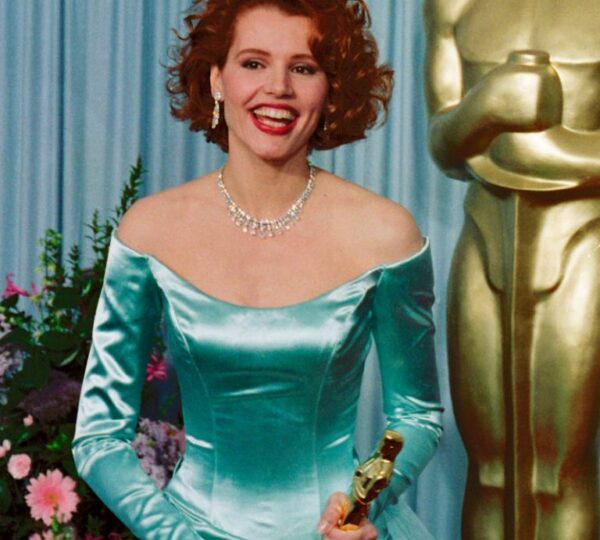
Her career reached new heights with films like The Fly, Beetlejuice, and The Accidental Tourist. The latter earned her an Academy Award for Best Supporting Actress, confirming her place among Hollywood’s elite performers.
One of her most iconic roles came in Thelma & Louise, directed by Ridley Scott. The film became a cultural milestone, celebrated for its powerful portrayal of female friendship, independence, and rebellion. Her collaboration with Susan Sarandon created one of cinema’s most memorable duos, and the film continues to be widely regarded as a landmark in feminist storytelling.
Following this success, she starred in A League of Their Own, further strengthening her reputation for portraying strong and complex female characters. At the peak of her career, Davis was admired not only for her beauty but also for the intelligence and emotional depth she brought to her roles.
However, like many actresses in Hollywood, she experienced a noticeable shift in opportunities as she approached her 40s. In interviews, she has described this period as one where meaningful roles became increasingly scarce, despite her proven talent and success.
Outside of her professional career, Davis’s personal life also evolved significantly. She has been married four times, including to actor Jeff Goldblum. Later in life, she embraced motherhood at the age of 46, welcoming her first child, daughter Alizeh, followed by twin sons, Kaiis and Kian.
Her fourth husband, surgeon Reza Jarrahy, became an important part of her family life. The couple met socially and eventually formed a relationship that led to marriage in 2001. Together, they built a family and raised three children.
Becoming a mother later in life brought both joy and challenges, especially while raising three young children close in age. Davis has spoken about the overwhelming responsibility she felt during that time, particularly in managing the demands of motherhood alongside her career.
As her children grew older, Davis became more aware of gender inequality in the entertainment industry. This realization led her to establish the Geena Davis Institute on Gender in Media in 2004, an organization focused on improving representation and opportunities for women in film and television.
Today, Geena Davis remains active both as an actress and an advocate. Now 69, she continues to appear in new projects, including upcoming television series work, while also maintaining her long-standing commitment to promoting equality in media. Her legacy stands not only as a celebrated actress but also as a powerful voice for change in Hollywood.

