
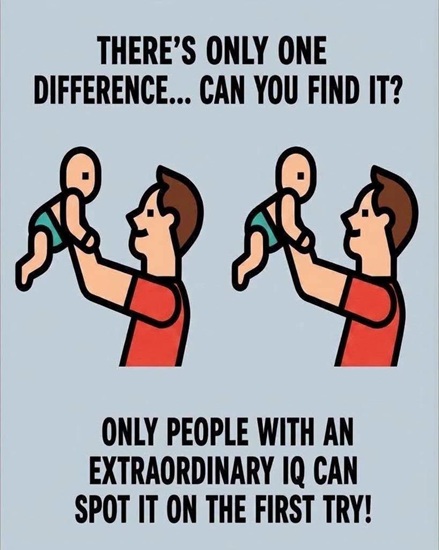
At first sight, two pictures in a spot-the-difference challenge can appear completely identical. The major objects seem to occupy the same positions, the colors look consistent, and the overall scene creates an immediate feeling that nothing has changed. Yet somewhere inside the images, a small detail may have been removed, reversed, recolored, or repositioned. Finding that difference can take surprisingly long because people usually recognize the complete scene before consciously examining every individual feature.
The challenge is therefore primarily an exercise in visual attention and careful comparison rather than a meaningful test of intelligence. Human vision is remarkably efficient. When people enter a familiar room or look at an everyday scene, they generally do not consciously inspect every edge, object, color, and shadow before understanding what they are seeing. The visual system rapidly organizes information into recognizable patterns.
That ability allows people to navigate the world without becoming overwhelmed by enormous amounts of visual information. In a puzzle, however, the same efficiency can make a carefully hidden alteration surprisingly difficult to detect. If the overall structure of two pictures remains the same, the brain may quickly categorize them as matching scenes. Once that first impression forms, small inconsistencies can receive less attention. A viewer might therefore look directly at the changed object several times without consciously recognizing that something about it differs.
This helps explain the strange experience many people have with these puzzles. Before finding the answer, the difference seems almost invisible. Immediately afterward, it appears obvious. The pixels or printed lines never changed. What changed was the viewer’s attention.
The most reliable way to solve the puzzle is usually to stop scanning randomly. Random searching can cause the eyes to revisit the same prominent objects while repeatedly overlooking less noticeable areas. A structured method reduces that problem.
One useful approach is to begin in the upper-left corner. Compare that small area with the corresponding section of the second image. Then move slowly toward the right until the entire top section has been checked.
After completing the top, move through the center in the same direction. Finally, inspect the lower portion. This creates a simple grid-like search without requiring any special equipment.
Another method is to imagine dividing both images into several boxes. Each box becomes its own miniature puzzle. Do not move to the next section until the corresponding areas have been compared carefully.
This method is particularly helpful when the scene contains many objects. Instead of trying to process everything simultaneously, the viewer reduces the problem into smaller comparisons.
It is also useful to compare specific categories rather than simply asking whether the pictures “look the same.”
Begin with outlines.
Check whether any object has gained or lost a line.
Look for differences in curves, corners, borders, and edges.
Then examine colors.
A large color change is usually easy to notice, but a small patch of slightly different color may remain hidden within a complicated scene.
After color, compare direction.
A bird might face left instead of right.
A handle might curve in the opposite direction.
A person’s hand might point differently.
A leaf or branch might tilt another way.
The object itself remains familiar, so the brain may recognize it without immediately noticing its orientation.
Spacing is another important category.
Two objects might be slightly farther apart in one image.
A gap may exist in one version but disappear in the other.
An object may be positioned a few pixels higher or lower.
These small changes are especially difficult when the overall composition remains balanced.
Repeated objects should be counted rather than estimated.
If a picture contains several flowers, count them.
If there are windows, compare their number.
If there are buttons, books, birds, clouds, leaves, or stars, count each group carefully.
The brain is often good at recognizing “a group of flowers” without immediately noticing that one image contains seven and the other contains six.
Patterns deserve similar attention.
A striped shirt might contain one fewer stripe.
A fence may be missing a vertical section.
A checkerboard could contain an altered square.
A decorative border may have a small break.
Because patterns naturally repeat, one missing component can blend into the larger design.
Text and numbers are also common hiding places.
Check clocks, signs, license plates, calendars, labels, jerseys, book covers, and any other written elements.
Changing one digit or letter can create a difference that remains unnoticed while the viewer concentrates on pictures rather than text.
Small facial features can also be altered.
An eyebrow may change shape.
An eye may be closed instead of open.
A smile may curve differently.
An earring may disappear.
A strand of hair might be missing.
The brain is extremely good at recognizing faces as complete units, which means it may identify the same person in both images without checking every feature individually.
Clothing provides many opportunities for hidden changes.
Buttons can disappear.
Pockets can move.
Sleeves can change length.
Shoelaces can be altered.
Patterns can lose a line or shape.
Accessories such as watches, necklaces, hats, or glasses can also be modified.
Background details should never be ignored.
Many viewers naturally concentrate on the main character or central object.
Puzzle designers can take advantage of this by placing the change near a corner or in the background.
Check trees, buildings, clouds, doors, fences, furniture, lamps, and other secondary objects.
Even empty space can contain the answer.
A gap between two objects may be wider.
A small shadow may disappear.
An area of background color may change.
One image might contain a tiny line where the other contains nothing.
Shadows and reflections can be particularly deceptive.
People often treat shadows as secondary information rather than independent objects.
A shadow might point in a different direction or have a different shape.
A reflection may contain an object missing from the main scene or vice versa.
If the puzzle seems impossible, deliberately checking shadows can sometimes reveal the answer.
Another useful strategy is to change viewing distance.
Looking too closely can make it difficult to compare overall shapes.
Looking from slightly farther away can sometimes make a missing object or asymmetry stand out.
Then moving closer again can help confirm the exact detail.
Zoom can also help, especially on a phone.
However, excessive zooming may create another problem.
When only a tiny portion of the picture is visible, it becomes harder to maintain awareness of which areas have already been checked.
A moderate zoom combined with a systematic scan is often more effective.
Screen quality can significantly affect difficulty.
The same puzzle may look very different on a large computer monitor and a small mobile display.
Compression can blur thin lines.
Brightness settings can hide subtle color differences.
Low resolution can make two distinct shapes appear identical.
Glare can also interfere with small details.
This means two people viewing different copies of the puzzle may not actually be solving exactly the same visual challenge.
One person might have a high-resolution version.
Another may be looking at a heavily compressed social-media screenshot.
Small details can disappear entirely during repeated uploading and resizing.
That is why disagreements about an answer should sometimes begin with a simple question: Are both people looking at the same version?
Fatigue can influence the result too.
A person solving the puzzle after hours of screen use may find it more difficult to maintain focused attention.
Another person viewing it while rested may notice the change almost immediately.
Neither result establishes anything meaningful about overall intelligence.
Experience also matters.
Someone who regularly solves visual puzzles may have learned common hiding strategies.
They may automatically check corners, count objects, inspect reflections, and compare orientation.
A beginner may spend most of the time staring at the central subject.
The experienced solver therefore has a strategic advantage.
That advantage comes from practice rather than necessarily from superior eyesight or intelligence.
The good news is that strategy can be learned.
After completing several puzzles, many people naturally become more systematic.
They stop trusting the first impression.
They begin checking the scene section by section.
They learn which details are easiest to overlook.
This is one reason spot-the-difference games can be enjoyable beyond simply finding the answer.
They reward method.
A viewer who initially sees nothing can change strategy and suddenly succeed.
The improvement feels immediate because the problem was not necessarily inability.
The search process simply needed adjustment.
Hints demonstrate this particularly well.
Suppose someone has searched for several minutes without success.
Then they receive a hint: “Look near the lower-right corner.”
Suddenly, the task becomes much easier.
The visual information was always there.
The hint simply directed attention toward the relevant area.
A second hint can be even more specific.
“Look at the direction of the small objects.”
The viewer now knows both where and how to search.
The answer may appear within seconds.
This illustrates the difference between seeing and noticing.
The eyes may receive visual information without every part of it reaching conscious attention.
Attention determines which details receive closer processing.
That concept is useful for understanding the puzzle without making exaggerated claims about what the result means.
Finding the difference quickly does not prove that someone is a genius.
Taking longer does not mean someone lacks intelligence.
A single recreational puzzle cannot measure the full range of human cognitive abilities.
Intelligence involves many different skills.
Reasoning, memory, language, creativity, learning, problem-solving, and knowledge cannot be reduced to one image comparison.
Claims such as “only people with an IQ above 140 can solve this” should therefore be treated as entertainment unless supported by actual validated research.
The same applies to strict time limits.
A post may claim that finding the answer within five seconds means someone has extraordinary vision.
There is generally no scientific basis for such a conclusion from an ordinary viral puzzle.
The countdown is mainly designed to make the challenge feel exciting.
There is nothing wrong with using a timer for fun.
The problem begins when the result is presented as a serious psychological or medical assessment.
Visual puzzles are not diagnostic tools.
They cannot determine whether someone has an attention disorder.
They cannot diagnose memory problems.
They cannot reveal emotional health.
They cannot reliably determine personality.
Professional psychological assessment requires validated methods and substantially more information.
Another common type of viral image asks viewers what they noticed first and then assigns a personality meaning to the answer.
Perhaps one person sees a face while another sees an animal.
The different perceptions can create an entertaining conversation.
They should not be treated as reliable evidence that one person is more loyal, anxious, creative, romantic, or intelligent than another.
Human personality is far more complex.
A first visual impression can be influenced by size, contrast, color, screen position, previous experiences, and where someone happened to look first.
Those factors make simple personality conclusions unreliable.
The most accurate way to enjoy these challenges is therefore also the simplest.
Treat them as puzzles.
They encourage observation.
They provide a small challenge.
They create a satisfying moment when the answer becomes clear.
Nothing more dramatic is required.
For children, spot-the-difference activities can provide an enjoyable opportunity to practice comparison.
Adults can encourage them to explain how they found the change.
Instead of asking only, “Did you find it?” they can ask, “What did you compare first?”
That turns guessing into reasoning.
A child might explain that one picture contains five balloons while the other contains four.
Another might notice that a character’s hat changes color.
Explaining the answer makes the observation easier for someone else to verify.
The same principle improves adult discussions of puzzles.
Instead of simply writing “Found it!” in a comment section, describe the location and feature.
For example: “Check the second window on the right; one vertical line is missing.”
That creates a verifiable answer.
It also reduces arguments caused by people referring to different details.
Some puzzles intentionally contain several differences.
Others advertise one difference even though image compression accidentally creates additional variations.
A clear explanation helps distinguish intentional changes from technical artifacts.
Counting puzzles create similar challenges.
An image might ask how many triangles or squares appear.
The obvious shapes are usually only the beginning.
Larger shapes may be created by combining smaller ones.
A systematic solver can categorize them by size.
Count all the smallest shapes first.
Then count shapes formed by combining two or more sections.
Record each category.
This reduces double-counting.
The final total can then be explained rather than simply asserted.
That approach illustrates a broader benefit of recreational puzzles.
They encourage people to show their method.
A correct answer is more useful when another person can reproduce it.
This is especially important when a viral puzzle produces several competing answers.
Different totals may result from different interpretations of what qualifies as a shape.
Explaining the method exposes those differences.
Sometimes both answers make sense under different definitions.
The discussion then becomes about rules rather than about who is supposedly smarter.
That is a healthier way to enjoy visual challenges.
Competition can remain playful.
There is no need to attach personal value to the outcome.
Someone who takes 30 seconds has not failed because another person needed five.
The puzzle remains solved either way.
In fact, rushing can increase errors.
A viewer under time pressure may identify the wrong feature simply because they expect an answer immediately.
Slowing down allows comparison rather than guessing.
This is especially useful when the two images are extremely similar.
The challenge is designed to exploit quick perception.
A slower method directly counters that design.
Begin at a corner.
Move consistently.
Check one feature category at a time.
Count repeated objects.
Compare orientation.
Inspect small gaps.
Check the background.
Then verify the answer.
If nothing appears, take a short break.
Returning with fresh attention can be surprisingly effective.
After staring at the same picture for too long, the visual system can become accustomed to the scene.
A short pause disrupts that familiarity.
The viewer may then notice the difference immediately upon returning.
Another technique is to cover part of each image.
Compare only the visible sections.
Then move the cover gradually.
This physically prevents attention from jumping randomly around the picture.
On a digital screen, zooming into matching sections can achieve something similar.
Some people also find rapid alternation useful.
Look at one section of image A.
Immediately look at the same section of image B.
Repeat several times.
A changed feature may appear to flicker between the two versions.
This can make positional differences particularly noticeable.
Whatever method works best, the key principle remains the same.
Do not rely entirely on the overall impression.
The images were designed to produce that impression.
The difference hides inside the similarity.
Once attention moves from the whole scene to individual components, the challenge becomes easier.
This explains the satisfying moment when the solution finally appears.
The brain stops treating both images as one familiar pattern.
It recognizes a mismatch.
After that, the mismatch becomes difficult to ignore.
The viewer may even wonder how anyone could miss it.
But moments earlier, they did.
That experience is not evidence of poor perception.
It is evidence of efficient perception being challenged by a deliberately constructed image.
Everyday vision prioritizes useful information.
A puzzle asks the viewer to prioritize information that would normally be unimportant.
A missing button may not matter in daily life.
In a spot-the-difference puzzle, it becomes the entire objective.
That change in purpose requires a change in attention.
The challenge therefore works best when approached with patience rather than pressure.
There is no need to prove anything.
There is no meaningful intelligence ranking at stake.
The puzzle is simply asking whether a viewer can locate a deliberately altered feature.
Different people will find it at different speeds.
Different screens will make it easier or harder.
Different search strategies will produce different results.
All of those variations are normal.
What matters is that the answer can eventually be verified.
That verification separates observation from guessing.
If someone claims a difference exists, another viewer should be able to inspect the same location and confirm it.
This is why explaining the answer is more valuable than simply claiming success.
It transforms a personal impression into a shared comparison.
Visual puzzles become especially enjoyable when several people solve them together.
One person can check the top.
Another can inspect the background.
Someone else can count repeated objects.
Different attention styles become useful rather than competitive.
The group may find the answer faster precisely because each person notices different kinds of details.
That illustrates something simple about perception.
People do not always notice the same feature first.
One viewer may be drawn toward faces.
Another notices bright colors.
Another immediately looks for symmetry.
These differences are ordinary variations in attention.
They should not automatically be interpreted as hidden personality traits.
The strongest conclusion a spot-the-difference puzzle supports is simply that one detail was noticed before another.
Anything beyond that requires additional evidence.
Keeping those limits clear allows the challenge to remain entertaining without spreading misleading claims.
There is already enough fascination in how perception works.
The brain can recognize an entire scene almost instantly.
It can ignore tiny inconsistencies to preserve a stable interpretation.
Then, with deliberate attention, it can reorganize that interpretation when a small difference becomes visible.
That sequence happens in seconds.
It is what makes a simple pair of pictures surprisingly engaging.
The challenge begins with confidence.
“They are identical.”
Then comes uncertainty.
“There must be something different.”
The viewer starts searching.
Several possibilities are rejected.
Eventually, one detail stands out.
The answer becomes obvious.
That progression creates the satisfaction.
The image itself does not need a dramatic psychological interpretation.
The experience of finding the difference is enough.
It rewards patience.
It rewards structured comparison.
It encourages viewers to question their first impression without treating that impression as a failure.
Most importantly, it demonstrates that looking carefully is different from merely looking longer.
A person can stare randomly for several minutes without success.
A systematic scan may find the answer much faster.
Method matters.
If the puzzle in front of you still looks completely identical, try changing your approach.
Stop focusing only on the largest object.
Begin at an edge.
Compare corresponding sections.
Look for missing lines.
Check the number of repeated objects.
Compare colors and directions.
Inspect shadows and reflections.
Look at the corners last if you usually begin in the center—or begin there first if you normally ignore them.
The tiny difference is designed to hide inside familiarity.
Once you stop allowing familiarity to guide the search, it becomes much easier to expose.
And when you finally see it, there is no need to turn the result into a judgment about intelligence or personality.
Enjoy the small moment of recognition.
Show someone else where the change appears.
Compare how each person searched.
Then move on to the next puzzle.
That is ultimately what these visual challenges do best: they turn an ordinary image into a brief exercise in attention, patience, and careful observation while reminding us that the first thing we notice is not always everything there is to see.

