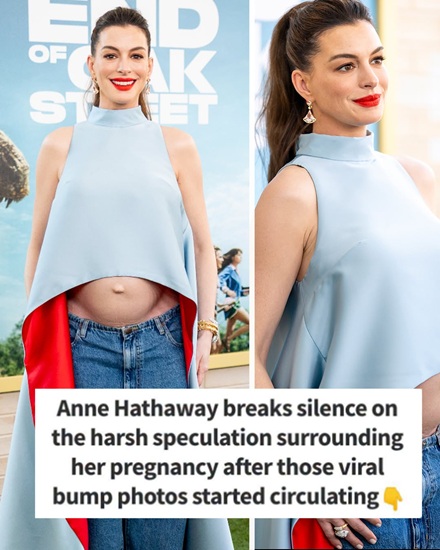
Anne Hathaway is preparing for another major chapter in her family life as she expects her third child with husband Adam Shulman. The Oscar-winning actor and Shulman, who married in 2012, are already parents to two sons, Jonathan and Jack. Hathaway has generally kept her children away from intense public exposure, but she has occasionally discussed motherhood and the importance of protecting her family’s privacy while maintaining her demanding acting career.
Hathaway publicly shared news of her latest pregnancy in June, using a lighthearted social-media post to introduce the announcement. Wearing a flowing white outfit, she appeared on camera before revealing her growing baby bump and gently placing her hands around it. The announcement quickly attracted attention from fans and entertainment outlets, although Hathaway kept many details surrounding the pregnancy private.
The pregnancy is particularly meaningful in light of Hathaway’s previous comments about fertility and conception. In earlier years, she acknowledged that becoming pregnant had not always been an easy or predictable experience for her. When announcing her second pregnancy in 2019, she offered supportive words to people experiencing infertility, emphasizing that her own path toward motherhood had involved difficulties that were largely invisible to the public.
For that reason, Hathaway has approached her latest pregnancy with noticeable gratitude. During interviews following the announcement, she spoke enthusiastically about expecting another child while acknowledging that pregnancy is not something every person who wants a baby is able to experience. Her comments placed the emphasis on appreciation rather than presenting conception as something guaranteed or straightforward.
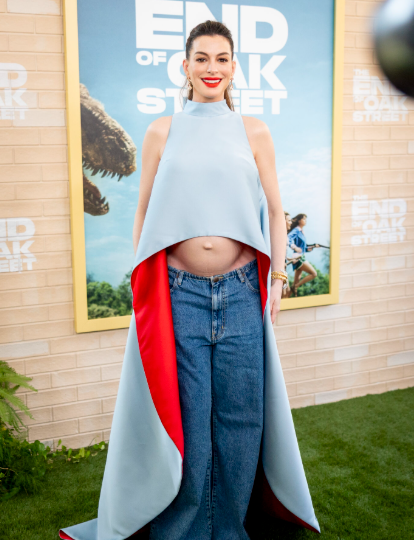
The conversation changed considerably after Hathaway appeared at a Los Angeles movie premiere in August. Instead of focusing exclusively on the film she was promoting, considerable online attention shifted toward her maternity outfit. Hathaway wore an unusual blue top with a dramatic silhouette together with low-rise jeans, leaving her pregnant stomach visible.
Pictures and videos from the event quickly spread across entertainment websites and social-media platforms. Many viewers praised Hathaway’s willingness to experiment with maternity fashion and display her changing body confidently. Others simply debated whether they liked the unconventional combination of formal fabric and casual denim, which is normal territory for red-carpet fashion discussions.
A smaller group of social-media users, however, began questioning the appearance of Hathaway’s stomach. Some comments claimed that her baby bump looked unusual or suggested, without evidence, that it was not genuine. Those comments were based on photographs and short video clips rather than verified information, and there was no credible evidence supporting claims that Hathaway had fabricated her pregnancy.
It is important to distinguish that online speculation from established information. Hathaway herself had already publicly announced that she was expecting another child. She had also discussed the pregnancy in interviews and appeared publicly while pregnant. Comments about the shape of her stomach therefore represented individual opinions about photographs, not independently verified evidence contradicting her announcement.
Photographs are also an unreliable way to make conclusions about someone’s pregnancy. Camera lenses, posture, clothing, lighting and viewing angles can substantially change how a person’s body appears. Pregnancy itself also looks different from person to person, and even separate pregnancies experienced by the same individual can produce noticeably different physical changes.
Rather than becoming involved in an extended argument with strangers online, Hathaway responded with humor. In a subsequent social-media post connected to her premiere preparations, she included a brief remark acknowledging the discussion. Her response made clear that while certain elements of her glamorous appearance might not have been entirely natural, her pregnancy was real.
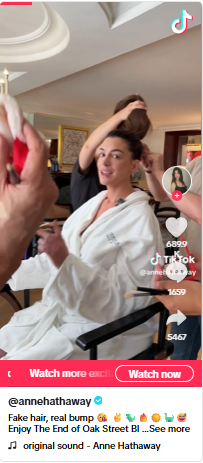
The concise response was notable because Hathaway did not attempt to provide medical details or justify the appearance of her body. She had already publicly confirmed her pregnancy, so there was little reason for her to offer additional private information simply because some social-media users had questioned photographs.
The incident reflects a familiar pattern surrounding celebrities and viral images. A photograph can travel across dozens of accounts within hours, frequently separated from its original context. Commentary then accumulates around the image, and speculation can eventually become more visible than the verified information that existed before the photograph went viral.
Pregnancy is especially susceptible to this type of speculation because people sometimes believe there is one particular way a pregnant body should look. In reality, the appearance of pregnancy depends on numerous individual factors. Comparing someone’s body with another person’s experience or judging pregnancy from a single photograph does not provide reliable information.
Hathaway’s maternity outfit also illustrates how attitudes toward pregnancy fashion have changed. Pregnant celebrities increasingly wear clothing that highlights rather than conceals their stomachs. Fitted dresses, cropped garments and exposed baby bumps have become common at entertainment events, allowing expectant mothers considerably more freedom in deciding how they want to dress.
Hathaway chose to make her pregnancy part of the visual design of her premiere outfit. That naturally made her stomach more noticeable in photographs, but visibility should not be confused with an invitation for unsupported medical conclusions. Fashion can reasonably be discussed as fashion without turning a person’s physical appearance into evidence for claims about their health or pregnancy.
The actor has experienced intense public attention throughout much of her career. Since becoming internationally recognizable through The Princess Diaries, Hathaway has seen her performances, fashion choices, interviews and public personality repeatedly examined online. Her later roles in movies including The Devil Wears Prada, The Dark Knight Rises and Les Misérables further increased that visibility.
Despite that level of fame, Hathaway and Shulman have maintained comparatively strong boundaries around their family life. Their sons are not routinely presented as public personalities, and Hathaway does not frequently share detailed information about their everyday lives. Her approach demonstrates that a celebrity can acknowledge motherhood publicly without making every aspect of family life available for public consumption.
Hathaway and Shulman’s relationship dates back many years. They married in September 2012, several years before welcoming their first son, Jonathan, in 2016. Their second son, Jack, arrived in 2019. The new baby therefore represents another significant addition to a family Hathaway has consistently described as central to her life outside Hollywood.
Her previous discussion of fertility adds another layer to the current moment. When she revealed her second pregnancy, Hathaway explicitly acknowledged people experiencing infertility or conception difficulties. She explained that her own pregnancies had not followed an uncomplicated path, challenging the assumption that celebrity pregnancies necessarily happen easily simply because audiences only see the eventual announcement.
Those earlier comments help explain why Hathaway has described another pregnancy as something she appreciates deeply. Rather than treating it as an ordinary expectation, she has spoken about the uncertainty that can accompany efforts to expand a family.
None of that context supports the more sensational claims that appeared after the premiere photographs circulated. The appropriate description is straightforward: some social-media users questioned Hathaway’s baby bump, while Hathaway had already publicly confirmed her pregnancy and subsequently responded to the comments.
Maintaining that distinction is particularly important when reporting entertainment stories. Saying that “social-media users speculated” accurately identifies the source of a claim. Presenting the same speculation as an unresolved factual question would give unsupported comments credibility they have not earned.
The episode also demonstrates why viral reactions should be interpreted carefully. Large numbers of comments do not necessarily mean a claim is accurate. Social-media algorithms frequently amplify surprising, controversial or unusual statements precisely because they encourage reactions and discussion.
A dramatic claim can therefore spread much farther than a mundane correction. Someone suggesting that a celebrity’s pregnancy looks “fake” may attract considerable engagement, but popularity is not evidence. Verified statements from the person involved remain more reliable than strangers interpreting isolated photographs.
Hathaway’s response avoided amplifying the controversy unnecessarily. Instead of treating the comments as a serious accusation requiring an extensive rebuttal, she answered briefly and continued focusing on her work. The approach allowed her to acknowledge what people were saying without transforming unsupported speculation into a larger dispute.
There is also a broader privacy issue involved. Public figures voluntarily attend premieres and promotional events, meaning their clothing and professional appearances will inevitably be photographed and discussed. That does not mean every private medical or reproductive detail automatically becomes public information.
Pregnancy announcements represent information someone has deliberately chosen to share. Additional health information remains private unless that person decides otherwise. No celebrity should need to disclose medical records or intimate details merely because photographs produce online speculation.
For audiences, the simplest approach is to separate observation from assumption. It is reasonable to observe that Hathaway wore an outfit exposing her baby bump. It is reasonable to discuss whether the outfit was fashionable. It is also factual to report that some commenters questioned the appearance of her stomach.
It becomes misleading, however, to convert those observations into claims that the pregnancy itself is questionable. There is no reliable basis for making that conclusion solely from visual impressions.
Hathaway has continued making professional appearances while preparing for her third child, demonstrating that pregnancy has not prevented her from participating in the promotional responsibilities surrounding her projects. Her appearances have consequently produced a variety of maternity looks, each reflecting a different approach to dressing during pregnancy.
The public response has generally included congratulations alongside the predictable commentary surrounding celebrity fashion. The unusual speculation generated by one particular appearance became noteworthy primarily because Hathaway chose to acknowledge it directly.
Her reaction was consistent with a broader tendency to handle online criticism without providing it unlimited attention. Rather than arguing point by point, she used a brief joke to establish the factual situation and moved forward.
That choice also prevented the conversation from overshadowing the more meaningful part of her announcement: Hathaway and Shulman are preparing to welcome another child. Their growing family remains the central confirmed story, while interpretations of photographs are secondary online commentary.
For Hathaway, motherhood has existed alongside a career spanning more than two decades. She has moved from youthful roles to dramatic performances, comedies, independent projects and major studio productions while also raising her children largely outside public view.
Her ability to maintain those boundaries becomes increasingly relevant whenever online discussions move from her professional work toward intimate speculation. A red-carpet appearance may be public, but assumptions about someone’s reproductive health should still be treated cautiously.
The situation is also a useful example of responsible online reading. When encountering a viral claim, readers should consider where the information originated, whether the person involved has addressed it and whether reputable sources provide evidence supporting the claim.
In this case, the most dramatic allegations originated from social-media reactions to photographs. Hathaway’s pregnancy, meanwhile, had already been publicly announced by Hathaway herself.
That difference matters. One side consists of confirmed information provided directly by the person involved; the other consists of visual speculation from strangers.
Ultimately, Hathaway did not need an elaborate explanation. Her pregnancy announcement, subsequent appearances and public comments had already established the relevant facts. Her brief response simply acknowledged the unusual conversation that developed around the photographs.
The episode demonstrates how quickly an ordinary entertainment story can become distorted once images circulate without context. A maternity fashion choice became a discussion about whether someone’s body looked sufficiently pregnant, despite the absence of credible evidence supporting such doubts.
Hathaway’s response brought the conversation back to reality without turning it into a confrontation. She acknowledged the speculation, clarified her position and continued with her professional responsibilities.
As she prepares to welcome her third child, the more substantial story remains one of family, gratitude and another stage of motherhood. Hathaway has previously acknowledged that expanding a family is not always easy, making her excitement about another child particularly understandable.
The viral comments surrounding her appearance may have briefly attracted attention, but they do not alter the verified information. Hathaway has publicly announced her pregnancy and has spoken openly about her happiness over expecting another child.
For readers, the incident offers a straightforward reminder: photographs can generate opinions, but opinions should not automatically be presented as facts. Celebrity status does not change that principle.
A responsible account can describe what happened without exaggerating the controversy, invading private medical territory or presenting unsupported claims as credible alternatives. In Hathaway’s case, that means recognizing the online speculation for what it was while keeping the confirmed facts at the center of the story.
And perhaps that is why her short response worked so effectively. Instead of allowing strangers’ assumptions to define the conversation, Hathaway made her position clear and moved on—leaving the focus where she appeared to want it: on her work, her growing family and the next chapter ahead.
