
Every now and then, the internet introduces us to unusual objects that seem impossible to identify at first sight. A single photograph can spark hundreds of guesses, theories, and discussions as people try to determine what an unfamiliar item was originally used for. Fortunately, online communities have become incredibly effective at solving these mysteries. Thanks to the combined knowledge of thousands of users, many forgotten tools and household objects are quickly identified and explained.
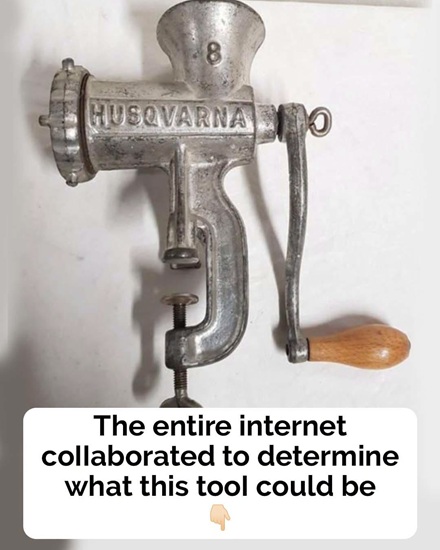
One particular image that recently attracted attention featured a solid metal device with a distinctive design. To many people, especially those who had never encountered older kitchen equipment, the object looked confusing. Some believed it might be a workshop tool, while others thought it could be part of a machine from another era. As more people joined the conversation, however, the answer soon became clear.
The object was identified as a traditional meat mincer, often referred to as a meat grinder. Decades ago, this device was commonly found in kitchens across many countries. Before modern electric appliances became widely available, families relied on practical hand-operated tools to prepare food at home. A meat grinder was one of the most useful devices for processing ingredients efficiently.
The operation of a classic meat grinder is both simple and effective. Small pieces of meat are placed into the top opening of the machine. When the user turns the handle, an internal screw mechanism moves the meat forward toward a perforated metal plate. As the meat passes through the tiny holes, it is broken down into smaller strands. This straightforward process made food preparation significantly easier for households of the past.
Although its name suggests that it is only used for meat, the device has traditionally served many different purposes. Home cooks have used meat grinders to process fish, vegetables, and various other ingredients. Depending on the recipe, the machine could help create fillings, mixtures, spreads, and preparations for a wide range of meals. Its versatility contributed greatly to its popularity.
The history of the meat grinder stretches back to the nineteenth century, a period when inventors were constantly searching for ways to simplify everyday tasks. Early versions of the device are commonly associated with innovations developed by Karl Drais. While designs have evolved considerably since then, these early concepts helped establish the mechanical principles that remain in use today.
In earlier generations, preparing food often required much more physical effort than it does now. Purchasing ready-made ground meat was not always practical or even possible. Many families bought larger cuts of meat and prepared them themselves. A manual meat grinder provided a convenient way to process ingredients at home while maintaining control over quality and freshness.
Most traditional grinders were manufactured from strong materials such as cast iron. Their durable construction allowed them to withstand years of frequent use. Because of this durability, many vintage grinders have survived to the present day. Some are still functional, while others are preserved as historical pieces that showcase the craftsmanship of earlier manufacturing methods.
A common feature of older meat grinders was the clamp used to secure the device to a table or countertop. This design kept the grinder stable during operation and allowed users to turn the handle comfortably. Despite its mechanical simplicity, the tool proved highly effective and became an essential part of many kitchens for generations.
As electrical appliances became more common in homes, manufacturers began introducing powered versions of the meat grinder. These newer models reduced the amount of manual effort required and significantly increased efficiency. Electric grinders quickly became popular because they could process larger quantities of food in a fraction of the time needed by traditional hand-cranked models.
Today’s meat grinders are far more advanced than their early predecessors. Modern machines often include multiple grinding plates that produce different textures and consistencies. Many models are also equipped with specialized attachments that expand their functionality. Some can assist with sausage preparation, while others support additional food-processing tasks that make meal preparation more convenient.
One reason many people continue to use meat grinders is the level of control they provide. Processing ingredients at home allows users to select exactly what goes into their food. This can be especially valuable for individuals who prefer fresh ingredients or who want to customize recipes according to personal preferences and dietary needs.
The popularity of online discussions about antique tools demonstrates how quickly everyday objects can fade from common knowledge. Items that were once present in nearly every household may become unfamiliar within just a few generations. As a result, photographs of older tools often generate curiosity among people who have never seen them before.
Online communities play an important role in preserving information about these historical objects. Collectors, historians, hobbyists, and everyday enthusiasts frequently share their expertise to help identify unusual finds. Their contributions help document the history of practical inventions and ensure that knowledge about older technologies is not lost over time.
Kitchen equipment from previous eras offers valuable insight into how daily life has changed. Each tool reflects the challenges, habits, and innovations of its period. The meat grinder serves as a particularly interesting example because it demonstrates how a relatively simple mechanical device could dramatically improve efficiency in food preparation long before modern appliances existed.
Today, many antique meat grinders have become sought-after collectibles. Some people restore them to their original condition, while others display them as decorative reminders of the past. Their solid construction, historical significance, and distinctive appearance make them appealing to collectors and history enthusiasts alike.
The evolution of the meat grinder highlights the broader story of technological progress. What began as a manually operated kitchen tool gradually transformed into a powerful modern appliance capable of handling a variety of food-processing tasks. Despite numerous improvements over the years, the basic principle behind the machine has remained largely unchanged.
Stories like this remind us that even the most ordinary household objects can have fascinating histories. An item that once served a practical purpose every day may eventually become a mystery to future generations. Thanks to the collective knowledge shared online, these forgotten pieces of history continue to be identified, understood, and appreciated by people around the world.

