
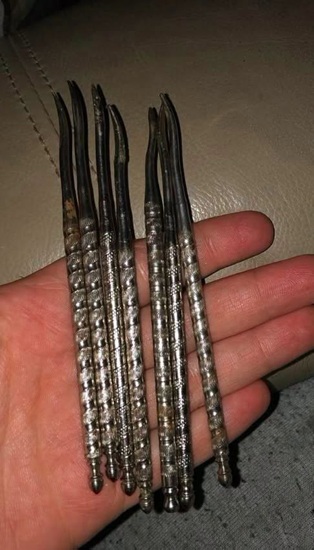
Cleaning out the home of a loved one is rarely a simple task. Every drawer, cabinet, and attic shelf seems to hold pieces of a family’s history, each object carrying memories that often matter far more than their monetary value. While many people expect to discover old photographs, handwritten letters, or vintage furniture, sometimes the most memorable discoveries are the ones nobody can immediately identify. Those mysterious objects often become unexpected windows into everyday life from another era, reminding us that even ordinary household items can tell remarkable stories about how previous generations lived, gathered, and celebrated.
A friend of mine recently experienced exactly that while helping clear out his late grandparents’ home. Hidden beneath several dusty blankets in the attic was a beautifully crafted wooden box that looked as though it had remained untouched for decades. Inside rested a collection of polished wooden and metal tools unlike anything he had ever seen. Some resembled miniature forks, others looked almost like antique medical instruments, and one large carved wooden bowl featured an unusual metal lever attached directly to its center. At first glance, nothing about the collection suggested an obvious purpose.
Naturally, curiosity took over. My friend searched online, compared photographs, and even asked relatives if they recognized the unusual objects. Everyone had a different theory. Some believed the tools belonged to an old woodworking kit, while others suggested they might have been part of antique farming equipment or historical scientific instruments. None of the explanations seemed convincing. The craftsmanship was impressive, the materials were of high quality, and everything had clearly been carefully preserved, suggesting the collection once held considerable importance to the family.
Wanting a reliable answer, he eventually visited a local antique specialist who regularly evaluated vintage household items and historical collectibles. The expert examined each piece carefully before smiling almost immediately. Rather than uncovering rare medical equipment or forgotten industrial tools, the collection turned out to be a remarkably well-preserved mid-century vintage nut bowl set, complete with an integrated mechanical nutcracker and matching nut picks. What had looked mysterious to modern eyes was once a familiar feature in countless homes throughout the twentieth century.
The discovery surprised everyone because these traditional sets have largely disappeared from everyday life. Today, most nuts are sold already shelled, packaged, and ready to eat. Modern kitchens rarely require specialized tools for cracking walnuts, pecans, hazelnuts, almonds, or Brazil nuts. As convenience foods became increasingly common, many beautifully crafted nutcracker sets were quietly placed into cupboards, packed into storage boxes, or forgotten in attics, where they remained for decades before being rediscovered by younger generations unfamiliar with their purpose.
During the early and middle decades of the twentieth century, however, these wooden nut bowls served as both practical kitchen tools and elegant decorative centerpieces. Families often placed them in living rooms or dining rooms during the colder months of the year. Holiday gatherings, winter evenings, and weekend visits frequently included bowls filled with whole nuts waiting to be cracked by family members sitting together around the fireplace or dining table. The activity encouraged conversation, laughter, and shared time long before smartphones, streaming services, and social media competed for everyone’s attention.
The wooden bowls themselves were often handcrafted by skilled artisans using durable hardwoods such as walnut, maple, cherry, or mahogany. These woods were selected not only because of their attractive appearance but also because they could withstand years of repeated use without cracking. Many bowls displayed beautiful wood grain patterns, carefully polished surfaces, and elegant carved details that transformed ordinary kitchen tools into attractive pieces of home décor.
One of the most interesting features of these sets was the built-in mechanical nutcracker. Rather than relying on handheld pliers or separate cracking devices, many bowls included a sturdy metal lever attached directly to the center. This simple yet clever mechanism used leverage to apply controlled pressure, allowing users to crack even hard shells while reducing the chance of crushing the edible nut inside. Although mechanically simple, the design reflected thoughtful craftsmanship and practical engineering that remained effective for decades.
The slender metal tools found beside the bowl often confuse modern collectors because they resemble tiny forks or antique dental instruments. In reality, these were specially designed nut picks. After cracking the shell, users carefully inserted the narrow tips into small openings to remove the delicate pieces without breaking them apart. Their design required precision, making them surprisingly useful for extracting food from other shellfish as well. Many households eventually used the same picks during seafood dinners for lobster, crab, or similar dishes.
Beyond their practical function, these vintage sets represented something much more meaningful than simply preparing snacks. They reflected an era when families often spent evenings together without rushing. Instead of opening processed snacks in seconds, everyone participated in preparing food by hand. Children learned patience while carefully cracking shells, grandparents shared stories from earlier years, and conversations unfolded naturally around the table. The activity itself became part of the entertainment, creating memories that lasted much longer than the food.
Historians who study everyday domestic life often note that simple household routines reveal as much about previous generations as famous historical events. Objects like vintage nutcracker sets illustrate how daily life once revolved around shared experiences rather than convenience. Preparing food was rarely treated as an interruption. Instead, it became another opportunity for family members to gather, cooperate, and enjoy one another’s company.
Interestingly, occupational therapists sometimes point out that activities involving controlled hand movements can also help maintain fine motor coordination. Using traditional nutcrackers and nut picks requires grip strength, careful hand positioning, and precise finger movements. While earlier generations likely viewed these simply as everyday tasks, such activities naturally exercised muscles and joints in ways modern lifestyles often no longer require.
Nutritionally, the foods traditionally served with these vintage tools remain highly valued today. Walnuts, almonds, pecans, hazelnuts, and similar nuts provide healthy unsaturated fats, dietary fiber, plant-based protein, vitamins, and essential minerals. Research has consistently shown that moderate nut consumption can support heart health as part of a balanced diet. Preparing whole nuts by hand may also encourage slower, more mindful eating compared with consuming highly processed snack foods.
Today, many collectors actively search for vintage nut bowl sets because they appreciate both their craftsmanship and the history they represent. Antique shops, estate sales, and family inheritances occasionally reveal beautifully preserved examples that remain fully functional despite being several decades old. Some owners choose to restore them for everyday use, while others proudly display them as decorative reminders of family traditions that deserve to be remembered.
When my friend finally understood what had been sitting inside that dusty wooden box, his perspective changed completely. What had first appeared to be an assortment of strange, outdated tools suddenly became something far more meaningful. The bowl was no longer just carved wood, and the metal picks were no longer mysterious objects. Together, they represented evenings his grandparents had likely spent with relatives and friends, sharing food, conversation, and laughter around the table.
That discovery served as a reminder that many ordinary household objects carry extraordinary stories. They connect generations not through great historical events but through everyday traditions repeated countless times inside family homes. In a world increasingly shaped by speed and convenience, these vintage kitchen tools encourage us to slow down, appreciate craftsmanship, and remember that some of life’s most meaningful moments have always been the simplest ones shared with the people we love.

