
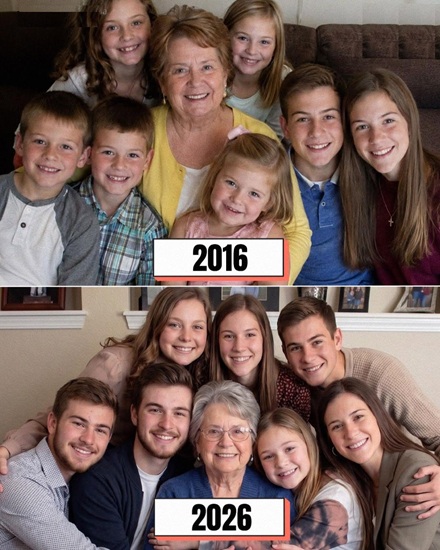
The morning began like so many others in our home—busy, slightly chaotic, and built around routines that had slowly become our way of surviving life after loss. I was in the kitchen preparing breakfast for my seven grandchildren, just as I had done every single day since the tragedy that changed everything. The smell of warm pancakes filled the air, and for a short while, the house felt almost peaceful. Grace, my youngest granddaughter, had been unusually quiet for several days.
At fourteen, she was at the age where curiosity turns into questions that adults often struggle to answer. She had been thinking more about her parents lately, trying to piece together memories she barely had. I assumed it was simply grief resurfacing in a new form, as it often does with children as they grow older. That morning, she walked into the kitchen carrying an old wooden box. It looked worn, dusty, and forgotten, as if it had been hidden for a very long time.
She placed it carefully on the table, her expression serious in a way that immediately made me uneasy. Her eyes never left mine, as if she needed me to understand the importance of what she had found. “I found this behind a cabinet in the basement,” she said softly. “Grandma… Mom and Dad didn’t die that night.” Her words froze me in place. For ten years, I had lived with the belief that my son and daughter-in-law had died in a tragic accident.
The memory of that night—the knock on the door, the sheriff’s voice, the funeral that followed—was something I had carried every day since. Hearing Grace speak like this made reality feel suddenly unstable. I tried to calm her, telling her that grief can sometimes make us imagine connections that aren’t there. But she pushed the box toward me, insisting I look inside. Her certainty unsettled me more than anything else. Reluctantly, I sat down at the table and opened it.
Inside were stacks of cash, carefully bundled and hidden. My hands trembled as I lifted them out. But what lay beneath them made my heart drop even further—official documents, plastic folders, and items that clearly belonged to my son and his wife.
There were birth certificates, social security cards, and identification papers for all seven grandchildren. At the bottom of the box was a folded map, marked with hand-drawn routes leading beyond the state.
Nothing about it felt random. Everything felt planned.
I gathered the children in the living room without delay. One by one, they entered, confused by the tension in the air. When I placed the contents of the box on the table, the room erupted with questions and disbelief. Each of them reacted differently, struggling to understand what they were seeing.
Aaron, the oldest, immediately began sorting through the money, trying to make sense of it logically. Mia and Jonah debated possible explanations, while Rebecca and Sam kept asking how something like this could have been hidden from us for so long.
Grace, however, stood firm in her belief. To her, this was proof that her parents were still alive.
I tried to maintain control of the situation, but deep inside, uncertainty began to creep in. The evidence suggested preparation, secrecy, and intention—things that didn’t match the story we had always believed.
We went down to the basement together, searching for anything else that might help explain the discovery. We opened boxes, moved old belongings, and looked behind storage shelves. Hours passed before Jonah called out from a corner of the room.
He had found a folder hidden behind a loose panel.
Inside were financial records—old bills, overdue notices, and statements showing debts I had never seen before. But there were also unfamiliar account documents, along with a handwritten note in Laura’s handwriting that simply said:
“Do not touch anything else.”
That message changed the atmosphere completely.
The next morning, I went alone to the bank. I brought the account number written in the documents, along with everything I had saved from my son’s estate after his death. The bank clerk entered the information and frowned slightly at the screen.
She then told me something I did not expect—the account was still active.
At first, I thought there must be a mistake. But she explained further. There had been recent activity on the account. Not years ago. Recently.
That single detail changed everything I thought I knew.
When I returned home and told the children, the house filled with confusion and rising emotion. Some believed it meant survival. Others thought it pointed to fraud or hidden involvement from someone else. But Grace became more convinced than ever that her parents were alive.
Eventually, I made a decision I never imagined I would make. If the account was active, then someone was still connected to it. And the only way to uncover the truth was to force a response.
I returned to the bank and requested the closure process for the account, knowing it would trigger alerts and possibly bring someone forward. It was a risk, but after ten years of unanswered questions, I needed clarity more than anything else.
Three days later, there was a knock at the door.
When I opened it, I saw a man I recognized instantly, even though time had changed him. My son, Daniel, stood there—older, worn, and visibly shaken. Behind him was Laura, pale and uneasy, avoiding eye contact.
The entire household gathered behind me as silence filled the space between us.
Then everything unfolded at once.
Questions came from the children. Emotions rose quickly. And Daniel finally began to explain. He spoke about financial collapse, overwhelming debt, and fear that pushed them into making desperate choices. They claimed they had intended to return when things stabilized, but life had spiraled further than they expected.
However, their explanation did not erase the years of absence.
Ten years of missed birthdays, milestones, struggles, and moments I had carried alone could not be undone by intentions or regrets spoken too late.
When Daniel mentioned the money, hoping to regain access to the account, something in me finally settled into certainty. I told him the accounts had already been closed and the funds transferred into the grandchildren’s future education savings.
His reaction made it clear that the past was not something he had truly let go of either.
The grandchildren stood together behind me—not confused anymore, but grounded in the reality of what had happened. They had been raised through absence, responsibility, and resilience, and in that moment, they understood where their strength came from.
As Daniel and Laura stood at the doorway, there was no dramatic reconciliation. Only silence, regret, and acceptance that too much time had passed to rebuild what had been broken.
When they finally left, the house felt quieter, not lighter.
I closed the door and turned back to my grandchildren. No one spoke at first. Then Grace stepped forward and hugged me, and slowly, the others followed until we were all standing together.
We were not untouched by what had happened. We were shaped by it.
But we were still a family.

