
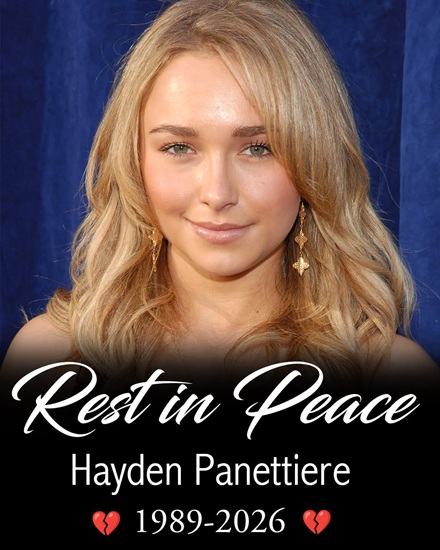
Hayden Panettiere, the actress who began working in entertainment as a young child and later became widely recognized for her performances in Heroes, Nashville and the Scream franchise, has died at the age of 36. Her representative confirmed her death to ABC News, while her father, Alan “Skip” Panettiere, shared a statement expressing the family’s grief. He remembered his daughter as a powerful and loving presence who brought happiness to the people who knew her and to audiences who followed her career.
The family also requested privacy while dealing with an extraordinarily painful loss. News of Panettiere’s death prompted renewed attention to a career that had lasted for most of her life and included memorable performances across television, film and voice acting. At the time the news became public, a definitive cause of death had not been officially announced. Authorities in Greenville, South Carolina, responded after Panettiere was found unresponsive on August 16, 2026.
Officials subsequently indicated that there were no apparent signs of trauma or evidence suggesting foul play. However, those preliminary observations should not be interpreted as a final determination about why she died. The official investigation and medical process must be allowed to establish the circumstances. Panettiere had previously spoken publicly about addiction and other difficult periods in her life, but those past experiences should not be used to speculate about an unconfirmed cause of death.
Long before she became one of television’s most recognizable young actresses, Panettiere had already spent years working professionally. Born on August 21, 1989, in Palisades, New York, she entered the entertainment industry at an exceptionally young age. Commercial work was followed by television appearances, including roles on the daytime dramas One Life to Live and Guiding Light. Her recurring work as Lizzie Spaulding on Guiding Light meant that Panettiere became familiar with television production while she was still growing up. At an age when most children were focused entirely on school and ordinary childhood routines, she was balancing those experiences with auditions, scripts, filming schedules and the responsibilities that accompanied professional acting.

Panettiere’s talents soon took her beyond daytime television. She provided the voice of Dot in Pixar’s animated movie A Bug’s Life, giving her another significant credit while she was still a child. In 2000, she appeared in the popular sports drama Remember the Titans, starring Denzel Washington. The film introduced her to an even larger audience and became one of the best-known projects from the early stage of her career. Roles in productions such as Ally McBeal, Malcolm in the Middle, Raising Helen, Tiger Cruise and Ice Princess followed, allowing Panettiere to continue developing as an actress while transitioning from childhood into adolescence.
The defining television opportunity of her teenage years arrived in 2006 when she joined NBC’s Heroes. Panettiere was cast as Claire Bennet, a high-school cheerleader who discovers that her body possesses an extraordinary ability to heal itself. Claire quickly became one of the series’ central characters, and Panettiere became closely associated with one of the show’s most famous phrases, “Save the cheerleader, save the world.” The success of Heroes dramatically increased her international visibility. Suddenly, the actress who had already spent years appearing on television was being recognized around the world as one of the leading young performers on a major network series.
Claire Bennet worked as a character because Panettiere portrayed more than a teenager with supernatural powers. Claire was also struggling with identity, family relationships and the realization that her life was far different from what she had previously believed. Those emotional elements gave Panettiere opportunities to demonstrate a range that went beyond the science-fiction premise of the show. As Heroes became an international success, Panettiere appeared at major entertainment events, awards ceremonies and interviews. She had achieved an extraordinary level of fame while still very young, creating opportunities that would shape the next stage of her professional life.
Growing up under that level of public attention was complicated. Panettiere had spent much of her childhood working, and by her teenage years she was experiencing a degree of celebrity that few people ever encounter. Her professional accomplishments were substantial, but she would later describe aspects of growing up in Hollywood that were considerably more difficult than audiences could see. Public appearances and successful television roles presented one image, while the realities of living under constant scrutiny were much more complicated. In later interviews and writing, Panettiere increasingly tried to explain the person who existed behind the familiar celebrity image.

Following Heroes, she continued appearing in television and film projects. One of her most memorable movie performances came in 2011 when she played Kirby Reed in Scream 4. Kirby became popular with fans of the long-running horror franchise, and Panettiere’s character remained memorable enough that she was eventually brought back more than a decade later. In 2023, she returned as Kirby in Scream VI. The return was particularly meaningful because it came after Panettiere had spent a significant period away from major acting projects and demonstrated that both the character and performer continued to have a strong connection with audiences.
Another major chapter in Panettiere’s career began in 2012 with the premiere of ABC’s Nashville. She played Juliette Barnes, a successful but complicated country music star navigating ambition, relationships, fame and personal challenges. Unlike Claire Bennet, Juliette was an adult character whose storyline allowed Panettiere to explore considerably darker and more mature emotional territory. The role also involved music, giving Panettiere opportunities to perform songs as part of the series. She remained an important member of the cast throughout the show’s six-season run, which concluded in 2018.
Her work as Juliette Barnes became one of the most critically recognized performances of her career. Panettiere received two Golden Globe nominations for Nashville, demonstrating how strongly the performance resonated beyond the show’s core audience. Juliette could be ambitious, vulnerable, difficult and sympathetic, sometimes within the same storyline. Panettiere brought those contradictions together in a character who was never presented as completely perfect or completely flawed. For viewers who had watched her grow up as Claire Bennet, Nashville also represented Panettiere’s successful transition into mature dramatic roles.
Some of the themes explored through Juliette became especially significant because Panettiere was dealing with serious challenges in her own life. Years later, she openly discussed experiencing postpartum depression after becoming a mother, as well as struggles involving alcohol and opioids. Panettiere did not attempt to present those experiences as easy or straightforward. Instead, she described periods of instability, treatment, recovery efforts and setbacks. Her willingness to discuss those subjects publicly eventually became an important part of her later life, particularly as she sought to separate the reality of her experiences from assumptions created by celebrity coverage.
Panettiere became a mother in December 2014 when she and her then-fiancé, former heavyweight boxing champion Wladimir Klitschko, welcomed their daughter, Kaya Evdokia Klitschko. Following Kaya’s birth, Panettiere experienced postpartum depression and later sought treatment. She eventually spoke publicly about the severity of what she had experienced, helping draw attention to a condition that affects many mothers but can still be misunderstood. Her comments emphasized that becoming a mother did not automatically protect someone from serious emotional difficulties and that seeking professional support could be an important part of recovery.
Her relationship with Kaya later attracted considerable public attention when her daughter began living primarily with Klitschko in Europe. Panettiere pushed back against portrayals suggesting that she had simply walked away from motherhood. She explained that decisions surrounding Kaya were made during a period when she was dealing with significant personal difficulties and trying to regain stability. The circumstances were more complicated than short headlines sometimes suggested. Although mother and daughter lived in different countries, Panettiere continued speaking warmly about Kaya and remained connected to her life.
Panettiere’s openness about addiction became another significant aspect of her public story. In interviews, she acknowledged struggling with alcohol and opioids and described reaching points where she realized substantial changes were necessary. Recovery was not something she portrayed as immediate or effortless. She spoke about the work required to confront destructive patterns and about learning to be honest with herself. Those disclosures showed a dramatically different side of her life from the polished images that accompanied her earlier fame.
Rather than attempting to erase difficult chapters, Panettiere increasingly chose to acknowledge them. She discussed treatment, recovery and the emotional consequences of experiences that had accumulated during years in the entertainment industry. Her comments often emphasized that progress could include both good periods and setbacks. This perspective allowed her to speak about recovery without presenting an unrealistic picture of instant transformation. She wanted people to understand that personal improvement required sustained effort rather than a single decision.
A particularly devastating moment came in February 2023 when Panettiere’s younger brother, Jansen Panettiere, died at only 28 years old. Jansen had also worked as an actor and artist. His family later said his death resulted from an enlarged heart combined with complications involving the aortic valve. For Hayden, losing her only sibling was profoundly painful. The two had shared years of memories and experiences, including connections to the entertainment industry, and she later described the loss as feeling as though part of her had disappeared with him.
Panettiere continued speaking about Jansen as she tried to cope with her grief. In a 2024 interview, she explained that his death had affected her emotionally and physically. The experience added another enormous challenge to a life that had already included addiction, recovery and intense public scrutiny. She nevertheless continued trying to rebuild her confidence and regain stability. Her comments from that period showed someone who did not claim to have completely overcome grief but who was trying to continue living while carrying it.
Her return to acting around this period was therefore significant. Reprising Kirby Reed in Scream VI allowed Panettiere to reconnect with a character audiences remembered from years earlier. The role also represented a professional comeback after time away from major screen projects. Fans welcomed Kirby’s return, while Panettiere once again demonstrated the screen presence that had made her recognizable from childhood. Later projects continued adding to a career that had already spanned several different eras of television and film.
Another important step came when Panettiere decided to tell her story more extensively in her memoir, This Is Me: A Reckoning. Published in May 2026, the book offered her perspective on decades spent in entertainment and on the experiences that occurred away from cameras. She addressed growing up in Hollywood, relationships, motherhood, addiction, recovery, trauma, grief and other deeply personal parts of her life. Rather than allowing her story to be defined exclusively by interviews, tabloid coverage or other people’s interpretations, the memoir gave Panettiere the opportunity to explain those experiences in her own words.
The memoir became especially significant because Panettiere had spent almost her entire life as a public figure. Audiences had watched her change from a child actress into a teenage television star and eventually an adult performer and mother. Yet familiarity with someone’s work does not necessarily mean knowing the person behind it. Panettiere’s book attempted to address that distance by presenting a more complicated account of her experiences. It showed that success and suffering could exist at the same time and that the public version of celebrity life rarely captures everything happening privately.
Looking across her career reveals an unusual range of memorable roles. Some viewers first remember Panettiere as the young girl in Remember the Titans. Others immediately associate her with Claire Bennet and Heroes. Fans of Nashville know her primarily as Juliette Barnes, while horror audiences remember Kirby Reed from the Scream franchise. She also worked in animation, television dramas, family films and other projects throughout her career. That variety reflects just how long she had been working despite being only 36 at the time of her death.
Her career also highlights the complicated nature of becoming famous at an unusually young age. Panettiere achieved professional success that most actors never experience, yet she later acknowledged that fame did not prevent serious personal difficulties. Professional recognition and emotional distress can exist simultaneously. Public success does not automatically provide protection from addiction, depression, grief or other challenges. Panettiere’s later willingness to discuss those realities gave audiences a fuller picture of her experiences than the celebrity image that had surrounded her during the height of her early fame.
Following her death, it is particularly important to distinguish those documented struggles from speculation about what ultimately happened. Panettiere openly discussed addiction and recovery during her lifetime, but that history alone does not establish her cause of death. Early reports stated that authorities had found no indication of foul play, while an official cause had not yet been publicly confirmed. Until investigators and medical authorities complete the appropriate process, claims assigning a specific cause should not be presented as established fact.
That caution allows attention to remain on what is already known about Panettiere’s life. She spent decades entertaining audiences, beginning before she was old enough to fully understand what celebrity would eventually mean. She successfully moved from childhood roles into teenage stardom and then into mature dramatic performances. She became a mother, confronted addiction, sought treatment, experienced devastating grief and eventually chose to speak publicly about experiences she once carried privately.
Her story cannot be reduced to its most difficult moments. Neither should those moments be erased in favor of presenting an unrealistically perfect portrait. Panettiere herself increasingly embraced a more complicated version of her life, one that included achievements and mistakes, happiness and grief, success and recovery. That complexity became central to how she wanted her story understood.
For many longtime viewers, Panettiere’s death feels particularly striking because audiences watched so many stages of her life unfold through her work. She was already appearing on television when she was a child. She became internationally famous as a teenager and later built another major television identity through Nashville. When she returned to the Scream franchise as an adult, audiences who remembered her earlier work were able to see another stage of a career that had continually evolved.
Her characters also remain an important part of that legacy. Claire Bennet represented one of the defining characters of Heroes and helped make Panettiere internationally recognizable. Juliette Barnes gave her an opportunity to portray a complicated adult woman over multiple seasons and brought her significant critical recognition. Kirby Reed established a lasting connection between Panettiere and horror audiences strong enough to survive more than a decade between appearances.
Beyond individual performances, however, Panettiere’s later years changed the way many people understood her. By discussing postpartum depression, addiction, treatment and grief, she moved beyond the carefully controlled image that often surrounds celebrity. She acknowledged painful realities without pretending that every problem had been permanently solved. Her memoir extended that effort by allowing her to tell a broader story about what growing up and living in Hollywood had actually been like for her.
Panettiere was only 36 when she died, just days before what would have been her 37th birthday. She is survived by her daughter, Kaya, and her parents. Her family has requested privacy as they grieve, while official authorities continue the process of determining the circumstances surrounding her death.
Until that process is complete, responsible discussion of Panettiere’s death should avoid rumors and unsupported conclusions. Her documented history provides enough material to understand both the remarkable achievements and difficult experiences that shaped her life without adding speculation. The facts already tell the story of someone whose professional journey began extraordinarily early and whose public life became far more complicated than audiences initially understood.
Hayden Panettiere leaves behind decades of work despite a life that ended far too young. From childhood television appearances to Remember the Titans, from the worldwide popularity of Heroes to the emotional complexity of Nashville, and from Scream 4 to her eventual return as Kirby Reed, her performances reached audiences across generations. Her later openness about her personal experiences added another dimension to the way she will be remembered.
For viewers who watched her grow up on screen, Panettiere was part of television and film culture for more than a quarter of a century. Her life included remarkable achievements, motherhood, painful losses and difficult attempts at recovery and rebuilding. Those experiences deserve to be remembered with accuracy rather than sensationalism.
Ultimately, Hayden Panettiere’s legacy is larger than any single character, interview or difficult chapter. She was a performer who began working as a child and remained recognizable throughout adulthood, an actress who created several enduring television and film characters, and a woman who eventually chose to speak openly about parts of her life that had once remained hidden behind fame.
Her death at 36 brings that journey to an unexpectedly early conclusion. But the performances she left behind, the story she chose to tell in her own words and the memories held by the people closest to her remain. For audiences around the world who knew Panettiere through decades of television and film, those contributions form a lasting record of a career—and a life—that was considerably more complex than the celebrity image alone could ever reveal.

