
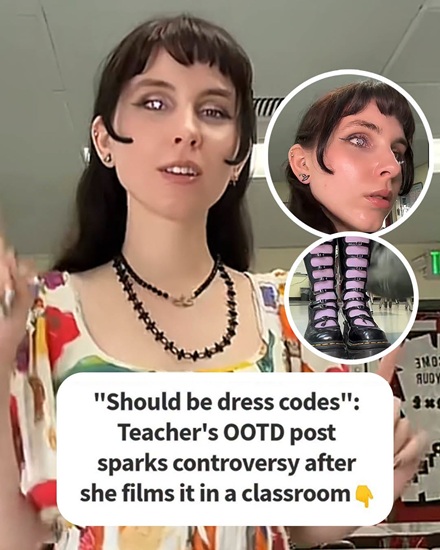
A teacher and social-media creator known online as Sunshine Jones has found herself at the center of a lively internet debate after videos showing her colorful outfits inside a classroom spread beyond her usual TikTok audience. Jones posts under the account @heymissteacher, where she shares outfit-of-the-day clips and other content connected with fashion, teaching and her personality. Some viewers have praised her distinctive appearance and enthusiasm, while others have questioned whether a classroom is an appropriate setting for personal fashion content.
The discussion grew after clips of Jones posing in different outfits were reposted on other social-media platforms. Her clothing often features bright colors, patterns and accessories designed to stand out. To supporters, the videos simply show a teacher having fun with fashion and expressing her individuality. Critics, however, interpreted them as evidence of changing expectations surrounding professional appearance in schools.
Some of the strongest criticism focused not only on what Jones wore but also on where the videos were recorded. Commenters argued that classrooms should primarily function as educational spaces rather than backgrounds for personal social-media posts. Others suggested that teachers should follow more traditional workplace dress standards because of the authority and responsibility associated with their profession.
Those reactions quickly expanded into a wider conversation about professionalism. Some critics argued that schools sometimes place restrictions on what students can wear and questioned whether teachers should face comparable expectations. Others suggested that highly noticeable outfits could distract students during lessons.

However, those statements represent the opinions of individual commenters rather than established findings about Jones or her classroom. A short social-media video cannot demonstrate whether students are distracted, how effectively a teacher performs professionally, or whether academic outcomes are affected by someone’s clothing.
There is likewise no basis for concluding from an outfit video that Jones lacks authority in her classroom or that students do not respect her. Such conclusions would require information about her actual teaching environment that is not contained in the viral clips.
Many viewers made exactly that point while defending her.
Supporters said they struggled to identify anything inherently inappropriate about the outfits. Several noted that the clothing shown in widely circulated clips covered her body and argued that unusual colors, patterns or accessories do not automatically make clothing unsuitable for a teacher.
Some parents said they believed children might actually enjoy having an educator with a memorable sense of style. Comparisons with Ms. Frizzle from The Magic School Bus appeared repeatedly in online reactions because the fictional teacher is famous for wearing colorful and unusual outfits.
For those commenters, Jones’ clothing represented personality rather than unprofessionalism.
Others focused on the positive energy they believed her videos projected.
They argued that teachers spend enormous amounts of time preparing classrooms and interacting with students and should not automatically be expected to abandon every form of personal expression when they enter school.
That does not mean every viewer agreed.
Some remained uncomfortable with educators filming personal social-media content in professional spaces, regardless of what they were wearing.
That distinction is important.
There are really two separate questions within the controversy.
One is whether Jones’ clothing is appropriate.
The other is whether a classroom should appear in outfit-of-the-day content.
Someone can believe that her clothes are completely acceptable while still preferring stronger boundaries between workplaces and personal social media.
Jones later provided additional context about at least one of the videos attracting criticism.
She explained that the clip had been filmed while she was setting up her classroom before the beginning of the school year.
According to her explanation, she had not yet met the students who would be entering her classroom.
That means the disputed video should not automatically be characterized as footage of a teacher stopping an active lesson to create fashion content.

Jones specifically pointed out that she was preparing the classroom rather than teaching students when the video was made.
Including that context substantially changes one of the accusations circulating online.
It does not require critics to approve of filming inside a classroom.
But it does mean claims that she was creating the video instead of teaching students would go beyond what the available evidence establishes.
The discussion surrounding Jones also includes another distinctive element of her appearance.
She wears a prosthetic right eye.
Jones has publicly discussed losing her eye when she was approximately five years old.
Rather than always wearing a prosthetic designed to closely imitate a natural eye, she sometimes chooses decorative prosthetics with distinctive colors and designs.
That choice has become part of her personal style.
It has also influenced the way she responds to claims about being visually “distracting.”
Jones has argued that students will encounter people throughout their lives who look different from them.
Some people have disabilities.
Others use prosthetics.
Some dress in unconventional ways.
For Jones, hiding those differences is not necessarily the best way to prepare children for the wider world.
She has instead suggested that students can learn to interact respectfully with people whose appearance differs from what they normally expect.
That is Jones’ perspective rather than an established educational rule.
But it provides important context for understanding why she rejects criticism based simply on looking unusual.
Her decorative prosthetic eye is not merely an accessory someone can evaluate in exactly the same way as a dress or pair of shoes.
It is connected with a disability she has lived with since childhood.
Jones has chosen to approach that part of herself visibly rather than conceal it.
Some supporters said that choice could offer students a positive example of confidence around physical differences.
Again, there is no evidence from the videos alone demonstrating how individual students respond.
But there is equally no evidence establishing that her prosthesis or colorful outfits prevent them from learning.
The viral debate therefore frequently moves beyond what can actually be verified.
One commenter may look at the same video and see creativity.
Another may see distraction.
A third may focus primarily on social-media boundaries.
Those are interpretations.
The video itself cannot resolve the broader argument.
Professional dress standards are also not universal.
Different schools and employers can establish different policies for employees.
Expectations can vary depending on grade level, job responsibilities, workplace culture and local rules.
An elementary-school art teacher, for example, may work in a different clothing environment from someone teaching in another professional setting.
Teachers frequently choose clothing that balances professionalism with the practical demands of spending long periods standing, moving around classrooms and interacting with students.
Some educators prefer formal clothing.
Others dress more casually.
Some use clothing connected with lessons or school events.
Others enjoy colorful patterns.
Jones clearly favors a more expressive style.
Whether that violates any actual employment policy cannot be determined from social-media criticism.
No credible evidence presented alongside the viral discussion establishes that her employer disciplined her because of the outfits shown in the clips.
That distinction matters.
Being criticized online is not equivalent to being found in violation of workplace rules.
Likewise, thousands of supportive comments would not automatically establish that every outfit complies with every applicable policy.
Only the relevant employer could make that determination based on its actual standards.
The controversy also demonstrates how social-media context can disappear rapidly.
A creator posts a video for one audience.
Someone else downloads or reposts it.
A new caption is added.
The clip reaches people who know nothing about the original account.
Within hours, the same footage can become evidence in a completely different cultural argument.
Jones’ classroom videos appear to have experienced that process.
Once they circulated outside TikTok, some users connected them with much broader complaints about education, student behavior and changing social expectations.
Those larger conclusions cannot reasonably be proven by one teacher’s fashion videos.
Jones’ clothing does not provide evidence about an entire school system.
Nor can it explain broad changes in student attention, academic performance or respect for authority.
Those are complex issues involving numerous factors.
Reducing them to one educator’s colorful outfit may generate engagement online, but it does not provide meaningful evidence.
Supporters have also occasionally made broad assumptions of their own.
A teacher who dresses creatively is not automatically more caring or effective.
Clothing alone cannot demonstrate teaching quality in either direction.
An educator can dress conventionally and be excellent.
Another can dress colorfully and be excellent.
Either could also perform poorly.
Actual teaching effectiveness requires considerably more information than appearance.
That is perhaps the most important limitation of the entire debate.
People are evaluating a teacher’s professional identity through short videos designed primarily to show clothing.
The format provides extensive information about her style and almost none about lesson planning, classroom management, communication with families or student learning.
Jones has nevertheless chosen to respond rather than completely ignore the criticism.
Her responses have emphasized context and individuality.
She has explained when disputed videos were recorded.
She has defended her decorative prosthetic eye.
And she has challenged the assumption that educators must fit one narrow visual definition of professionalism.
Her critics remain entitled to disagree with that philosophy.
Some may continue believing that teachers should dress conservatively.
Others may object specifically to social-media filming in classrooms.
Those positions can be discussed without making unsupported claims about Jones personally.
There is no need to suggest that her students are failing.
There is no evidence that her clothing has caused disciplinary problems.
There is no basis for claiming that she filmed instead of teaching when she specifically said the widely discussed setup video occurred before students arrived.
At the same time, Jones’ explanation does not mean every concern about social media in schools is unreasonable.
Educators work in environments where student privacy is important.
Schools may have rules concerning photography, recording and personal content.
Teachers who create online material must therefore consider boundaries that someone filming from a private home might not face.
Those questions can be discussed separately from attacking someone’s appearance.
Jones’ situation has also highlighted how quickly debates about women in professional settings can become centered on clothing.
Some commenters examined skirt length, patterns and accessories in considerable detail.
Others questioned why an outfit that covered her body was generating such intense scrutiny in the first place.
The disagreement reflects broader differences in how people define professional presentation.
For some, professionalism includes visual restraint.
For others, it primarily means performing responsibilities competently and behaving appropriately, leaving considerably more room for individual style.
Neither definition can be settled by a viral comment section.
Jones appears comfortable making her own position clear.
She enjoys fashion.
She uses bright colors.
She sometimes wears decorative prosthetic eyes.
And she creates social-media content that incorporates those elements.
The videos attracted an audience partly because her style is memorable.
That same visibility eventually attracted criticism.
The result was a debate extending far beyond the original outfit posts.
What began as fashion content became a discussion about teachers.
Then professionalism.
Then student attention.
Then disability visibility.
Then social-media boundaries.
That progression illustrates how quickly online conversations expand beyond their original context.
The confirmed facts remain much narrower.
Sunshine Jones is a teacher and social-media creator who posts outfit videos.
Some have been recorded in a classroom environment.
Her colorful clothing and appearance have received both praise and criticism.
She explained that at least one disputed video was recorded while she was preparing the classroom before meeting students for the school year.
She has also publicly discussed her prosthetic eye and defended her decision to express herself through distinctive designs.
People remain divided.
Some viewers consider her approach fun, creative and harmless.
Others prefer a more traditional image of professional teachers or believe classroom spaces should remain separate from personal social-media content.
Neither side can establish Jones’ effectiveness as an educator merely by examining her outfits.
That would require evidence the videos do not provide.
For now, the controversy says considerably more about society’s competing expectations of teachers than it does about Jones’ ability to teach.
Her clothing is visible.
Her TikTok content is public.
The reactions are real.
But assumptions about what happens inside her classroom when the camera is off remain assumptions.
That distinction is essential when discussing someone whose online content has suddenly become the subject of widespread attention.
A colorful outfit can start a conversation.
It cannot, by itself, provide a complete picture of the person wearing it.

