
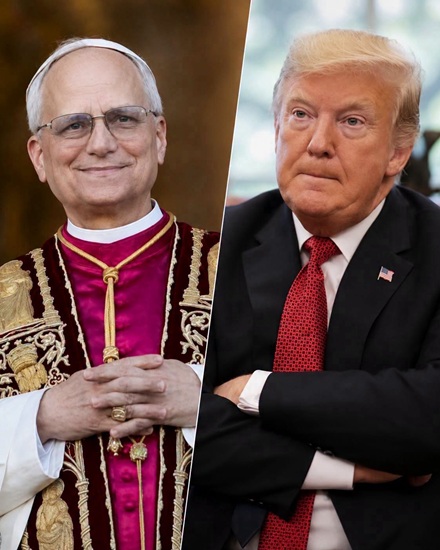
Pope Leo XIV, a recently discussed figure in modern Catholic commentary, has already drawn significant international attention at the beginning of what is described as his papal leadership. Even in the early stages of his public presence, conversations surrounding him have expanded quickly across media outlets, social platforms, and religious discussion circles. Reports circulating in public discourse describe him as having been born in Chicago and raised in the United States before entering religious life.
This detail, whether interpreted as factual or part of ongoing reporting narratives, has contributed to increased global interest, particularly because it reflects a cultural background rooted in contemporary American society. Observers and commentators note that from the moment he began appearing in public-facing roles, Pope Leo XIV has been the subject of careful scrutiny. His tone, gestures, and especially his brief responses during early interactions have been widely analyzed.
In today’s fast-moving media environment, even short statements from influential religious leaders can quickly become global talking points. One particular moment that has attracted widespread attention involves a short exchange with reporters. During the interaction, he was asked a question related to the United States. Instead of offering an extended explanation, he reportedly responded with a single word. Although the response was minimal, it quickly spread across online platforms, where users debated its meaning and possible interpretation.
Some commentators have described the response as a reflection of restraint and traditional papal communication style. Within the Catholic tradition, leaders often emphasize symbolic speech, careful wording, and avoidance of overly direct political statements. From this perspective, the simplicity of the answer may be seen as intentional and reflective rather than accidental.
Others, however, have interpreted the moment differently, suggesting that in today’s highly sensitive political and cultural climate, even brief remarks can be overanalyzed or assigned meanings beyond their original intent. This has led to widespread online discussion, with varying opinions depending on political and cultural viewpoints.
Religious scholars emphasize that early moments in a papacy are often misinterpreted due to limited context. They point out that new popes typically go through a transitional period where their communication style, priorities, and public messaging are still being shaped. As a result, early reactions may not accurately represent long-term leadership direction.
The rapid spread of attention around Pope Leo XIV also reflects the influence of modern digital media. In the past, papal statements would typically be processed through formal news cycles. Today, however, short clips, quotes, and interpretations can circulate globally within minutes, often detached from their original context.
Supporters within religious communities encourage patience, noting that the true character of a papacy is revealed over time through consistent action, teachings, and engagement with global issues. They argue that focusing too heavily on isolated moments may create an incomplete picture of leadership.
Despite the speculation, Pope Leo XIV has already become a figure of notable international curiosity. His background, communication style, and early public interactions have all contributed to a growing narrative that extends beyond religious boundaries and into broader cultural discussion.
As his papacy continues to develop, analysts expect that more clarity will emerge regarding his priorities and approach to global dialogue. For now, much of the public conversation remains based on early impressions and interpretation rather than long-term policy or action.
In this sense, the early attention surrounding Pope Leo XIV highlights not only the interest in religious leadership but also the modern way in which global figures are observed, analyzed, and discussed in real time.

