
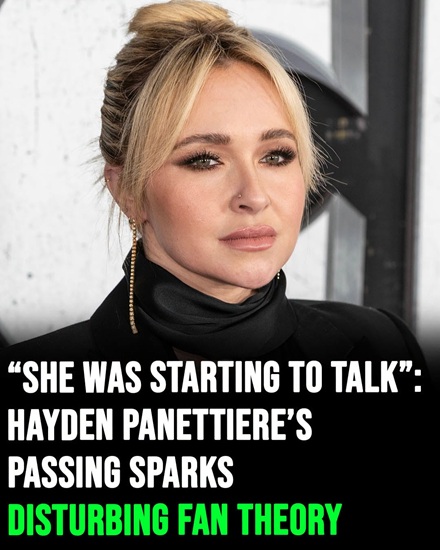
The death of Hayden Panettiere at only 36 has prompted an outpouring of grief while also bringing renewed attention to the actress’s final months. Panettiere, known around the world for her performances in Heroes, Nashville and the Scream films, died on August 16, 2026, after being found unresponsive in Greenville, South Carolina. Her family and representatives confirmed her death as authorities began examining the circumstances. Police said their preliminary investigation had revealed no evidence of foul play.
An official cause of death had not been publicly established in the initial reports, meaning unanswered questions remain while the appropriate medical and investigative process continues. Panettiere’s father, Alan “Skip” Panettiere, released a statement expressing the family’s profound grief following his daughter’s death. He remembered Hayden as an extraordinary presence who brought enormous happiness to the people who knew her personally and to millions who had followed her career.
The family also requested privacy while processing the unexpected loss. Panettiere had spent most of her life in the public eye, but her death is first and foremost a personal tragedy for her parents, daughter and other people who were close to her. Because Panettiere died unexpectedly at a relatively young age, discussion about what happened quickly spread across social media. Some users began revisiting interviews she had given shortly before her death, particularly conversations connected with the publication of her memoir, This Is Me: A Reckoning.
Those interviews included candid discussions about childhood fame, addiction, postpartum depression, relationships, trauma, recovery and difficult experiences she encountered during her years in entertainment. The timing of those disclosures has led some social-media users to suggest there could be a connection between Panettiere speaking publicly and her subsequent death. More extreme posts have alleged that she was deliberately “silenced” because of what she revealed about her experiences in Hollywood. Such allegations have not been supported by publicly verified evidence. Investigators have not announced that her memoir, interviews or disclosures were connected to her death, and preliminary police findings did not indicate foul play.
That distinction is essential when discussing an ongoing investigation. People are free to question circumstances they find unusual, but a question is not evidence and a theory is not a confirmed conclusion. Two events occurring within several months of each other do not automatically demonstrate that one caused the other. Unless authorities discover evidence establishing such a connection, claims that Panettiere was deliberately harmed because she spoke about Hollywood remain speculation.
Panettiere’s memoir, published in May 2026, nevertheless contains important details about experiences she wanted the public to understand. After spending decades being discussed through entertainment reporting, interviews and celebrity coverage, the actress used the book to present her own account of her life. She discussed growing up in Hollywood, becoming famous at an unusually young age and dealing with the consequences of having important stages of her development unfold under public scrutiny.
Among the difficult subjects Panettiere addressed was her exposure to substances when she was young. She previously described receiving pills before public appearances while she was still a teenager, explaining that they were presented as something that would make her energetic during interviews and events. The experience became part of her broader account of the circumstances that surrounded her during the early stages of fame and the substance-use problems she later developed.
Panettiere eventually spoke openly about struggling with opioids and alcohol. She described periods when addiction affected her health, relationships and professional life and acknowledged that recovery required significant personal work. Rather than portraying herself exclusively as a victim of outside circumstances, she also discussed decisions she regretted and the responsibility she believed she had to take while rebuilding her life.
Her memoir therefore should not simply be characterized as a book “exposing Hollywood.” It was a much broader personal account. Panettiere wrote about fame and troubling experiences within entertainment, but she also addressed motherhood, relationships, addiction, postpartum depression, treatment, recovery, grief and her own mistakes. Understanding that wider context is particularly important now that excerpts from the book are being recirculated after her death.
The same is true of her appearance on Jay Shetty’s On Purpose podcast in May 2026. Panettiere participated in a lengthy conversation in which she reflected on becoming famous as a child and the impact that experience had on her development. The discussion also covered anxiety, trust, relationships, motherhood, postpartum depression, addiction and recovery. She spoke openly about traumatic experiences and about trying to understand herself after spending much of her life surrounded by other people’s expectations.
During the conversation, Panettiere also recalled an uncomfortable experience involving a famous man when she was 18 years old. She did not publicly identify the person. She described the experience while discussing boundaries, vulnerability and difficult situations she encountered while growing up around celebrity. Following her death, clips referencing that story began circulating again, sometimes alongside posts suggesting that her willingness to speak openly placed her in danger.
No verified evidence currently establishes that connection. Panettiere’s decision to discuss an uncomfortable or traumatic experience does not by itself demonstrate that someone subsequently targeted her. The appropriate way to understand what caused her death is through the findings of medical and investigative authorities rather than through assumptions based on the timing of interviews.
Social-media speculation often intensifies following the sudden death of a famous person. When official information is limited, unanswered questions create space for rumors and theories to develop. A claim can quickly move from one account to thousands of others, and repetition may create the impression that evidence exists even when users are simply repeating the same unsupported allegation.
Panettiere’s situation is particularly vulnerable to that pattern because her final months included unusually candid public discussions. She had recently spoken about painful experiences that many fans had never heard in such detail. When her unexpected death followed, some people naturally revisited those statements. But revisiting an interview is different from proving that its contents were connected to her death.
Police initially said their investigation showed no signs of foul play. That does not answer every question about why Panettiere died, but it is an important confirmed detail. The official cause of death requires a separate medical determination, and until that process is complete, reports should avoid treating an unconfirmed explanation as fact.
Panettiere’s previous history with addiction has similarly become part of the discussion surrounding her death. She had publicly acknowledged struggles involving opioids and alcohol and had described treatment and recovery. Those facts are part of her documented life story. They should not, however, be used to declare what caused her death without an official finding.
A history of substance-use problems does not automatically explain a later death, just as a recently published memoir does not establish that someone was deliberately targeted. Both possibilities illustrate why investigators and medical professionals gather evidence before reaching conclusions. Responsible coverage should maintain the same distinction.
Long before the difficult experiences Panettiere discussed as an adult, she had established an extraordinary career. Born in 1989, she began appearing professionally when she was still a small child. Early television work included One Life to Live and Guiding Light, while she also appeared in commercials and other productions.
Her film and voice work soon expanded her audience. Panettiere voiced Dot in Pixar’s A Bug’s Life and appeared in the popular sports drama Remember the Titans. Additional projects such as Raising Helen, Tiger Cruise and Ice Princess helped her make the transition from child performer to teenage actress.
Then came Heroes. Panettiere joined the NBC series in 2006 as Claire Bennet, a teenager who discovers that she possesses an extraordinary ability to regenerate after injuries. Claire became one of the defining characters of the series, while the phrase “Save the cheerleader, save the world” became one of the show’s most recognizable lines.
The success of Heroes made Panettiere internationally famous while she was still a teenager. Her face appeared on magazines, promotional campaigns and entertainment coverage around the world. She became one of television’s most recognizable young performers at an age when most people are only beginning to determine what they want to do with their lives.
That early fame came with opportunities but also pressures that Panettiere later discussed candidly. She had spent much of her childhood working in an adult professional environment. By adolescence, she was balancing the demands of a major television series with the attention that accompanied celebrity. Her later reflections suggested that the experience shaped her in ways audiences could not necessarily see at the time.
After Heroes, Panettiere continued working in film and television. Horror audiences came to know her as Kirby Reed in Scream 4, released in 2011. Kirby became a popular character among fans, and Panettiere eventually returned to the role more than a decade later in Scream VI.
Another defining opportunity arrived in 2012 when she began playing Juliette Barnes in Nashville. Juliette was an ambitious country singer dealing with professional success, complicated relationships and serious personal difficulties. The character allowed Panettiere to combine dramatic acting with music and became one of the most substantial roles of her adult career.
Panettiere remained with Nashville throughout its six-season run and received two Golden Globe nominations for her performance. Juliette was considerably more complicated than many of Panettiere’s earlier characters, giving her opportunities to portray vulnerability, ambition, anger, insecurity and resilience.
At the same time, Panettiere was experiencing major changes in her personal life. She and her former fiancé, Ukrainian boxing champion Wladimir Klitschko, welcomed their daughter, Kaya, in December 2014. Panettiere later revealed that she experienced postpartum depression after becoming a mother and eventually sought professional treatment.
Her decision to discuss postpartum depression publicly became an important part of her story. She explained that the condition could be severe and that motherhood had not automatically brought the emotional stability outsiders might have expected. Her comments helped highlight an issue that can affect mothers from many different backgrounds.
Panettiere also discussed how her struggles affected decisions surrounding her daughter. Kaya eventually lived primarily with Klitschko in Europe while Panettiere addressed significant personal difficulties. Panettiere later challenged simplified claims that she had abandoned her child and described the circumstances as far more complicated and painful.
Despite the geographic distance, Panettiere continued talking about Kaya with affection. Motherhood remained one of the most significant subjects in her memoir and later interviews. She acknowledged mistakes while also explaining how difficult it had been to make decisions during periods when she was struggling with her own health and stability.
Recovery became another major focus of Panettiere’s later life. She described treatment for addiction and the process of confronting behaviors that had harmed her. Her comments made clear that recovery was not a simple transformation in which every difficulty disappeared at once.
Instead, she described a process involving setbacks, honesty and continued personal work. Panettiere acknowledged painful chapters rather than attempting to erase them. That openness became one reason her later interviews resonated strongly with people who had followed her since childhood.
Then came another devastating loss. Panettiere’s younger brother, Jansen, died unexpectedly in February 2023 at only 28. His family later said his death resulted from an enlarged heart combined with complications involving the aortic valve.
Jansen was Panettiere’s only sibling, and she later described his death as one of the most painful experiences of her life. She spoke about grief, guilt and the feeling that she had lost part of herself. The emotional consequences continued well beyond the immediate aftermath of his death.
Panettiere explained that grief affected her physically as well as emotionally. Nevertheless, she continued attempting to rebuild her life and career. Her return to the Scream franchise and subsequent projects represented part of that effort to move forward while still carrying the loss of her brother.
The publication of This Is Me: A Reckoning became another major step. Instead of allowing other people to summarize her experiences, Panettiere presented her own account. She discussed the complicated reality behind decades of fame and described both experiences she believed had harmed her and choices for which she accepted responsibility.
Her willingness to speak openly is worth remembering without turning those disclosures into evidence for an unverified theory. Panettiere’s words matter because they were her account of her own life. Their significance does not depend on proving a conspiracy surrounding her death.
Some online users have nevertheless claimed that the timing is too unusual to be coincidental. Others have directly alleged that unidentified people in Hollywood were responsible. Those statements represent the opinions or suspicions of individual social-media users, not findings from law enforcement.
There is currently no verified evidence establishing that Panettiere was killed because of her memoir, her interview with Jay Shetty or other public statements. Police initially reported no indication of foul play. Unless new evidence changes that assessment, claims of deliberate silencing remain unsupported speculation.
It is possible to acknowledge why some people find the timing striking without presenting their conclusions as fact. Panettiere had recently released a revealing memoir. She had participated in candid interviews. She then died unexpectedly at 36. Those are established events.
What has not been established is a causal connection between them. Timing alone cannot demonstrate motive, responsibility or criminal activity. That requires evidence, and no such evidence has been publicly established in the initial investigation.
Panettiere was also discussing future plans during the period surrounding her memoir. Her conversations were not solely focused on revisiting painful experiences. She spoke about continuing to work, rebuilding different areas of her life and exploring what might come next.
That context is important because narratives created after someone dies can unintentionally reshape their final months. Events that appeared unrelated while a person was alive can suddenly be presented as clues after their death. Such retrospective interpretations need evidence before they can responsibly be described as more than theories.
Panettiere’s death is already tragic without unsupported additions. She was 36, the mother of a young daughter and a performer who had been working for most of her life. Her parents had already endured the death of their son only three years earlier.
For her family, the focus is understandably on grieving. Her father requested privacy following the announcement of her death. Respecting that request also means avoiding presenting rumors about the circumstances as established information while investigators are still working.
For audiences, Panettiere leaves behind an unusually extensive body of work for someone whose life ended so young. Many remember her as Claire Bennet. Others associate her most strongly with Juliette Barnes or Kirby Reed. People who followed her from childhood may remember her long before any of those roles.
Her later interviews added another dimension to that professional legacy. Audiences who had watched Panettiere perform for decades were finally hearing her describe how those years had felt from her perspective. Some of what she revealed was painful, while other parts focused on growth and attempts to rebuild.
That story deserves to be preserved accurately. Panettiere spoke about difficult experiences in Hollywood, but she did not provide evidence establishing that an organized group would later target her. Claims that she was “silenced” go substantially beyond what she publicly documented.
Until authorities release definitive findings, the known facts provide the clearest framework. Hayden Panettiere died on August 16, 2026, at the age of 36. Her death is under investigation, and initial police findings did not indicate foul play. An official cause was not immediately announced.
It is also confirmed that she had recently published a memoir containing deeply personal disclosures and had discussed many of those experiences during interviews. The proximity of those events has generated online speculation, but speculation should remain clearly identified as such.
There is no need to dismiss people simply for asking questions about an unexpected death. At the same time, questions should not be converted into accusations without supporting evidence. Responsible discussion can acknowledge both uncertainty and the information authorities have actually released.
As additional official information becomes available, the understanding of Panettiere’s death may become clearer. Until then, there is no factual basis for declaring that her memoir or interviews caused someone to take action against her.
Her final months can instead be understood as a period in which she increasingly tried to tell her own story. After decades of being known through fictional characters and celebrity coverage, Panettiere was speaking publicly about who she believed she had become and what she had survived.
That effort now forms part of her legacy alongside Heroes, Nashville, Scream, Remember the Titans and the many other projects that filled her career. Her story contained remarkable success, motherhood, addiction, treatment, recovery and devastating grief.
Hayden Panettiere’s death at 36 brings that story to an unexpectedly early conclusion. The unanswered questions surrounding her death should be resolved through evidence and official findings rather than assumptions based on social-media posts.
Remembering Panettiere accurately means recognizing the courage involved in discussing painful experiences while also refusing to transform those experiences into claims she never made. Her own words provide an extensive account of what she wanted people to understand about her life.
For now, the claim that Hayden Panettiere was deliberately “silenced” remains an unsupported online theory. What is established is that a woman who spent most of her life entertaining audiences died far too young, leaving behind her daughter, family, friends, colleagues and millions of viewers who remember the characters she brought to life.
Her career and personal story require no conspiracy theory to make them significant. Panettiere had already lived an unusually complicated public life before reaching 36, and during her final years she made a determined effort to describe that life on her own terms. As the investigation continues, accuracy, context and respect for verified facts remain the most responsible ways to tell her story.

